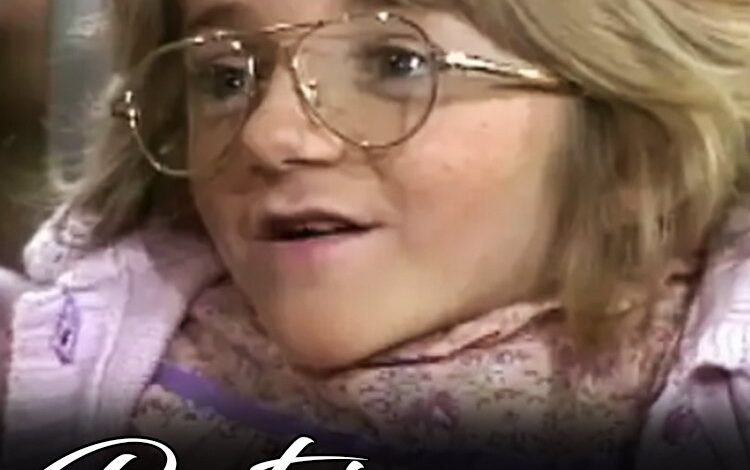
With deep sadness, the television world says goodbye to a woman whose impact reached far beyond the number of episodes she appeared in. Melanie Watson, best known for her role as Kathy Gordon on the iconic sitcom Diff’rent Strokes, has passed away at the age of 57. Her brother, Robert Watson, confirmed that she died after being hospitalized in Colorado Springs, Colorado. The news has resonated quietly but powerfully with those who remember what her presence meant at a time when television rarely made space for stories like hers.
Melanie Watson was born in July 1968 in Dana Point, California, into a life shaped from the very beginning by adversity. She was diagnosed at birth with osteogenesis imperfecta, widely known as brittle bone disease. The genetic condition causes bones to fracture easily and is often accompanied by short stature, skeletal fragility, and chronic pain. For Watson, this meant growing up with constant physical limitations and medical risks that most children never have to consider. Everyday activities carried consequences, and fear of injury was never abstract—it was lived reality.
Yet even as a child, Watson refused to let her condition define her ambitions. She was drawn to performance and storytelling, not as an escape from her disability, but as a way to be seen as more than it. Acting gave her a voice, a presence, and a sense of agency in a world that often underestimated people like her. While Hollywood was not known for its inclusivity in the 1970s and early 1980s, Watson pursued acting anyway, determined to take up space in an industry that had rarely made room for visible disability.
Her breakthrough came when she was cast as Kathy Gordon on Diff’rent Strokes, one of the most influential sitcoms of its era. The show, which tackled social issues through humor and heart, became a cultural staple in American households. Watson appeared in four episodes between 1981 and 1984, sharing scenes with stars such as Todd Bridges and the late Gary Coleman. Though her screen time was limited, her presence was unforgettable.
Kathy Gordon was written specifically with Watson in mind. The character used a wheelchair, reflecting Watson’s real-life mobility needs. At the time, seeing a young person with a disability portrayed by an actor who actually lived with that disability was almost unheard of on network television. Representation, as it’s discussed today, barely existed as a concept then. And yet, Watson was there—visible, real, and unapologetically herself.
That visibility, however, came with challenges. In one episode, the script required Kathy to walk using crutches. Watson was deeply uncomfortable with the idea. She had previously suffered a serious fall, and the physical risk was real. She expressed her fear and hesitation, explaining that walking on crutches was not something she could do safely or confidently. But the scene was framed as a moment of emotional triumph, and she was told it was essential to the storyline.
Years later, in a candid interview in 2020, Watson reflected openly on that experience. She described feeling as though she was being asked to fulfill “somebody else’s dream,” rather than honoring her own reality. Despite her reservations, she ultimately agreed to perform the scene, encouraged by those around her, including her mother. At the time, she was young, surrounded by adults, and trying to be professional in an environment where power dynamics were not in her favor.
Looking back, Watson carried mixed feelings. There was fear and discomfort tied to that moment, but also an understanding that the episode resonated with audiences. What once felt overwhelming later took on a different meaning. She came to see that her role—flawed, difficult, and imperfect as the experience sometimes was—had mattered.
Watson later acknowledged the importance of Norman Lear, the legendary producer behind Diff’rent Strokes. Lear was known for pushing boundaries and addressing topics mainstream television often avoided. By casting a young actress with a visible disability and writing her character into the fabric of the show, he took a risk that few others were willing to take at the time. Watson credited him for opening a door that had long been closed.
At the time she was filming, Watson didn’t fully grasp the scope of what she was doing. She was a child navigating work, health issues, and the pressures of being different in a very public space. It wasn’t until years later that she realized how many people had seen themselves reflected in her. For children with disabilities—and for their families—Kathy Gordon wasn’t just a character. She was proof that they existed in the world of television, too.
In hindsight, Watson said that if she could do it again, she might have stayed in the entertainment industry longer. Her acting career was relatively brief, and she eventually stepped away from the spotlight. Life, health, and personal priorities led her down different paths. But her short time on screen left a long shadow. Representation does not always require decades of fame. Sometimes it only takes one honest presence at the right moment.
Watson’s legacy is not built on a long list of credits or awards. It rests on something quieter and more enduring. She helped normalize the presence of disability on television at a time when it was almost invisible. She showed audiences that a character using a wheelchair did not need to be a symbol or a lesson—she could simply be a kid, living her life, part of the story.
Her passing is a reminder of how progress is often made not through grand gestures, but through individuals who step forward despite fear, limitations, and uncertainty. Watson did that as a child, without fully realizing the weight of what she carried. The impact came later, rippling outward through time, touching people she would never meet.
Melanie Watson will be remembered not only for who she was, but for what she represented: courage without spectacle, visibility without exploitation, and authenticity in a medium that often avoided it. She helped open doors quietly, and once opened, those doors never fully closed again.
May she rest in peace, remembered for her strength, her honesty, and the lasting mark she left on television history.


