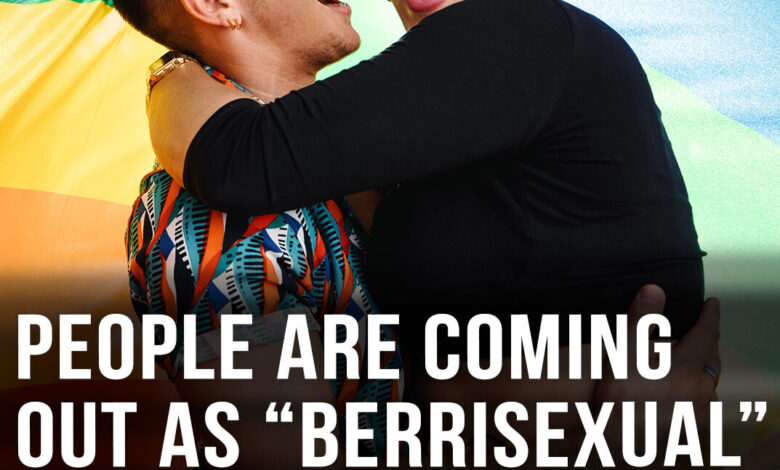
Berrisexuality is a relatively new micro-label that has been gaining quiet momentum, especially in online queer spaces where people are increasingly interested in describing their inner experiences with more precision. At its core, berrisexuality refers to people who are capable of feeling attraction to all genders, but who experience a noticeably stronger, more frequent, or more emotionally resonant attraction toward women, feminine-presenting people, and androgynous individuals. Attraction to men or masculine-aligned people is not excluded, but it tends to feel lighter, less common, or secondary.
For many people who identify with this term, the imbalance has always existed. They didn’t suddenly wake up with a new orientation; they simply lacked language that felt accurate. Traditional labels like bisexual or pansexual technically fit, but emotionally they felt incomplete. Those labels suggest an evenness of attraction that doesn’t reflect everyone’s reality. Berrisexuality emerged as a way to acknowledge that attraction can be broad without being symmetrical.
The rise of micro-labels like berrisexuality reflects a broader cultural shift in how people think about identity. Rather than treating sexuality as a rigid category with fixed rules, many now see it as a spectrum shaped by nuance, context, and lived experience. For some, attraction isn’t just about who they can be attracted to, but about patterns: who they fall for most often, who stirs deeper emotional responses, and who feels more aligned with their sense of intimacy and desire.
Online forums such as Reddit, Tumblr, and queer-focused wikis have played a major role in the spread of the term. In these spaces, people often share deeply personal reflections about their attractions, frustrations, and sense of belonging. Many describe years of feeling slightly out of place even within queer communities. They might identify as bisexual, yet notice that nearly all of their crushes are women. Or they might call themselves pansexual, while privately acknowledging that masculine energy rarely sparks the same interest. Berrisexuality gives those experiences a name without forcing people to deny parts of themselves.
One of the most common reactions to discovering the label is relief. People often describe it as finally seeing their internal world reflected back at them. Instead of feeling like they have to constantly explain themselves—“I’m bi, but mostly into women” or “I like everyone, just not equally”—they can use a term that already carries that meaning. For them, berrisexuality isn’t about being trendy or overly specific; it’s about honesty.
At the same time, supporters of the term are often careful to emphasize that micro-labels are optional. No one is required to adopt berrisexuality or any other identity to be valid. These labels are tools, not obligations. They exist to serve people, not to police them. Many who use the term openly acknowledge that sexuality can change over time, and that a label that feels right today may not feel right forever. That flexibility is part of the appeal.
Critics of micro-labels sometimes argue that they overcomplicate sexuality or fragment the community. But for those who identify as berrisexual, the label doesn’t create division; it creates clarity. It allows them to participate in broader queer spaces without constantly feeling like they are misrepresenting themselves. Instead of flattening their experience into something simpler, berrisexuality allows them to honor the uneven, human nature of attraction.
Another important aspect of berrisexuality is that it separates attraction from obligation. Being capable of attraction to all genders does not mean being equally interested in all genders, nor does it require someone to “prove” their identity through behavior. A berrisexual person may never date a man, or they may date one occasionally. Their identity is defined by internal experience, not by a checklist of partners.
This distinction is especially meaningful for people who have felt pressured to justify their sexuality. Some bisexual and pansexual individuals report being questioned or dismissed if their dating history appears “too straight” or “too gay.” Berrisexuality sidesteps that scrutiny by acknowledging imbalance as natural rather than suspicious. It says that preference does not negate possibility, and that leaning strongly one way does not erase openness.
The term also resonates with people who experience attraction differently depending on emotional safety. Some berrisexual individuals describe feeling more relaxed and authentic around women or feminine-presenting people, which in turn allows attraction to flourish more easily. Attraction to men may exist, but feel constrained by social expectations, past experiences, or discomfort with certain dynamics. Berrisexuality provides language for that reality without framing it as a flaw.
As with many emerging identities, berrisexuality is still evolving. There is no single authority defining who “counts” or how the label must be used. That openness is intentional. The people who gravitate toward the term often value self-definition over rigid boundaries. What matters is whether the word helps someone understand themselves better and communicate that understanding to others.
The growing visibility of berrisexuality also highlights how language shapes self-acceptance. When people lack words for their experiences, they often internalize confusion or self-doubt. When language becomes available, that confusion can soften into recognition. A single term won’t solve everything, but it can act as a small anchor—a way to say, “This exists. I exist.”
In the end, berrisexuality is not about replacing bisexuality or pansexuality, nor is it about ranking genders or diminishing attraction to anyone. It is simply a name for a specific pattern of attraction that many people quietly share. Its rise doesn’t signal fragmentation so much as refinement: a collective effort to describe human experience with more care, accuracy, and compassion.
For those who find themselves in that description, berrisexuality offers something simple and rare—a word that fits without squeezing, a label that reflects complexity without demanding explanation, and permission to be exactly as nuanced as they already are.