The message was short, almost disarmingly ordinary. “Love you, Dad.” No alarm, no explanation, no hint that it was a goodbye. Three familiar words that families exchange every day, suddenly frozen in time by what came next. When the news followed, it did not arrive with spectacle or warning. It arrived like a rupture, splitting a family’s life into before and after, and altering a public legacy in a way no role or performance ever could .
For Michael Madsen, the loss was not filtered through cameras, interviews, or headlines. It was intensely private and devastatingly human. Known to audiences for portraying men carved from menace and grit, characters who rarely flinched or broke, Madsen was suddenly confronting the most unbearable truth of all: that strength, even when genuine, can quietly coexist with suffering no one sees in time.
His son, Hudson Madsen, was just 26 years old.
From the outside, Hudson’s life appeared to reflect resilience and forward motion. He served as an Army sergeant, completed a deployment in Afghanistan, and carried himself with discipline and pride. Military service shaped his identity, instilling structure, responsibility, and a deep sense of duty. He was married, building a future, and outwardly composed. In photographs, he smiled easily. In uniform, he stood steady. To many, he looked like someone who had weathered hardship and come through stronger.
But appearances, as so often, told only part of the story.
Behind that image was a young man quietly carrying layers of pain he did not feel permitted to fully express. Hudson had been dealing with ongoing health challenges, including fertility struggles that weighed heavily on him and his wife, Carlie. These were not struggles easily discussed, particularly in cultures that prize endurance, toughness, and self-reliance. For many veterans and young men alike, vulnerability can feel like weakness, and asking for help can feel like failure. Silence becomes a learned behavior. Pain becomes something to manage alone.
Those closest to Hudson now speak not in accusation, but in echoes of disbelief and sorrow. His wife’s words, shared in the aftermath, reflected confusion rather than certainty, grief rather than blame. There are no clean answers, no single cause that can be pointed to with clarity. There is only the haunting reality that suffering does not always announce itself, and love, no matter how deep, does not always arrive in time to change the outcome.
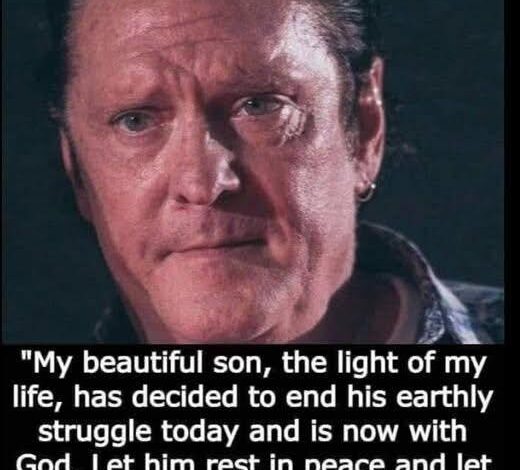
Michael Madsen’s public statement carried the rawness of a father’s grief rather than the polish of a celebrity response. “My beautiful son, the light of my life, has chosen to end his earthly struggle today and is now with God,” he wrote. “May he rest in peace, and may no one follow his example. My baby, I love you so much. Be at peace.” The words were not crafted for effect. They were an open wound, shared because silence felt unbearable.
His call for an investigation into the circumstances surrounding Hudson’s death has been widely misunderstood by some. It is not about spectacle or suspicion. It is about a parent’s instinctive need to understand, to search for meaning where none is readily available. It is about confronting a reality that too often remains buried beneath assumptions about strength and success.
This story is not about fame. It is about the cost of unspoken pain.
In societies that reward productivity, stoicism, and outward achievement, internal suffering often goes unnoticed until it is too late. Mental health struggles, particularly among veterans and young adults, do not always present as visible crises. They can exist alongside accomplishment, love, and plans for the future. The absence of visible struggle does not mean the absence of suffering.
Hudson’s life reminds us of the danger of equating composure with wellness. He was not reckless. He was not disconnected. He was loved. And yet, something inside him became too heavy to carry alone. That truth challenges comforting narratives about who is “at risk” and who is not.
In the wake of his death, there is a temptation to search for a lesson that feels tidy or reassuring. But grief rarely offers that. What it offers instead is urgency. A reminder that checking in is not intrusive. That listening without judgment is not optional. That creating space for vulnerability is not a luxury, but a necessity. Sometimes, those small acts are not small at all. Sometimes, they are the difference between surviving a moment and being lost to it.
For Michael Madsen, the grief is ongoing and uncontainable. No performance, no success, no public recognition can insulate a parent from the loss of a child. The hardened characters he portrayed on screen dissolve in the face of this reality. What remains is a father mourning his son, grappling with questions that will never have full answers, and hoping—desperately—that sharing this pain might spare another family from the same silence.
Hudson Madsen should not be remembered solely for how his life ended. He was a son, a husband, a soldier, and a young man who carried more than he was ever taught how to release. His story is a reminder that love must be paired with listening, that strength must make room for vulnerability, and that mental health is not a private battle to be fought alone.
If this story does anything, let it slow us down. Let it prompt conversations that feel uncomfortable but necessary. Let it remind us that a simple message, a quiet check-in, or an honest conversation can matter more than we ever realize.
And let it stand as a plea, not wrapped in headlines or celebrity, but in humanity: suffering does not always look like suffering, and asking for help is not a failure. It is an act of courage that deserves to be met with care.


