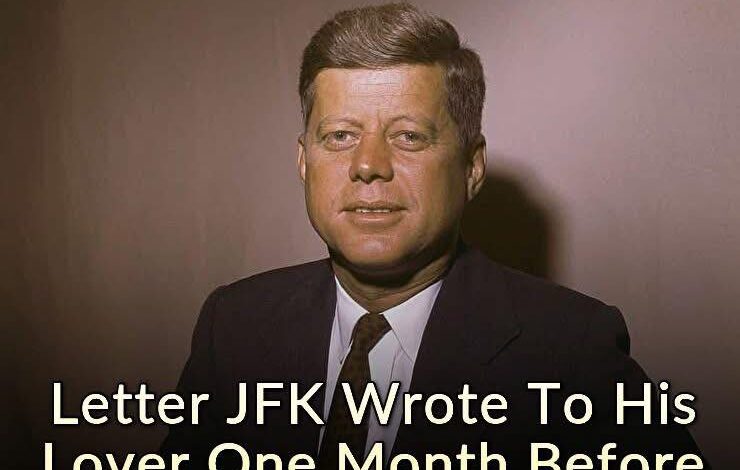
In the public imagination, John F. Kennedy and Jacqueline Kennedy Onassis embodied the image of an ideal American couple—youthful, elegant, and seemingly unshakable. Their presence in the White House helped define an era often remembered as “Camelot,” a time associated with glamour, optimism, and cultural refinement. Yet behind that carefully constructed image, Kennedy’s personal life was far more complicated, marked by a series of extramarital relationships that contrasted sharply with the public narrative.
Among these relationships, one of the most intriguing—and perhaps the most emotionally significant—was his connection with Mary Pinchot Meyer, an artist and socialite deeply embedded in Washington’s elite circles. Their relationship remained largely hidden from the public eye during Kennedy’s lifetime, but decades later, new details emerged that shed light on the depth of their bond.
In 2016, a remarkable piece of history surfaced: a handwritten letter Kennedy had composed for Meyer in October 1963, just weeks before his assassination. The letter was never sent. Instead, it remained tucked away among the personal belongings of Kennedy’s longtime White House secretary, Evelyn Lincoln. When it was eventually revealed prior to being auctioned, it offered a rare and intimate glimpse into Kennedy’s private thoughts—far removed from speeches, policy decisions, and the pressures of the presidency.
The contents of the letter were striking in their tone. Rather than the calculated language of a political leader, Kennedy’s words conveyed longing, vulnerability, and a desire for connection. He wrote of wanting to escape the burdens of his position, if only briefly, and to meet Meyer in secret—suggesting a relationship that provided him with emotional refuge. The letter hinted at a sense of urgency, as though he felt time slipping away, though whether that feeling stemmed from political stress or something more personal remains open to interpretation.
Despite its deeply personal nature, the letter never reached Meyer. Why Kennedy chose not to send it remains unknown. Some speculate that he reconsidered the risk, given the potential consequences if the relationship became public. Others suggest that the demands of his office simply intervened. Whatever the reason, the letter became a silent artifact—an unsent message frozen in time.
When the letter was eventually put up for auction, it drew significant attention from collectors and historians alike. It ultimately sold for nearly $89,000, a testament not only to its rarity but also to the enduring fascination with Kennedy’s life and legacy. More than just a collectible, the letter served as a tangible link to a hidden chapter of history, revealing a more human side of a man often seen through the lens of myth.
Meyer herself was a compelling figure. Born into a wealthy and well-connected family, she moved comfortably within Washington’s social and political circles. She was intelligent, artistic, and known for her independent spirit. Her first encounter with Kennedy reportedly occurred years earlier at a social event, but it wasn’t until later—when both were living in Washington—that their relationship deepened.
Complicating matters further was Meyer’s friendship with Jackie Kennedy. The two women were part of overlapping social circles, and Meyer was known to have spent time with the First Lady. This connection adds an additional layer of complexity to the story, raising questions about what was known, suspected, or deliberately ignored within those tightly knit circles.
The story takes an even darker turn with Meyer’s death. In 1964, less than a year after Kennedy’s assassination, she was murdered under mysterious circumstances along the Chesapeake & Ohio Canal towpath in Washington, D.C. The case drew intense scrutiny but ultimately resulted in no conviction. Her death has since been the subject of ongoing speculation, with theories ranging from random violence to more elaborate conspiracies.
After her death, a personal diary believed to belong to Meyer was discovered. According to those who claimed to have seen it, the diary contained references to her relationship with Kennedy, potentially confirming the emotional and possibly physical nature of their connection. However, the diary itself has never been made public. It reportedly disappeared shortly after being found, adding yet another layer of intrigue to an already complex story.
The combination of Kennedy’s unsent letter and Meyer’s mysterious death has fueled decades of curiosity. Historians and researchers continue to examine these fragments of evidence, attempting to piece together a clearer understanding of what their relationship truly meant. Was Meyer simply one of many affairs, or did she occupy a more significant place in Kennedy’s life? The tone of the letter suggests the latter, but without additional documentation, definitive conclusions remain elusive.
What is clear, however, is that the story challenges the simplified narrative often presented about Kennedy’s presidency. It reveals a man grappling not only with the immense pressures of leadership but also with deeply personal desires and conflicts. It also highlights the complexity of the people surrounding him—individuals like Meyer, whose lives intersected with power in ways that were both intimate and perilous.
In many ways, the letter stands as a symbol of what history often leaves out. Official records capture decisions, policies, and public actions, but they rarely preserve the emotional undercurrents that shape those moments. Kennedy’s note to Meyer offers a rare exception—a glimpse into the private world behind the public persona.
Decades after both Kennedy and Meyer are gone, their story continues to resonate. It endures not because it provides clear answers, but because it raises compelling questions about love, secrecy, power, and the human side of those who occupy the highest offices. The letter, once hidden and forgotten, now serves as a quiet reminder that even the most iconic figures lived lives far more complicated than the images history has preserved.