Twelve years ago, my life changed at five in the morning on a Tuesday that began like every other workday. I was forty-one then, working sanitation, driving one of those massive trash trucks through streets most people never noticed unless something went wrong. That morning, the cold was vicious, the kind that burned your lungs and made your eyes sting. At home, my husband Steven was recovering from surgery. I’d changed his bandages, made sure he ate, kissed his forehead before heading out.
“Text me if you need anything,” I told him as I pulled on my jacket.
He smiled weakly. “Go save the city from banana peels, Abbie.”
Life felt small but steady back then. A modest house, bills we juggled carefully, dreams of kids we quietly set aside because reality always won. It was tiring, but it was ours.
Then I turned onto one of my usual streets and saw the stroller.
It sat alone on the sidewalk, not near a driveway, not parked beside a car, just there—still, silent, wrong. My stomach dropped. I slammed the truck into park, flipped on the hazards, and climbed down with my heart pounding so hard I could hear it over the engine.
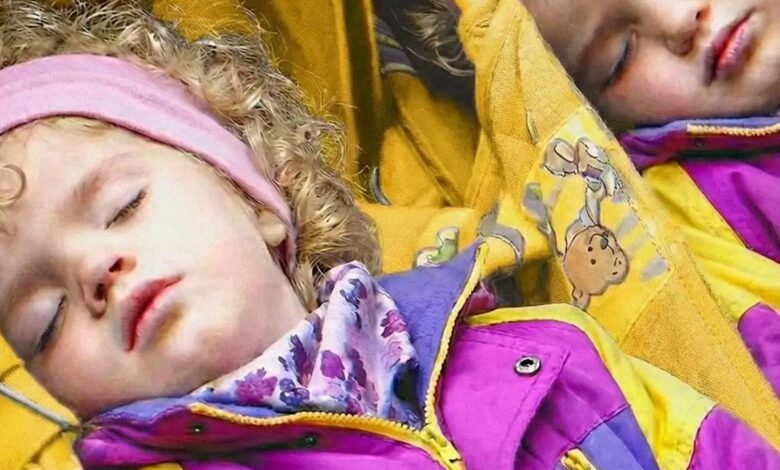
Inside the stroller were two babies. Twin girls, no more than six months old, bundled in mismatched blankets. Their cheeks were pink from the cold. Tiny clouds of breath puffed into the air.
They were alive.
I looked up and down the street, my mind racing. No one running toward us. No doors opening. No shouting. Just quiet houses and drawn curtains.
“Hey, sweethearts,” I whispered, my voice shaking. “Where’s your mom?”
One of them opened her eyes and stared straight at me, calm and curious, like she was studying my face. I checked the diaper bag. A few diapers. Half a can of formula. No note. No identification. Nothing.
My hands wouldn’t stop trembling.
I called 911 and explained through a cracking voice that I’d found two babies abandoned in the freezing cold. The dispatcher told me to stay with them, to move them out of the wind. I pushed the stroller against a brick wall, knocked on doors that never opened, and finally sat down on the curb beside them.
“I’m here,” I told them quietly. “I won’t leave you.”
Police arrived, then a CPS worker wrapped in a beige coat, clipboard in hand. She checked the girls carefully, asked me questions I barely remember answering. When she lifted one baby onto each hip and carried them to her car, something in my chest tightened painfully.
“Where are they going?” I asked.
“A temporary foster home,” she said gently. “We’ll try to find family. They’ll be safe tonight.”
The car drove away. The stroller stayed behind, empty. I stood there long after they were gone, my breath fogging the air, knowing something inside me had shifted forever.
That night, I couldn’t eat. Steven noticed immediately.
I told him everything. The stroller. The cold. Watching them leave.
“I can’t stop thinking about them,” I said. “What if they get split up? What if no one wants them?”
He was quiet for a long moment, then said softly, “What if we try to foster them?”
I laughed, half hysterical. “We can barely afford groceries some weeks.”
“I know,” he said, taking my hand. “But you already love them.”
He was right.
The next day, I called CPS. Home visits followed. Questions about our finances, our marriage, our childhoods. Our fridge contents. A week later, the social worker sat on our worn couch and told us the twins were profoundly deaf.
“A lot of families decline when they hear that,” she said carefully.
“I don’t care,” I replied without hesitation.
Neither did Steven.
A week later, they arrived—two car seats, two diaper bags, two wide-eyed babies who would change everything. We named them Hannah and Diana.
The early months were chaos. They slept through noise but reacted to light and touch. We learned their language from scratch. Steven and I took ASL classes, practiced signs at midnight, laughed when I accidentally signed nonsense.
Money was tight. We sold things. Took extra shifts. Bought clothes secondhand. We were exhausted in a way that reached the bone.
And I had never been happier.
The first time they signed “Mom” and “Dad,” I cried so hard Steven had to sit me down. We fought schools for interpreters, advocated constantly, corrected strangers who asked what was “wrong” with our girls.
“Nothing,” I told them. “They’re deaf, not broken.”
Years passed quickly. Hannah grew observant and artistic, sketching outfits in the margins of her notebooks. Diana loved building things—anything she could take apart and remake. They were inseparable, finishing each other’s thoughts with signs only they understood.
When they were twelve, they came home from school buzzing with excitement. There was a design contest—adaptive clothing for kids with disabilities. They worked together, Hannah designing, Diana engineering. Hoodies that didn’t interfere with hearing devices. Pants with thoughtful closures. Clothes that were functional without screaming “special needs.”
They didn’t expect to win.
Life went on as usual. Then one afternoon, my phone rang while I was cooking dinner. A representative from a children’s clothing company explained they’d seen the girls’ designs. They wanted to collaborate. A real line. Paid. With projected royalties that made my head spin.
I nearly dropped the phone.
When I told the girls, they thought they were in trouble. When they understood, they cried. They hugged me so hard I lost my balance.
“I love you,” Hannah signed. “Thank you for learning our language.”
“Thank you for taking us in,” Diana added. “For not saying we were too much.”
I signed back the truth I’d always known. “I found you on a cold sidewalk. I promised I wouldn’t leave you. I meant it.”
That night, after everyone slept, I looked at their baby photos again—two tiny girls abandoned in the freezing dark.
People tell me I saved them.
They don’t understand.
Those girls saved me right back.