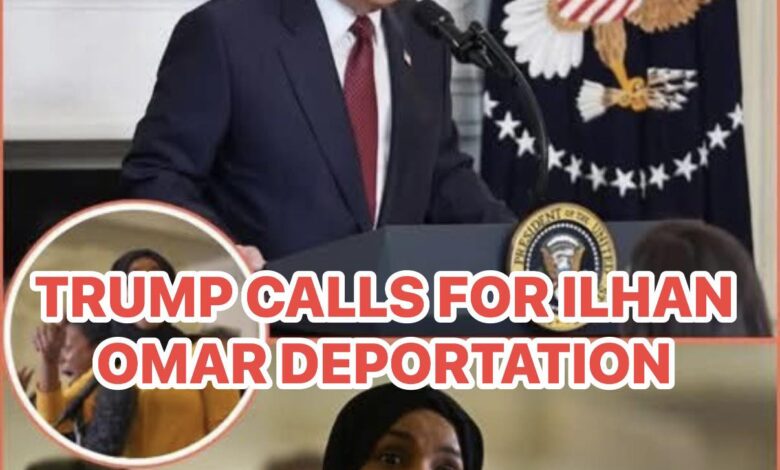
The moment did not unfold quietly. It landed with force, echoing far beyond the rally grounds and into living rooms, newsrooms, and digital feeds across the country. When Donald Trump delivered his blistering line aimed at Ilhan Omar, it was not framed as policy critique or legislative disagreement. It was raw, personal, and deliberately incendiary. Within minutes, the words were clipped, replayed, dissected, and weaponized, becoming one of the most polarizing moments of the current political cycle.
In the hours following the rally, the nation fractured along that single statement. To Trump’s supporters, the outburst felt cathartic. They interpreted it as a long-overdue confrontation with what they see as ideological hostility toward American institutions, values, and national sovereignty. In their view, Trump was articulating frustration that many felt but believed could never be said aloud. To them, it was strength, defiance, and political authenticity wrapped into one explosive sentence.
To his critics, the same words carried a far darker weight. They heard something else entirely: a signal that belonging in America is conditional, that dissent from a certain vision of patriotism could be met not with debate but with exclusion. For immigrant communities, elected officials, and civil rights advocates, the remark sounded less like rhetoric and more like a warning—one that blurred the line between political disagreement and personal legitimacy.
What made the moment especially volatile was not just what was said, but who it was said about. Ilhan Omar, a sitting member of Congress, is not merely a political opponent. She is a symbol in modern American politics—praised by supporters as a voice for marginalized communities and criticized by opponents as emblematic of progressive ideology they believe undermines national cohesion. The clash between Trump and Omar has always been more than personal. It represents competing definitions of patriotism, power, and American identity.
Omar’s response was measured but firm. She did not retreat from the spotlight or soften her positions. Instead, she doubled down on her critique of Trump’s politics, framing the moment as further evidence of what she describes as authoritarian tendencies and exclusionary nationalism. In doing so, she reinforced the very dynamic that fuels Trump’s base: confrontation without compromise.
Trump, for his part, offered no retraction. No clarification. No attempt at moderation. The absence of backpedaling was itself a statement. For his supporters, it confirmed resolve. For detractors, it underscored concern. In modern American politics, silence after provocation often speaks louder than apology.
The exchange crystallized a reality that many analysts have been reluctant to state plainly. The United States is no longer engaged in a traditional policy debate over taxes, healthcare, or foreign affairs. The conflict has shifted into something more fundamental. It is now a struggle over who defines loyalty, who sets the cultural boundaries of belonging, and who has the authority to claim ownership over the national narrative.
This is why the moment resonated so deeply. It was not about immigration law or legislative votes. It was about identity politics, national allegiance, and the emotional architecture of power. Trump’s language appealed to voters who feel displaced by rapid cultural change and globalized economics. Omar’s resistance appealed to those who see diversity and dissent as core to democratic strength.
From a political strategy standpoint, the exchange was almost inevitable. Trump has long relied on confrontation to dominate media cycles and energize his base. Outrage is not a byproduct of his approach; it is the mechanism. High-conflict rhetoric ensures attention, mobilizes donors, and draws sharp contrast lines. Omar, conversely, has built influence by standing firm against that style, knowing that resistance itself galvanizes her supporters.
Media coverage amplified the divide. Cable news panels framed the moment as either fearless truth-telling or dangerous demagoguery, depending on the network. Social media algorithms did the rest, feeding users the version of the story most aligned with their existing beliefs. In that sense, the rally moment was not just a political clash but a case study in modern information warfare.
What was lost in the noise was nuance. The United States has always wrestled with questions of inclusion and dissent. What has changed is the tone. Language once considered beyond the pale is now central to campaign strategy. Political rallies increasingly resemble loyalty tests rather than persuasion efforts. The goal is no longer to convince the undecided but to harden the already committed.
For voters watching from the middle, the moment was unsettling. Many expressed fatigue with the endless escalation, the sense that every election cycle must now carry existential stakes. Yet even that fatigue feeds polarization, as disengagement often benefits the loudest voices.
The Trump-Omar clash also exposed a deeper asymmetry. Trump speaks as a former president with a devoted national base and unparalleled media gravity. Omar speaks as a legislator whose power lies more in symbolism than institutional control. When those two forces collide, the result is rarely resolution. It is amplification.
That night at the rally will likely be remembered not for its immediate political consequences, but for what it revealed. It showed how deeply fractured the American electorate has become, how words alone can redraw emotional borders, and how identity has overtaken policy as the central battleground of national politics.
In the end, the moment forced a reckoning. Not with Trump or Omar individually, but with the country itself. What does it mean to belong? Who gets to define patriotism? And can a democracy survive when political opponents no longer see each other as fellow citizens, but as existential threats?
Those questions linger far longer than any rally chant or viral clip. And as the nation moves toward another high-stakes election cycle, the answers—or lack of them—will shape not just campaigns, but the future character of American democracy itself.