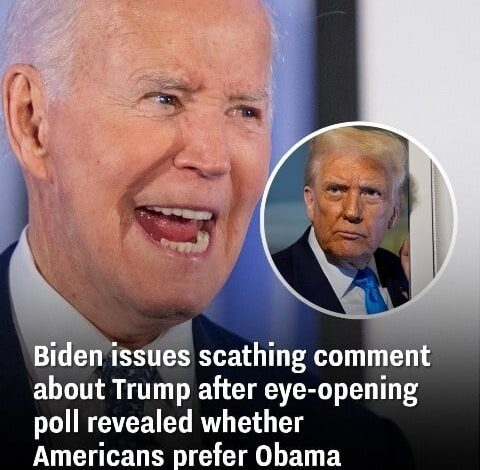
The exchange was framed as political, but its tone carried something heavier. When Joe Biden responded to a newly released national poll comparing public sentiment toward Barack Obama and Donald Trump, he did not treat it as a matter of personal rivalry or partisan scorekeeping. Instead, he presented it as a signal—one he argued reflected a deeper national exhaustion with political volatility, institutional damage, and what he described as a governing style built on disruption rather than responsibility.
The poll itself showed Obama maintaining a commanding lead in favorability over Trump, a gap Biden said should not be dismissed as nostalgia or media bias. According to Biden, the numbers pointed to something more structural: a public yearning for stability, predictability, and leadership that does not thrive on grievance. He described Trump’s political legacy as a “wrecking ball,” a metaphor chosen carefully to evoke destruction without reconstruction—an image of democratic norms smashed apart, leaving ordinary citizens to navigate the aftermath.
Biden’s remarks landed at a moment when the American electorate appears increasingly divided not just by ideology, but by competing definitions of governance itself. One vision celebrates confrontation, dominance, and spectacle. The other emphasizes institutions, process, and incremental repair. Biden positioned himself firmly in the latter camp, arguing that democracy is not strengthened by shock therapy, but by trust, continuity, and accountability.
What distinguished this speech from a standard campaign critique was the personal turn it took. Biden referenced his own recent battle with prostate cancer, speaking plainly about the experience rather than using it as rhetorical ornament. He described the anxiety of waiting for scans, the physical toll of radiation treatments, and the quiet fear that comes with confronting mortality in a healthcare system that is not equally accessible to all. The moment shifted the tone from abstract policy to lived reality.
He credited doctors, nurses, and medical staff for care that he acknowledged is not guaranteed for every American. From there, the contrast sharpened. Biden argued that healthcare is not an ideological talking point, but a dividing line between political philosophies with real consequences. He warned that Trump and allied Republican leaders have consistently sought to dismantle protections for preexisting conditions, weaken the Affordable Care Act, and reduce federal oversight that keeps insurance markets from excluding the sick.
In Biden’s framing, the election was not about personality contests or approval ratings alone. It was about who gets to survive a diagnosis without financial ruin. Who can afford treatment without choosing between care and housing. Who benefits when healthcare is treated as a right rather than a commodity. His message suggested that policy debates become meaningless if voters do not live long enough—or remain healthy enough—to participate in them.
The juxtaposition between Obama and Trump in the poll served as a symbolic axis for that argument. Obama, Biden noted, is still widely associated with the expansion of healthcare access, the stabilization of institutions after crisis, and a governing style that emphasized restraint. Trump, by contrast, remains linked in public memory to attempts to repeal healthcare protections, attacks on electoral legitimacy, and a political culture fueled by perpetual conflict.
Biden was careful not to present the poll as destiny. He emphasized that elections are not won by favorability metrics alone, nor are they lost by them. But he argued that such data reveals underlying currents—signals of what voters are tired of, and what they may be seeking instead. Fatigue, he suggested, is becoming one of the most powerful forces in American politics: fatigue with chaos, fatigue with outrage cycles, fatigue with leaders who thrive on division.
He also acknowledged the irony of his own position. As one of the oldest presidents in U.S. history, Biden has faced persistent scrutiny over age, health, and stamina. By openly discussing his cancer treatment, he appeared to challenge the notion that vulnerability is weakness. Instead, he framed transparency as strength, and empathy as a political asset rather than a liability.
The speech resonated beyond campaign lines because it touched on a shared reality: illness does not care about party affiliation. Cancer, chronic disease, and medical emergencies cut across ideological boundaries. Biden’s argument was that leadership should recognize that universality, not exploit fear or deny responsibility for protecting citizens at their most vulnerable.
Critics, predictably, accused him of politicizing personal health and exaggerating Republican intentions. Supporters countered that healthcare policy has always been political, precisely because it determines who is protected and who is exposed. The debate itself underscored Biden’s larger point: that elections shape outcomes long after campaign slogans fade.
In invoking Obama’s continued popularity, Biden was not simply aligning himself with a former president. He was invoking a period many voters associate with institutional normalcy, even amid disagreement. Whether that perception is entirely fair is secondary to its political power. Perception, after all, is often what moves electorates.
Trump’s response, delivered through rallies and social media, dismissed the poll and doubled down on familiar themes of media bias and elite conspiracy. The contrast in tone reinforced Biden’s narrative rather than undermining it. One side framed the moment as a warning about democratic erosion and healthcare access. The other treated it as another skirmish in an endless culture war.
As the election cycle intensifies, Biden’s remarks may be remembered less for the poll that prompted them and more for how he framed the stakes. Not as a contest between names, but as a choice between governing philosophies with tangible consequences. Between disruption and repair. Between spectacle and substance. Between policies that decide who gets care—and who gets left behind.
In that sense, the poll was never the point. It was the opening.