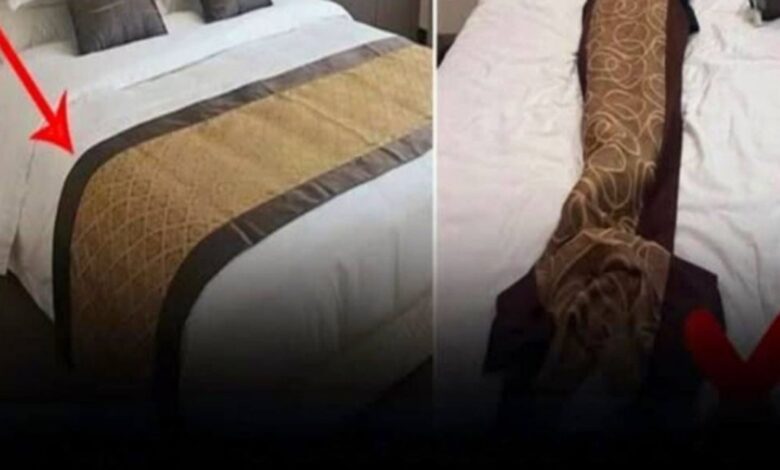
You step into a hotel room after hours of travel. Your shoulders drop. Your bag hits the floor. Shoes come off. The bed becomes the immediate destination. And then, almost without thinking, you notice that familiar strip of fabric stretched neatly across the foot of the mattress.
Sometimes it’s dark and understated. Sometimes it’s velvet, textured, bold, or patterned to match the room’s color scheme. Most guests remove it instantly or shove it onto a chair, assuming it’s nothing more than a decorative afterthought.
That assumption is wrong.
That strip of fabric—commonly known in the hospitality industry as a bed runner, bed scarf, or bed sash—is one of the most practical, cost-efficient, and quietly intelligent design choices in modern hotel rooms. It exists for real-world behavior, not aesthetics alone, and it plays a surprisingly important role in hotel cleanliness, guest comfort, and operational efficiency.
First, it protects the bed before you’re ready to sleep.
When guests enter a hotel room, they are rarely clean, rested, or ready to slide between crisp white sheets. Travel means exposure to airports, taxis, sidewalks, public seating, luggage handles, and countless shared surfaces. People sit on the bed fully clothed. They prop their feet up while wearing shoes. They scroll on their phones, snack, answer emails, or unpack bags directly on the mattress.
The runner acts as a buffer between real-world travel mess and the hotel’s most expensive and most frequently laundered asset: the bedding. Instead of grime transferring directly to the duvet or top sheet, it hits the runner first. This significantly reduces staining, fiber breakdown, and premature linen replacement.
From a hotel operations and housekeeping efficiency standpoint, this matters. Bedding replacement costs are substantial, especially in luxury hotels and boutique accommodations that use high-thread-count cottons, premium duvets, and custom-sized linens. A simple fabric strip absorbs a large percentage of early contact wear, extending the lifespan of everything underneath.
In practice, the runner functions like a welcome mat for the bed.
Second, it creates a safer zone for food and drinks.
Room service. Takeout. Midnight snacks. Business travelers eating over laptops. Families feeding kids on the bed because it’s the only comfortable surface in the room. These behaviors are not exceptions—they’re standard guest habits across the global hospitality industry.
White sheets and food do not mix. Bed runners are intentionally designed using darker tones, stain-resistant fabrics, and tighter weaves that handle spills far better than traditional bedding. Crumbs, coffee drips, sauces, and condensation rings are far easier to remove from a runner than from sheets or comforters.
From a guest experience perspective, the runner subtly encourages behavior without rules. It signals where it’s safer to place a tray, a drink, or a snack without ruining the bed. From a hotel cost-control perspective, it minimizes deep-cleaning cycles and emergency linen swaps.
It’s a small detail with high operational ROI.
Third, it serves as a landing zone for personal belongings.
Travel creates clutter instantly. Jackets, purses, backpacks, laptop bags, scarves, shopping bags—all of it ends up needing a temporary home. Placing these items directly on clean bedding transfers street dust, bacteria, allergens, and unseen debris to the surface where guests will later sleep.
The runner provides a designated zone for belongings. It’s a psychological boundary as much as a physical one. Smart travelers intuitively use it to keep outside items away from pillows and sheets. In shared accommodations, during cold and flu season, or in high-turnover hotel environments, that separation improves hygiene more than most guests realize.
From a public health and hospitality hygiene standpoint, it’s a subtle but effective intervention.
Fourth, it offers discreet protection during intimate moments.
This is rarely mentioned publicly, but it is well understood within hotel management and housekeeping teams. During private activities, moisture, makeup, oils, and other substances can easily reach bedding. The runner provides a removable, washable protective layer that absorbs first contact before anything reaches the duvet, mattress cover, or mattress itself.
Mattress protection is a major cost issue for hotels. Mattresses are expensive, difficult to deep clean, and replaced far less frequently than linens. The runner helps reduce damage, stains, and long-term wear, quietly saving hotels thousands of dollars per room over time.
Housekeeping staff depend on this layer more than guests ever know. It reduces awkward cleanups, accelerates room turnover, and keeps rooms in guest-ready condition with fewer complications.
Beyond function, there’s also branding and design.
The bed runner visually anchors the bed. It adds contrast, structure, and balance to an otherwise monochrome setup. In hospitality interior design, it’s often the element that ties the bed into the room’s broader color palette, reinforcing brand identity, luxury perception, and visual cohesion.
High-end hotels use runners to signal quality, intention, and attention to detail. Budget hotels use them to add perceived value at low cost. In both cases, the runner elevates the room’s presentation without requiring a full redesign.
There are also things guests should not do with it.
It’s not meant to be slept under. It’s not intended to replace sheets or blankets. And it’s not designed to hold food overnight, where stains can set and odors can linger. Used intentionally, it performs exactly as designed. Used carelessly, it becomes another piece of fabric to discard.
The truth is simple: that strip of fabric is solving real problems quietly and efficiently.
It absorbs travel mess.
It manages snacking habits.
It protects expensive bedding.
It improves hygiene.
It supports housekeeping workflows.
It reinforces hotel branding.
It extends asset lifespan.
In an industry obsessed with guest satisfaction, operational efficiency, and cost control, the bed runner is a masterclass in practical design. It doesn’t demand attention. It doesn’t need explanation. It simply works.
So the next time you enter a hotel room, pause before tossing it aside. That unassuming piece of fabric is doing more for your comfort—and the hotel’s bottom line—than almost any other item in the room.
Sometimes the smartest design choices are the ones you barely notice at all.