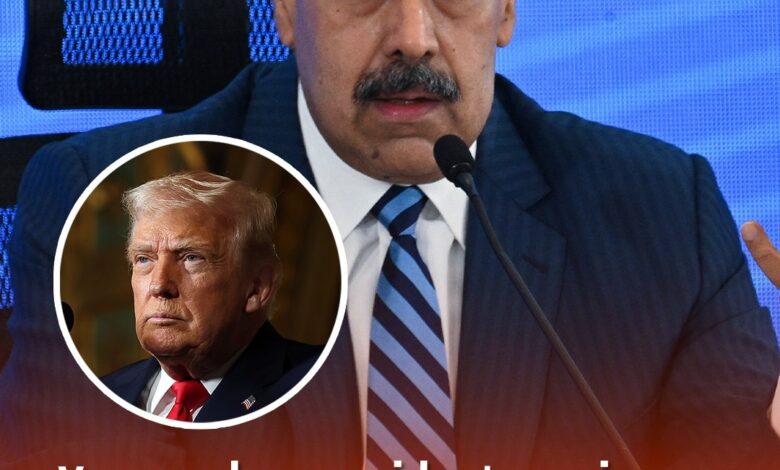
In a series of events that has sent tremors through the international community, reports emerged overnight of a dramatic and unprecedented escalation in the long-standing tensions between the United States and Venezuela. The narrative broke with the force of a geopolitical shockwave, centered on the stunning claim that Venezuelan President Nicolás Maduro had been apprehended by U.S. forces following a covert military operation within the heart of Caracas. As the world awoke to this news, the digital landscape was quickly flooded with grainy, unverified footage purporting to show precision strikes and rapid tactical movements in the Venezuelan capital. These videos, shared millions of times across various social media platforms, created a chaotic information vacuum where official government statements struggled to keep pace with viral speculation, leaving the global public to wonder if they were witnessing a historic shift in Western Hemispheric power.
The initial spark for this firestorm came from a series of high-profile declarations by President Donald Trump. Utilizing his Truth Social platform, Trump asserted that a large-scale, coordinated mission involving U.S. military assets and federal law enforcement had successfully resulted in the “capture” of both Nicolás Maduro and his wife, Cilia Flores. According to these posts, the pair had been extracted from Venezuela and were being transported to face justice in the United States. Trump’s characteristic rhetoric promised that more details would be forthcoming in a high-stakes press conference, but in those first critical hours, independent verification from the Department of Defense or neutral international observers remained elusive. This absence of immediate, formal confirmation from the current administration’s usual channels only added to the thick atmosphere of uncertainty, turning the event into a Rorschach test for political observers worldwide.
As the morning progressed, the legal framework for this alleged operation began to materialize through official U.S. judicial channels. U.S. Attorney General Pam Bondi stepped into the spotlight to announce a massive federal indictment against Maduro, filed in the Southern District of New York. The charges outlined by the Attorney General were sweeping in scope and severe in nature, painting a picture of a head of state who doubled as a kingpin of global crime. The indictment includes counts of narco-terrorism conspiracy, cocaine importation conspiracy, the illegal possession of machine guns and destructive devices, and a broader conspiracy to use such weapons as tools of aggression against the United States. Bondi characterized the case not as a sudden political maneuver, but as the culmination of a decade-long law enforcement investigation into the “Cartel of the Suns,” an alleged organization within the Venezuelan military and government dedicated to drug trafficking. She emphasized that Maduro would be held to account in an American courtroom, though notably, she did not clarify whether similar formal charges had been leveled against Flores.
The Attorney General’s presentation framed the episode primarily as a matter of national security and criminal justice, rather than a traditional act of war. By focusing on narcotics trafficking and terrorism, the administration sought to justify the reported military intervention as a necessary policing action against an international fugitive. However, the lack of transparency regarding the “how” and “where” of the capture left significant gaps in the story. Questions about the violation of sovereign territory, the specific rules of engagement used during the Caracas strikes, and the legal basis for the extrajudicial removal of a sitting head of state began to swirl. For many, the situation represented a volatile fusion of traditional military might and modern legal “lawfare,” signaling a new and unpredictable chapter in how the United States engages with adversarial regimes.
The reaction from within Venezuela was a mixture of confusion, defiance, and high-level panic. Vice President Delcy Rodríguez took to the airwaves to address a stunned nation, stating that the government had yet to receive any verified information regarding the location or status of the President. In a somber and urgent tone, she demanded immediate proof of life for both Maduro and Flores, suggesting that the lack of direct communication from the Presidential Palace was a sign of a massive, external disruption. This vacuum of leadership in Caracas sparked immediate concerns about a potential power struggle within the ruling United Socialist Party, as various factions looked for clarity in a city that felt increasingly like a combat zone.
Simultaneously, the Venezuelan military leadership moved to project a front of absolute resistance. Defense Minister Vladimir Padrino López issued a blistering condemnation of the reported U.S. actions, labeling the event as the most severe act of foreign aggression in the history of the republic. Speaking from a fortified position and flanked by high-ranking officers, Padrino López declared that the National Bolivarian Armed Forces were on a state of maximum alert. He insisted that the military remained loyal to Maduro’s authority and warned that any attempt to dismantle the government would be met with overwhelming force. His rhetoric suggested that even if the President had indeed been removed from the country, the institutional structures of the “Chavista” movement were prepared to engage in a protracted conflict to preserve their hold on power.
The geopolitical ramifications of this event are staggering and continue to ripple outward. Regional neighbors, from Colombia to Brazil, have begun mobilizing their own security forces along the borders, fearing a massive influx of refugees or a spillover of violence should Venezuela descend into civil war. International bodies like the United Nations and the Organization of American States have called for emergency sessions to discuss the legality of the U.S. operation and the potential for a humanitarian catastrophe. Allies of the Maduro administration, including Russia and China, issued stern warnings against “foreign meddling” and “imperialist aggression,” suggesting that the capture of a head of state could trigger a wider global diplomatic crisis.
As of this moment, the narrative remains a tangled web of claims and counterclaims. Short, unverified video clips have begun to circulate showing what some claim to be the arrival of a high-security transport at a private terminal in a New York-area airport, but these images are often blurry and lack the definitive clarity needed to settle the debate. The world finds itself in a strange state of limbo, where the fate of a nation and its leader is being decided not just on the ground in Caracas or in the courtrooms of New York, but in the court of public opinion and the frantic pace of the 24-hour news cycle. This episode serves as a chilling case study in the intersection of modern warfare, digital disinformation, and the aggressive application of domestic law to international politics. Whether the reports are eventually substantiated in their entirety or revealed to be a complex psychological operation, the psychological impact on the global order is permanent. The perceived boundaries of national sovereignty have been tested in a way rarely seen in the 21st century, revealing a world where power is increasingly defined by who can control the narrative as much as who can control the territory.