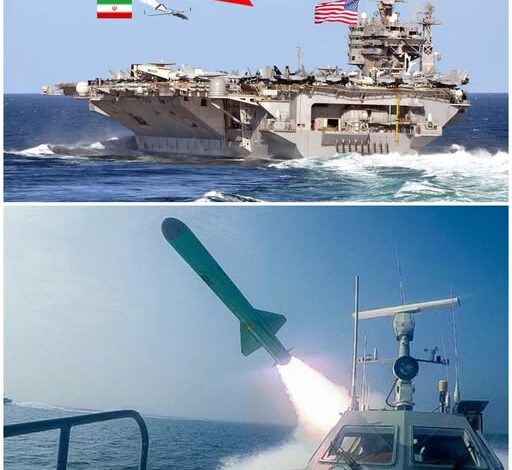
When the Iranian Revolutionary Guard Corps released high-definition footage depicting a swarm of loitering munitions striking a mock-up of the USS Abraham Lincoln, the geopolitical symbolism was as sharp as a blade. The video was a carefully choreographed exercise in “asymmetric messaging,” designed to suggest that inexpensive, mass-produced drones could render a multi-billion-dollar aircraft carrier obsolete. For naval planners in Tehran, the narrative is one of quantity over quality—a digital warning to Washington that the Strait of Hormuz could be turned into a graveyard for capital ships. However, propaganda videos are designed for the screen; the reality of naval warfare is a far more technical, less cinematic chess match played out across electromagnetic frequencies and automated defense sectors.
If the theoretical scenario of a mass drone strike were to transition into a real-world engagement, the opening salvos would likely lack the dramatic flair of a Hollywood montage. Instead of a simultaneous black cloud of drones, the attack would likely emerge from coastal launch sites near Bandar Abbas in staggered, incremental waves. Drones like the Shahed-136, often characterized as “kamikaze” or one-way attack munitions, would lift off following pre-programmed GPS routes. It is crucial to understand that these are not sophisticated, autonomous hunters capable of independent thought. They are essentially low-cost cruise missiles that rely on fixed satellite navigation. Once they are airborne, they lack the agility to reroute around active defenses or adapt to real-time electronic countermeasures. Their primary strength is not their intelligence, but their sheer volume.
For a U.S. Navy Carrier Strike Group (CSG), detection would occur long before these drones reached visual range. High above the fleet, an E-2D Advanced Hawkeye would be orbiting, serving as the “digital quarterback” for the strike group. Its AN/APY-9 radar is specifically engineered to discriminate small, low-flying targets against the “clutter” of the ocean surface. Through the Cooperative Engagement Capability (CEC) network, the Hawkeye shares this data instantly across the fleet. This distributed sensor network allows a destroyer positioned dozens of miles away from the target to generate a lethal firing solution based on data it did not directly collect. In this environment, the carrier group operates not as a collection of individual ships, but as a singular, synchronized combat system.
Initial defensive engagements would utilize a layered approach of conventional kinetics. Large-caliber naval guns, equipped with proximity-fused ammunition, can neutralize slow-moving aerial threats at moderate distances. As the swarm closes in, the defensive “bubble” tightens. The Phalanx Close-In Weapon System (CIWS) stands ready to shred any threat that penetrates to within a few kilometers, while the Rolling Airframe Missile (RAM) and Standard Missile variants (SM-2 and SM-6) provide an outer layer of protection. Critics of this traditional approach frequently cite “cost asymmetry”—the idea that it is unsustainable to fire an interceptor costing millions of dollars at a drone that costs as much as a used car. This arithmetic has been the cornerstone of Iran’s saturation doctrine, aiming to literally exhaust a ship’s magazine until it is defenseless.
However, the variable of “magazine depth” is currently undergoing a revolutionary shift. The U.S. Navy has moved beyond experimentation into the deployment of directed energy systems—specifically lasers and high-powered microwave (HPM) platforms. Unlike kinetic missiles, these weapons do not rely on a limited supply of physical ammunition stored in a hull. Instead, they draw directly from the ship’s electrical power generation. A high-powered microwave system, for instance, does not need to physically “hit” a drone to destroy it. It emits a burst of electromagnetic energy that fries the delicate circuitry and guidance systems of every drone within its beam. If a swarm were to approach, a single microwave engagement cycle could potentially neutralize dozens of incoming threats simultaneously. In this new paradigm, the constraint is no longer the number of missiles in the magazine, but the ship’s ability to manage the heat and power generated by its own systems.
This integration of directed energy does not render conventional missiles obsolete; rather, it creates a more complex defensive choreography. Microwave beams are indiscriminate; they can fry friendly electronics as easily as hostile ones. Modern Aegis combat systems manage this through automated deconfliction, calculating safe “firing windows” in milliseconds to ensure that defensive missiles and microwave bursts do not interfere with one another. This level of automation is necessary because the most stressing scenario is never just a drone swarm. It is a “combined-arms” assault: a wave of drones to saturate defenses, followed by anti-ship ballistic missiles like the Khalij Fars to force the launch of high-end interceptors, and finally, fast-attack boats armed with cruise missiles to exploit any momentary lapse in concentration.
Against high-velocity ballistic threats, kinetic interceptors like the SM-6 remain the absolute standard. Directed energy cannot yet melt a ballistic missile traveling at several times the speed of sound. Meanwhile, the maritime “surface threat” would be addressed by MH-60R Seahawk helicopters, which can deploy precision-guided munitions to neutralize fast-attack craft before they ever get within range to launch their own cruise missiles. Every sensor, every algorithm, and every weapon system works in a synchronized ballet of timing and sector management.
The strategic consequence of such a failed attack would be profound for the adversary. Every time a coastal radar is activated to guide an attack, and every time a telemetry burst is transmitted from a launch site, the E-2D Hawkeye geolocates that emission with surgical precision. The act of launching an attack inherently “paints a target” on the infrastructure that launched it. If a Carrier Strike Group can neutralize a drone swarm while retaining the majority of its kinetic inventory, the balance of regional deterrence shifts dramatically. The Navy effectively maps the adversary’s entire coastal network simply by defending itself.
Ultimately, the narrative that inexpensive drones have “broken” the age of the aircraft carrier assumes that naval defenses have remained static. In reality, naval power today is defined by the seamless integration of sensors, networks, and advanced power management. While no system is perfectly invulnerable to environmental interference or sheer overwhelming volume, the introduction of directed energy and automated deconfliction has weakened the economic argument for saturation strategies. For the Iranian Revolutionary Guard, the propaganda footage serves as a declaration of confidence. For the U.S. Navy, the response is a procedural, technical, and largely invisible evolution of power. In the high-stakes environment of the Strait of Hormuz, the quiet upgrades—the software patches, the microwave emitters, and the power routing—are the elements that truly define the “light of truth” in modern naval warfare.
