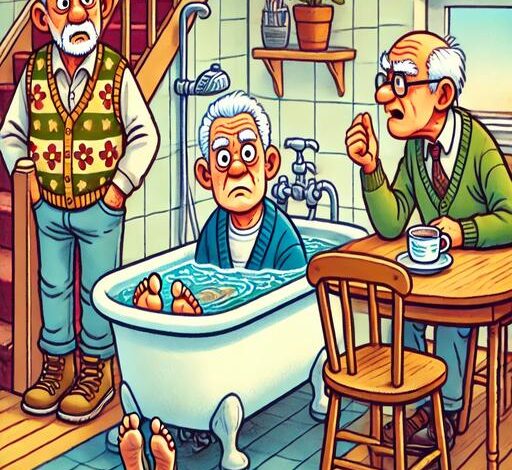
Three brothers—aged 92, 94, and 96—had reached a stage of life where time moved a little slower, memories occasionally took scenic detours, and humor had become their favorite survival skill. They had lived together for years in the same creaky old house, a place filled with history, habits, and the comforting rhythm of familiarity. The walls had heard decades of laughter, arguments, and stories retold so many times that even the furniture could probably recite them.
One quiet evening, as the house settled into its usual nighttime calm, the eldest brother, at 96, decided it was time for a bath. He turned on the water, waited patiently as the tub filled, and then carefully placed one foot inside. He paused. His brow furrowed. Something wasn’t adding up.
In a voice that echoed down the staircase, he called out, “Was I getting into the bath… or getting out of it?”
Downstairs, the middle brother, 94, looked up from his chair, mildly annoyed but mostly unfazed. After a moment of thought that led nowhere, he shrugged and called back, “I don’t know. I’ll come up and see.”
He stood, began climbing the stairs, and then stopped halfway. His hand rested on the banister as confusion washed over him. He frowned, leaned over the railing, and shouted, “Wait a minute—was I going up the stairs, or coming down?”
At the kitchen table sat the youngest brother, 92, sipping his coffee and listening to the entire exchange like it was an evening radio show. He shook his head slowly, a smug smile forming on his face.
“I sure hope I never get that forgetful,” he muttered to himself.
To reinforce his confidence, he reached out and knocked on the wooden table for good luck. Then he stood up, full of purpose, and called out, “I’ll come help both of you… just as soon as I see who’s at the door.”
The house fell silent for a moment—then laughter filled every room.
Growing older, after all, has a way of humbling everyone equally.
Not far away, in a sun-soaked coastal town known for its retirees, four old friends were enjoying one of their daily walks. They had known each other for decades—through careers, marriages, kids, and now retirement. Their conversations ranged from world news and financial planning to aches, pains, and which doctor was the least annoying.
As they turned a corner, something caught their attention.
A sign.
Bold letters. Bright paint.
“Oldtimer’s Bar – All Drinks 10 Cents.”
They stopped dead in their tracks.
The four men exchanged skeptical looks. One squinted at the sign like it might vanish if stared at too long. Another laughed and said it had to be a joke. But curiosity—and a lifetime of knowing when something might be too good to pass up—won out.
They walked in.
The bar looked real enough. Fully stocked shelves. Clean glasses. A long counter polished to a shine. Behind it stood an elderly bartender with a welcoming grin and a voice that carried across the room.
“Come on in, gentlemen! What’ll it be?”
The men glanced at each other again. If this was a trick, they were already committed.
“Four martinis,” one of them said confidently.
Without hesitation, the bartender got to work. He mixed, shook, and poured with professional precision. Moments later, four icy martinis sat in front of them—perfectly prepared, garnished, and inviting.
“That’ll be ten cents each,” the bartender said cheerfully.
The men stared.
Then they looked at one another.
Slowly, almost reverently, they placed forty cents on the bar.
They drank.
The martinis were excellent—smooth, strong, and undeniably high quality. This wasn’t watered-down nonsense. This was the real deal.
Naturally, they ordered another round.
Again, four flawless martinis appeared.
“Forty cents, please.”
By now, disbelief had turned into fascination. They had consumed two rounds of premium cocktails and hadn’t even spent a dollar. One of the men finally leaned forward.
“How on earth can you afford to sell drinks like these for ten cents?” he asked.
The bartender smiled.
“I’m a retired tailor from Sydney,” he said casually. “Always wanted to own a bar. Last year, I won twenty-five million dollars in the lottery. Decided to open this place. Ten cents per drink. Same price for everyone.”
The men sat back, stunned.
“Well,” one of them said, lifting his glass, “that’s quite a story.”
As they sipped their drinks, one of the men noticed something odd. At the far end of the bar sat seven people. They hadn’t ordered anything. No drinks. No snacks. Just sitting there patiently.
Curiosity struck again.
“What’s with them?” he asked, nodding toward the group.
The bartender chuckled.
“Oh, them?” he said. “They’re grey nomads from the caravan park down the road. They’re waiting for happy hour—when drinks are half price.”
The four men nearly choked on their martinis.
There’s something timeless about humor rooted in aging, memory, and the simple joy of shared laughter. In a world dominated by breaking news, financial stress, digital overload, and constant urgency, these kinds of stories endure because they’re human. They remind us that aging isn’t just about decline—it’s about perspective, resilience, and finding comedy in the absurd.
Whether it’s brothers navigating forgetfulness with confidence or retirees squeezing joy out of a bargain too good to be true, these moments resonate across generations. They perform well on entertainment platforms, lifestyle blogs, and viral humor feeds because they tap into universal truths—family, friendship, and the ability to laugh at ourselves.
Sometimes happiness doesn’t come from luxury, productivity, or youth. Sometimes it’s a cheap martini, a confusing staircase, or a knock on wood followed by answering the wrong door.
And sometimes, that’s more than enough to make the day better.