For nearly five years, every morning at 7:15 sharp, a man named Henry walked into the little café where I worked downtown. Always the same order — black coffee and two slices of toast. Sometimes, if business was good that week, he’d add jam.
He was polite, soft-spoken, and carried himself with a quiet dignity that stood out in a city where most people rushed through life barely making eye contact. Henry never asked for a discount or a free refill. He always paid with exact change — a few coins carefully counted out from his worn jacket pocket — and thanked me with a nod that felt genuine every single time.
In a world full of impatient customers, Henry was a small moment of calm.
At first, I didn’t know much about him. He seemed older than his years — silver hair, calloused hands, eyes that carried both pain and peace. Over time, as the routine continued, bits of his story began to surface.
Henry had once been a carpenter. He’d built homes, furniture, and a life he was proud of. He had a wife and a daughter. Then, a series of bad turns — layoffs, an injury, mounting medical bills — had stripped it all away. He lost his home, his family, and eventually, his footing. But he never lost his decency.
“Life takes,” he once told me quietly, “but it also gives back. Sometimes just in smaller portions.”
He said it while sipping his coffee, hands wrapped around the mug for warmth. That line stayed with me.
Whenever winter rolled in, I’d slip an extra muffin or a sandwich into his paper bag when no one was looking. On Christmas, I gave him a scarf. On Easter, gloves. He always protested, but his eyes always softened with gratitude.
“I’ll pay you back someday,” he’d say.
“You already have,” I’d tell him.
Then, one morning, Henry didn’t come.
At first, I thought he might’ve moved on — found another café or perhaps a job. But as the days stretched into weeks, the empty corner seat by the window started to feel heavier. His absence hung in the air like a missing note in a familiar song.
I eventually stopped one of the volunteers from the nearby shelter to ask if they’d seen him. Her expression told me everything before she spoke.
Henry had passed away quietly in his sleep.
I went into the kitchen, leaned against the counter, and cried — not just because he was gone, but because I never got to say goodbye. I kept expecting him to walk in again, that soft smile, those coins clinking on the counter. But he never did.
Years passed. I left the café eventually, started a new job, got married. But every time I made coffee in the morning, I thought of Henry.
On my wedding day, as I stood under a canopy of white roses in a small garden surrounded by friends and family, I felt his absence in a strange, inexplicable way. Maybe it was because the morning light hit the tables the same way it used to hit the café window. Maybe it was because I’d left an extra seat open near the aisle — an old habit from when I used to keep one free for him during breakfast rushes.
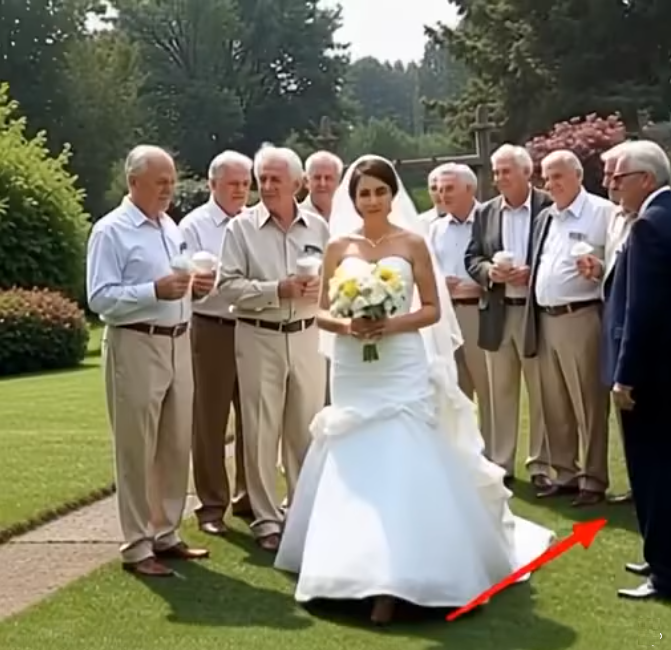
The ceremony had just begun when I noticed movement near the back. A small group of men — twelve of them — stood together, dressed simply, looking slightly uncomfortable but oddly familiar. They weren’t part of the guest list. Yet something in their faces made me pause.
After the vows, when the music softened and guests began mingling, one of the men — tall, lean, with weathered hands — stepped forward. He clutched an envelope.
“Are you… Mrs. Taylor?” he asked.
I nodded.
He smiled faintly. “Henry wanted us to come.”
For a second, I couldn’t breathe. Henry?
He handed me the envelope, edges frayed and yellowed. Inside was a folded piece of paper in shaky handwriting I recognized instantly.
It was from Henry.
“Dear Sarah,
If you’re reading this, it means I’m no longer around to tell you in person how much your kindness meant to me. You treated me like a man when the world treated me like a ghost. You gave me warmth when I had nothing but cold. You reminded me that people still care — and that made me want to live again.
When I got back on my feet, I made a promise: to pass your kindness forward. The twelve men standing before you were once like me — lost, alone, forgotten. I shared my tools, my food, my time, and my story. You gave me the strength to do that.
You might not remember every muffin or every smile you gave me. But I do. And so do they. Thank you for helping me remember who I was.”
The handwriting trembled near the end, as if written with weak hands, but the words were strong — simple and sincere, just like Henry.
The men then introduced themselves one by one.
There was Martin, who said Henry helped him rebuild furniture and his confidence. Jamal, who had been battling addiction until Henry found him at the shelter and taught him carpentry as a form of therapy. Luis, who said Henry lent him fifty dollars — “his last fifty,” he emphasized — to buy work boots for a construction job.
Each story built a picture I’d never fully seen before. Henry hadn’t just survived; he’d rebuilt his purpose around helping others do the same.
Then, the man who had handed me the letter reached into his jacket and pulled out a bundle of paper flowers — twelve of them, each delicately crafted from old newspapers, edges painted with soft watercolor shades.
“Henry made these,” he said. “He told us to bring them to your wedding.”
I felt my throat tighten. We placed the flowers around the altar and tucked one into my bouquet. They looked out of place among the roses — simple, handmade, imperfect — but somehow, they were the most beautiful thing there.
As the sun began to set, my husband and I danced under string lights while the twelve men sat quietly at a corner table, smiling, sharing food, laughing softly among themselves. It felt like Henry was there too — in their voices, their gratitude, their presence.
Later that evening, one of them approached me again. “You know,” he said, “Henry used to say kindness is like sawdust. You don’t see how much you’ve made until it’s everywhere.”
I smiled through tears. “That sounds exactly like him.”
After the reception ended and the guests went home, I kept Henry’s letter on my nightstand. Sometimes I still read it when I need reminding that what we give — no matter how small — never really disappears. It ripples outward, touching lives we’ll never even know.
Henry may have left this world quietly, but that day, surrounded by twelve strangers carrying his spirit forward, I realized something profound: kindness doesn’t die with the person who gives it. It multiplies.
It moves through time, through hands, through hearts — and one morning, when you least expect it, it finds its way back to you.