Mr. Thomas, or simply Thomas as everyone in the remote village cemetery called him, drove his shovel deep into the heavy, moist earth with a familiar, weary grunt. It was just another day, no different from the hundreds that had come before.

He had been doing this work for over two decades, ever since the harsh, indifferent city had dumped him like an old, worn-out tool.
Now he lived on the fringes of society, in a world where the d.ead spoke no lies and where silence reigned supreme.
In this solemn place, surrounded by weathered gravestones and ancient birches, Thomas found a kind of peace. There was no need for pretenses here. While he often muttered about the younger generation—glued to their screens, disconnected from real emotion—he did so not with bitterness, but with a kind of tired resignation.
But Thomas remained rooted, grounded like the graves he dug. He had long accepted the ache in his bones, the scent of damp earth, and the solitude that wrapped around him like an old coat. It was a hard life, but it brought him a strange comfort.
“Grandpa Thomas!” a high, cheerful voice rang out suddenly.

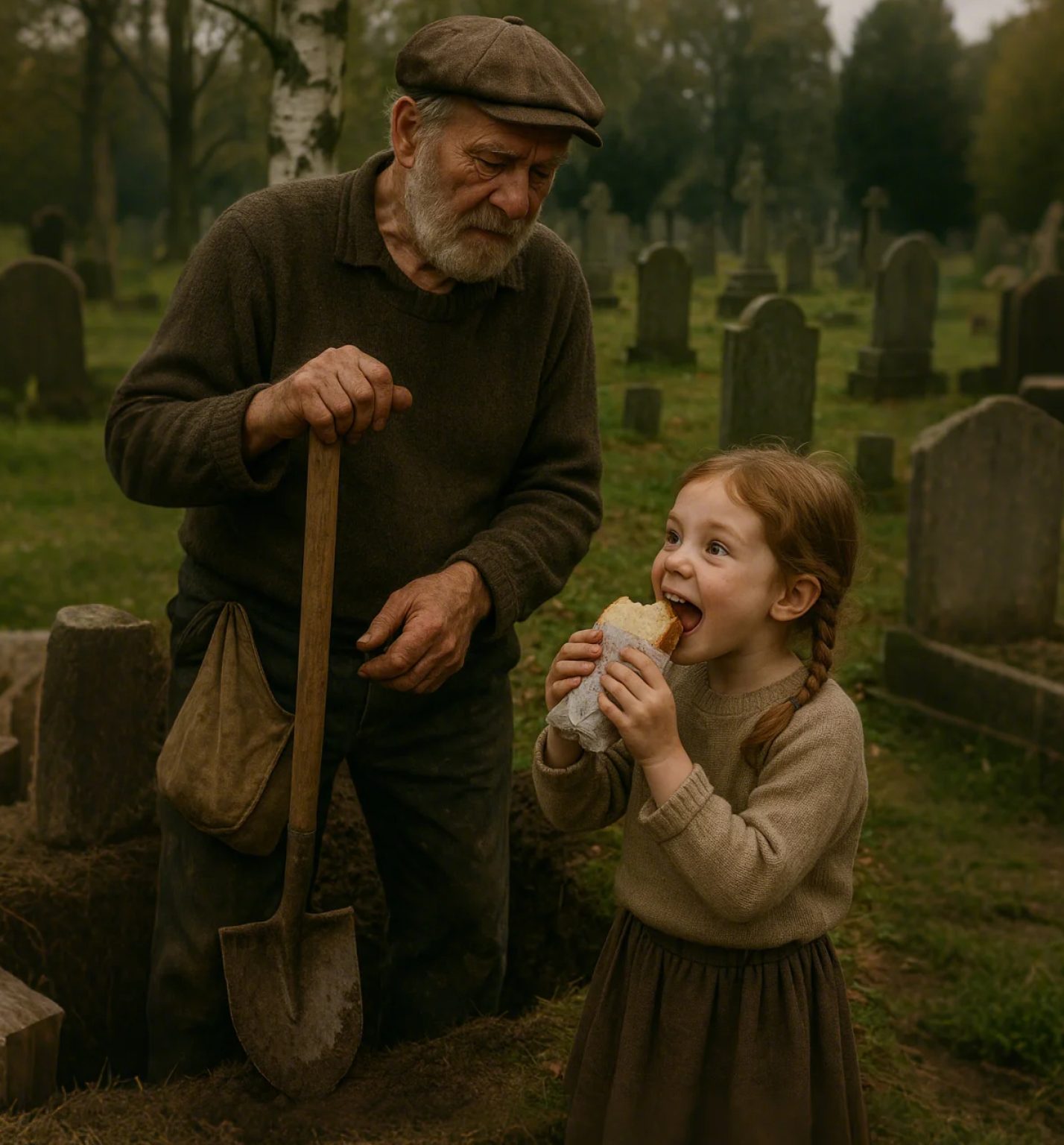
A slight girl, maybe eight years old, came skipping across the uneven ground, her figure barely more than a silhouette in the dim morning light. This was Lily—his frequent little visitor, a child who had somehow become as much a part of the cemetery as the moss-covered crosses and the cawing crows that perched above.
“There you are again, my little bird,” Thomas said.
He reached into a battered canvas bag slung over his shoulder. “Hungry?”
He handed her a modest sandwich, lovingly wrapped in yesterday’s newspaper. Lily took it with reverence, as if it were a precious gift, and devoured it with delighted urgency.
“Easy now,” he teased gently. “Chew properly. You’ll choke eating that fast.”
His tone held only concern. She was too small, too thin, and far too serious for her age.
When the sandwich had disappeared, Lily looked up at him, her large eyes full of something older than her years.
“Grandpa Thomas,” she murmured, “can I stay with you tonight? Mom’s getting married again.”
Thomas didn’t need her to say more. In her world, “married” meant loud parties, strange men, alcohol-fueled chaos—and bruises. He had seen the signs before, marks on her fragile arms that had made his blood boil.
“Of course, little bird,” he said quietly. “Come on, it’ll be dark soon.”
The following day brought with it another task.
A young woman—elegant, beautiful, and tragically lifeless—was to be buried. She had drowned in her luxury car just outside the city. When her family arrived, they seemed more preoccupied with inheritance documents than with mourning her loss.
Thomas dug steadily, his body moving on autopilot. He shook his head at the injustice of it all—so much money, so much promise, and not a single tear shed in sincerity.
“Who is she?” she asked curiously.
“A woman. A young one,” he replied without looking up.
“Do you feel sad for her?”
“I feel sorrow for all of them,” Thomas replied softly. “The d.ead can’t transform their fate anymore.”

When the grave was ready, Thomas leaned on his shovel and exhaled deeply. The sky had begun to darken, and the wind carried a chill.
“Let’s go inside and warm up,” he said.
The child’s tiny fingers wrapped around his, and together they made their way to the guardhouse—a small, smoky place filled with the comforting aroma of old herbs and burnt wood. To Lily, it was a fortress, the safest place in her world.
Morning came grey and still. A black hearse arrived at the cemetery gate and parked near the fresh grave.

Two men in pressed black suits stepped out, retrieved a sleek, disappeared coffin, and placed it atop wooden stools by the open pit.
“Make it quick, old man. We’re on a schedule,” one of them said impatiently.
Thomas frowned. “This isn’t firewood,” he said. “She deserves respect.”
The men rolled their eyes, got back in the car, and drove off, saying they’d return soon. Thomas was left alone—with the coffin, the silence, and the solemn duty of waiting.
Unseen, Lily emerged from the guardhouse and crept toward the grave. She crouched beside it, peering inside.
The woman inside was stunning, even in d.eath—pale and serene on a bed of white satin. She seemed more asleep than d.ead.
Lily turned to Thomas and said softly, “You’re not really going to bu:ry her, are you?”
Her question struck Thomas like a hammer to the chest. He staggered slightly, extinguished his cigarette, and walked toward the coffin.
Cold, yes—but not the kind of cold he knew all too well.
He placed two fingers against her neck. Waited. One heartbeat. Then another.
A pulse.
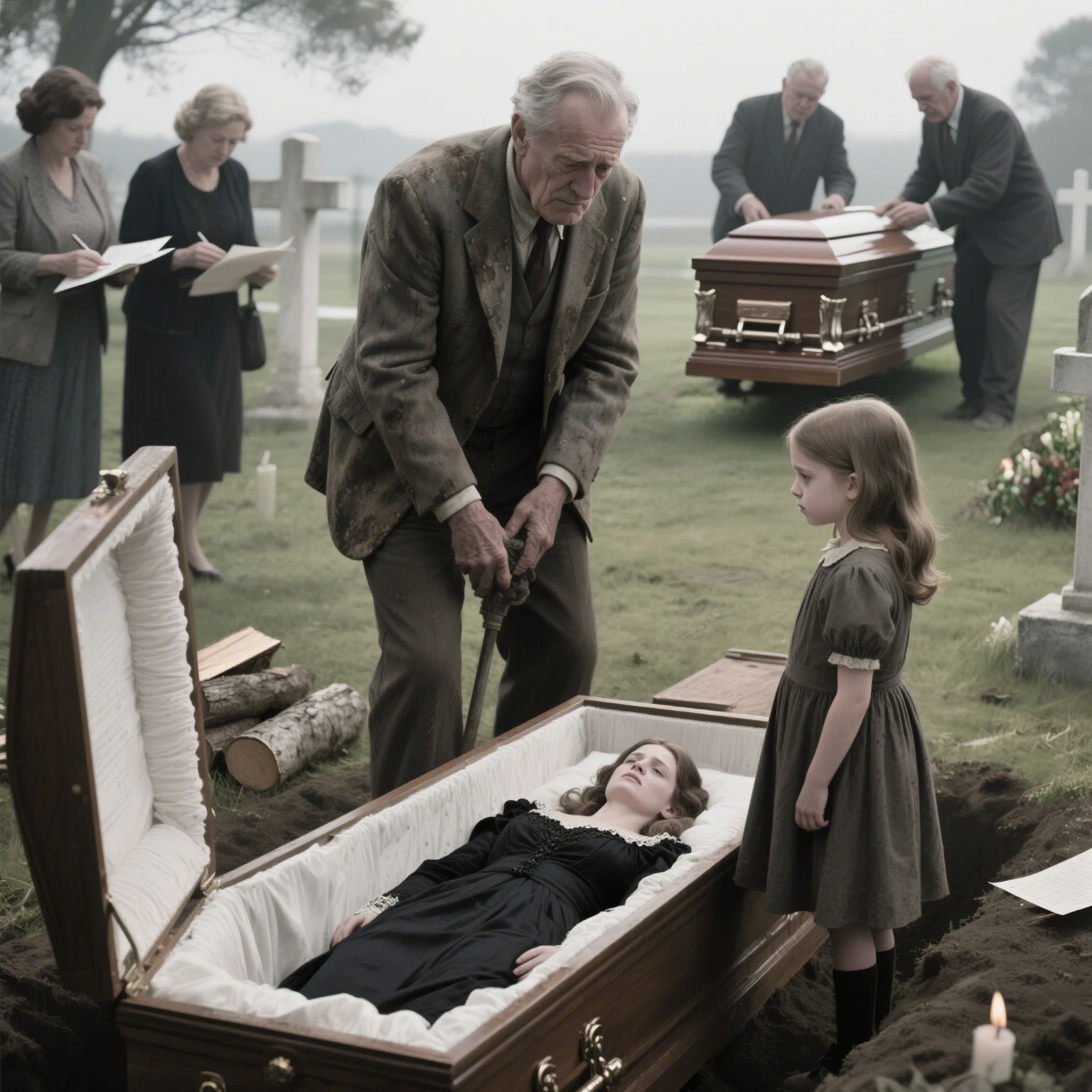
Thomas recoiled as if burned. His mind raced. He remembered an old story of a man misdiagnosed, waking up in the morgue. Could this be the same?
Without hesitation, he called for an ambulance. When the medics arrived and whisked the woman away, Lily clapped with joy.
“You saved her, Grandpa! You’re a real wizard!”
He gathered her into his arms.
“No, Lily,” he said quietly. “You saved us both.”
A month passed. The cemetery returned to its steady rhythm.
Thomas continued his work, while Lily remained his constant companion. But he thought often about school. He started setting aside whatever coins he could spare, determined to buy her what she needed: notebooks, shoes, a coat, a backpack.
Then one afternoon, someone knocked on the guardhouse door. Thomas was sh0cked—he rarely had visitors. When he opened the door, he found a well-dressed woman in an elegant coat, her eyes shining with quiet gratitude.
“Don’t you recognize me?” she asked gently.
He blinked. It was her. The woman he had almost buried.
“My name’s Claire,” she said with a warm smile. “And I came to thank you—and your granddaughter.”
“She’s not my granddaughter,” Thomas shouted.

They sat together, sipping tea from mismatched mugs. Claire told him everything: the betrayal, the forged d.eath, the greedy relatives, and how fate—or perhaps Lily—had saved her life. Thomas, in turn, told her about the girl who had become his family.
When Lily came in, Claire stood.
“And here she is,” she said, eyes bright. “My second savior.”
Learning about their trip to the city for school shopping, Claire said firmly, “No more buses. I’ll drive you. It’s the least I can do.”
In the city, she treated them to a whirlwind of generosity: new clothes, books, even a butterfly-covered backpack. Lily’s eyes sparkled. Thomas hung back, overwhelmed but grateful.
At lunch in a café—Lily’s first—Claire asked, “So, what school will you go to?”
Thomas went pale. “I forgot about the documents…”
That night, Claire made a decision.
Money – Definition, Uses, Properties and Characteristics
The next morning, she visited Lily’s home. It was worse than she thought. Squalor. Alcohol. Anger.
“I need Lily’s documents,” she said firmly.
“Give me money,” the mother said.

Claire paid. Took the documents. Walked away without a word.
She started the guardianship process. Hired lawyers. Faced the system. Fought for Lily’s future.
On the first day of school, Claire returned to the cemetery.
“It’s done,” she said. “I’m taking Lily home.”
Thomas was happy and heartbroken.
Claire saw it. “Come with us,” she said softly. “She needs a grandfather. I need a family.”
Tears filled Thomas’s eyes. He nodded.
The next morning, all three walked to school. Lily, radiant in her new uniform. Claire, elegant and strong. Thomas, proud and upright.
He muttered, “Ours is the most beautiful of all.”
This work is inspired by real events and people, but it has been fictionalized for creative purposes. Names, characters, and details have been changed to protect privacy and enhance the narrative. Any resemblance to actual persons, living or dead, or actual events is purely coincidental and not intended by the author.