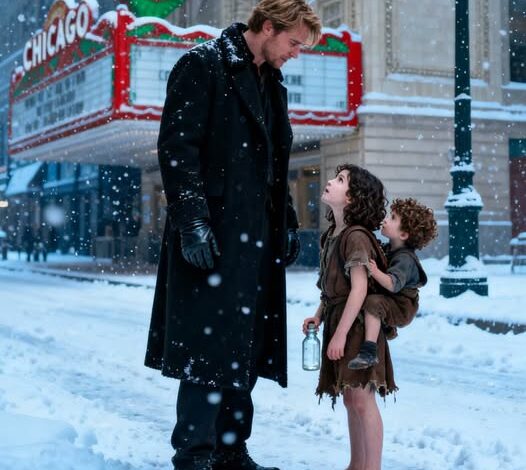
The afternoon sun bore down on downtown Seattle, turning the glass towers into shimmering monuments of unyielding momentum. In a city defined by its frantic pace, to stop was to become invisible. This was why hundreds of commuters failed to notice the ten-year-old girl tucked against a concrete pillar outside a grocery store on Pine Street. Her name was Lily, and she sat with her knees pulled tight to her chest, cradling her one-year-old brother, Noah, in a tattered gray blanket. The baby’s cry was no longer a demanding wail; it had faded into the weak, rhythmic whimper of a child who had learned that hunger is rarely answered.
Lily watched the world pass by—men in tailored suits, women with overflowing shopping bags, and parents pulling their own children along with hurried impatience. She didn’t beg indiscriminately. She waited, her eyes searching for a specific kind of strength. Finally, she saw him: David Lawson, a man whose name was synonymous with Seattle real estate and ruthless negotiation. He was mid-call, his voice sharp as he ordered a subordinate to “close the deal or walk away.”
As he approached the automatic doors, Lily stood, swaying slightly under the weight of her brother. “Sir,” she whispered, her voice barely piercing the urban din. David stopped, his brow furrowed in annoyance. “I just need a small box of milk,” she said, her voice trembling but determined. “For my brother. I’ll pay you back when I grow up. I promise.”
David Lawson was not a man known for charity. He was cold, efficient, and untouchable—a man who had turned entire neighborhoods into profit margins. Yet, as he looked down at the girl’s frayed sleeves and the baby’s pale lips, a dormant memory flickered within him. He remembered the hollow ache of his own childhood, the watery soup, and the stinging shame of being told “no.” Instead of walking away, David ended his call and knelt on the dirty pavement, his expensive charcoal suit pressing into the grit. He asked her name and her story, and when she simply replied that her parents were “gone,” he felt the weight of a fact too heavy for a child to carry.
“Stay here,” he commanded. Inside the store, David didn’t just buy a carton of milk. He moved with a sudden, frantic urgency, piling bags high with formula, diapers, fresh fruit, and bread. When he returned and placed the bags at Lily’s feet, she stared at them as if they were a mirage. “I’ll pay you back,” she insisted again, tears welling in her eyes. David offered a rare, thin smile. “You already did,” he replied, “by reminding me.”
That afternoon was a quiet catalyst for an internal revolution. David returned to his penthouse, but the city’s glitter suddenly felt hollow. He couldn’t shake the image of the girl who hadn’t begged for mercy, but had attempted to negotiate her future. That night, he opened an inactive tax shelter known as the Lawson Foundation. With a few keystrokes and a transfer so large it triggered bank alerts, he gave the foundation a new mission: providing emergency support for children with no advocates. He added a strict stipulation: no publicity, no conditions.
Over the next decade, the foundation’s reach grew in the shadows. It quietly funded a stable transitional home for Lily and Noah, ensuring they had clothes, medical care, and, most importantly, an education. Lily never knew the source of the scholarship that allowed her to graduate at the top of her class, but she felt the invisible hand of a protector. She grew into a woman of singular focus, driven by a desire to ensure that children like her didn’t simply disappear into the cracks of the sidewalk.
The threads of their lives finally converged at the Lawson Foundation’s annual gala years later. Lily, now a college graduate and a rising star in social advocacy, attended as a guest of honor. David, silvered at the temples and leaning slightly on a cane, moved through the ballroom with a newfound softness. When their eyes met across the crowded room, the recognition was instantaneous. The electric current of that afternoon on Pine Street returned, bridging the gap between a billionaire and a girl who had once had nothing.
“The girl,” David whispered as she approached.
“I’m Lily Turner,” she said, her voice steady. “And I’m here to start paying you back.”
The conversation that followed was not about debts, but about legacy. David confessed that the foundation had been born from guilt, but Lily’s success had transformed it into a purpose. He saw in her the resilience that he had once possessed, but tempered with a compassion he had spent a lifetime rediscovering. Within months, David made a radical decision. He bypassed his seasoned executives and named Lily as the operational lead of the foundation. He knew that the only person fit to lead a mission for the forgotten was someone who remembered exactly what the cold felt like.
Lily’s leadership was transformative. Her first initiative was titled “The Milk Promise,” a program that bypassed bureaucratic red tape to deliver essential nutrition to infants in crisis. It was a silent, efficient operation that reflected the man who had first helped her. When David eventually passed away, he left behind more than just buildings and land; he left a letter for Lily, acknowledging that she had paid him back a thousand times over by saving the best part of his humanity.
Today, the foundation’s headquarters features a small, unassuming plaque in the lobby. It doesn’t list David’s business achievements or Lily’s academic honors. Instead, it features a photograph of a man in a suit kneeling beside a girl with a baby. The inscription reads: No child should have to beg to survive.
Lily Turner often finds herself walking past the grocery store on Pine Street. She doesn’t see a place of tragedy, but a place of beginning. Whenever she encounters a struggling mother or a hungry child, she doesn’t just offer charity; she offers a partnership. She kneels on the pavement, looks them in the eye, and tells them that the world is watching. She understands that kindness is a debt that can never be fully settled—it can only be passed on, ensuring that the light lit by a single act of mercy continues to burn long after the shadows have faded.