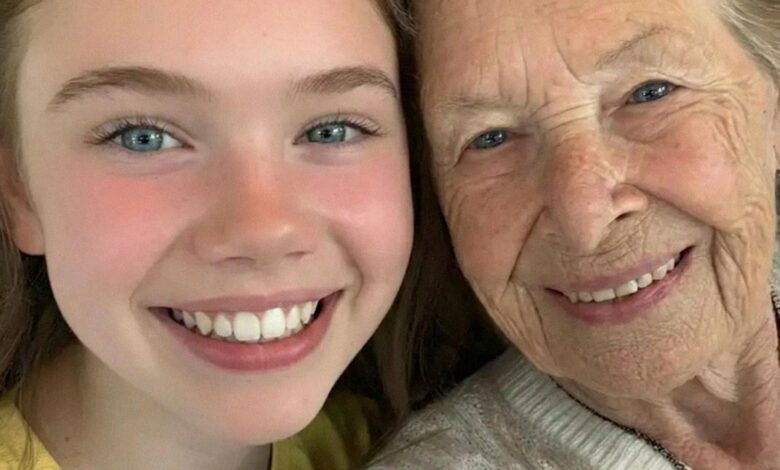
I was thirty-two years old when I discovered that the foundation of my life was built upon a compassionate, necessary fiction. For nearly three decades, I believed I was an orphan, the tragic survivor of a rainy highway collision that had claimed my parents and left me in the care of my grandmother. I had buried three people in my mind: my mother, my father, and finally, the woman who had raised me. But three days after her funeral, as I sat at our cracked vinyl kitchen table, a letter arrived that would dismantle my past and rebuild my future.
The house still smelled faintly of cinnamon and laundry soap, a lingering olfactory ghost of the woman who had occupied it. Her cardigan still hung over the back of the empty chair, its sleeve slipping toward the floor as if it, too, had lost the will to remain upright. Out of a reflexive, haunting habit, I put the kettle on and set out two mugs. It wasn’t until the water began to hum that I realized the second cup was intended for someone who would never drink from it again. I muttered a rejection of the grief, but I made the tea anyway. It was what she would have done.
The envelope was addressed in her unmistakable hand—a script that was firm, elegant, and weathered by years of manual labor. When I finally broke the seal, I was instantly transported back to the age of six. “My girl,” it began, “if you’re reading this, my stubborn heart finally gave up. I’m sorry to leave you alone again.” The word “again” snagged in my mind like a brier. I kept reading, my breath hitching as her voice echoed from the page. She reminded me that I was never unwanted—not for a single second.
My memory of that transitional childhood year was a blur of hushed adult tones and the smell of wet asphalt. I remembered a social worker with a clinical, pitying face explaining that there had been a “bad car accident.” She told me it was instant, that they hadn’t felt a thing. I had spent that afternoon staring at a coffee stain on the carpet, trying to process the concept of forever. Then, my grandmother appeared. She didn’t offer hollow platitudes. She knelt until we were eye-level, her brown coat smelling of cold mountain air, and asked, “Hey, bug. You ready to come home with me?” When I asked where home was, she simply said, “With me. That’s all that matters.”
Our life together was a masterpiece of small, busy sacrifices. She worked mornings at the laundromat and spent her nights cleaning corporate offices, her hands often smelling of bleach and lemon polish. On weekends, she hemmed jeans at the kitchen table while I struggled with algebra. Her own cardigans grew shiny at the elbows, and I eventually realized that the soles of her shoes were held together with more silver duct tape than rubber. At the grocery store, she was a mathematician of survival, checking every price tag and sighing before putting the luxuries back on the shelf.
Yet, despite the visible threadbare nature of her own life, my existence was lush. My field trips were always funded. There were birthday cakes with my name scrolled in thick, buttercream frosting. Picture-day money was always tucked into crisp envelopes. Fresh notebooks and sharpened pencils appeared every September like clockwork. People at church would remark that we were like mother and daughter, to which she would always reply, “She’s my girl. That’s all.”
We had our rituals: Sunday tea with far too much sugar, card games where she conveniently forgot the rules the moment I started to lose, and library trips where she would pretend to browse the adult fiction section only to “accidentally” end up beside me in the children’s stacks. At night, she read aloud until her head would nod mid-chapter. I would gently take the book, mark the page, and tuck a blanket around her shoulders. It was a beautiful, closed-loop world of two.
The friction began when I turned fifteen. Suddenly, the modest security of our home felt like a cage of poverty. In high school, status was measured in the shine of a car hood. I watched my peers climb into gleaming vehicles while I remained smudged with bus-pass ink. The jealousy was a slow-acting poison. One night, I confronted her as she sorted a stack of bills. I told her I needed a car. She didn’t look up, simply saying that the car could wait. I snapped, calling her “cheap,” accusing her of hoarding money while I suffered the social death of the school bus.
The word “cheap” landed like a physical blow. Her mouth tightened, and her face changed in a way that made my stomach drop. She didn’t yell; she simply said that was enough for the night. I slammed my door, rehearsing an apology I planned to deliver in the morning. But the morning brought a silence that was too heavy. I found her in her bedroom, work clothes still on, her hand already cool to the touch. The doctors said “heart attack,” and “quick,” and “she didn’t feel a thing.”
I felt everything. I felt the guilt of our last conversation, the weight of the things unsaid, and the sudden, terrifying vacuum of being truly alone. But the letter she left behind directed me to the top shelf of her closet, behind a blue shoebox. There, I found a thick folder containing savings accounts, a college fund, and a life insurance policy. The numbers were staggering—they didn’t match the watered-down soap or the duct-taped shoes. A sticky note read: “For your education. And maybe a small, sensible car if I’m not there to argue with you.”
Then came the revelation that made my skin go cold. “You were six when they told you your parents died in a car crash,” she wrote. “They did not. Your parents went to prison. Fraud, forgery, assault. They chose money over you.”
She explained that she had been faced with a devastating choice: tell a six-year-old the truth and let the shame of her parents’ character crush her, or create a story of tragic, blameless loss that would allow the child to sleep at night. She chose the lie that protected my soul. She had traded her own comfort, wearing rags and working three jobs, to build a fortress of “orphanhood” that was actually a shield against the reality of abandonment.
Seventeen years have passed since I read that letter. Today, I stand in a cramped dressing room, staring at my reflection under the harsh, buzzing lights of a regional theatre. On the counter sits a small glass award for “Best Actress.” I laid the letter beside it. I realized then that my career—my ability to inhabit stories and find the truth within fiction—was a gift from her.
I never looked for my parents. I never called. The truth is simple now: she didn’t lie to steal a life from me; she lied to give me one. She chose the story that let me believe I was loved by people who were gone, rather than rejected by people who were still here. In the end, she wasn’t just my grandmother; she was the architect of my survival. Her lie was the greatest act of truth I have ever known.
