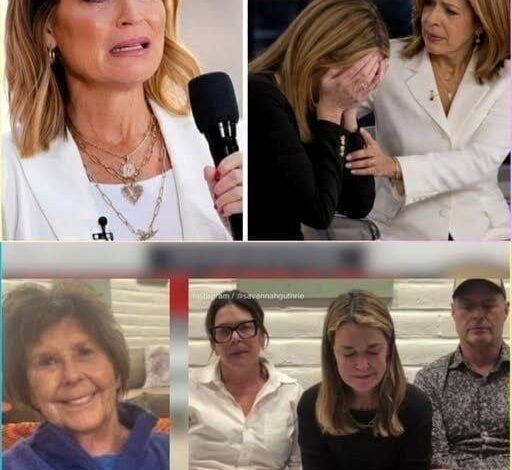
The intersection of journalistic duty and raw human emotion is a space few navigate as frequently or as visibly as Savannah Guthrie. As a mainstay of morning television, Guthrie has built a career on a foundation of steely professionalism, an ability to pivot from lighthearted human-interest stories to the grimmest of global headlines without losing her composure. Yet, even for a seasoned veteran of the newsroom, there are stories that breach the professional veil. In late February 2026, Guthrie stood before the cameras to deliver an update that would leave a permanent mark on the national consciousness: the official conclusion of a nationwide search for a missing child.
The broadcast began with the familiar cadence of a breaking news alert, but viewers immediately noticed a shift in Guthrie’s demeanor. Known for her clarity and focus, she struggled to maintain her usual vocal steady as she looked into the lens. The search, which had captivated the country for weeks, had come to its most devastating possible conclusion. As she informed the audience that authorities had officially ended their active search efforts, the weight of those four words—”the search is over”—rippled through living rooms across America. It was a moment of collective mourning, delivered by a woman who had become the face of the public’s hope throughout the ordeal.
To understand the impact of this announcement, one must consider the sheer scale of the mobilization that preceded it. This was not merely a local police matter; it had evolved into a massive, multi-agency operation that utilized every facet of modern investigative technology. From the initial hours of the disappearance, a wave of human compassion had surged across state lines. Thousands of volunteers had dedicated their days and nights to ground searches, moving in grids through dense forests and urban landscapes alike. Law enforcement had deployed advanced thermal-imaging drones, K-9 units with specialized tracking training, and digital forensic analysts who scrubbed every byte of data from local cellular towers and surveillance networks.
The cultural footprint of the case was equally vast. Social media platforms became a digital hub for the search, with “amber alerts” and flyers shared by millions. Community vigils had become a nightly occurrence in the child’s hometown, where the flickering light of candles served as a fragile stand-in for the hope that the child would eventually walk back through their front door. The news coverage had been relentless, a reflection of a society that refuses to look away when one of its youngest members is in danger. Guthrie herself had been at the forefront of this coverage, reporting on every lead and every small breakthrough with the cautious optimism that defines the best of her profession.
However, as the days stretched into weeks, the leads began to diminish. The exhaustive ground searches yielded no new physical evidence, and the advanced technical tools that investigators relied upon reached the limits of their utility. The agonizing silence from the investigative task force in the days leading up to the announcement had prepared many for the worst, but hearing it spoken aloud by a figure as trusted as Guthrie transformed the theoretical possibility into a crushing reality. During the broadcast, Guthrie emphasized that no stone had been left unturned, a testament to the dedication of the men and women who had refused to sleep until they found an answer.
The emotional toll of the moment was evident when Guthrie’s voice wavered. In that brief fracture of her professional mask, she spoke not just as a journalist, but as a parent and a member of the community. She acknowledged the profound pain felt by the family, a grief so immense it felt intrusive to even describe. Her words were a bridge between the sterile facts of a police report and the visceral reality of a family’s shattered world. By allowing her own emotion to surface, she validated the sorrow of millions of viewers who had invested their hearts into the safe return of a child they had never met.
While the active search phase has concluded, the legal and investigative journey is entering a new, more somber chapter. Authorities have been clear that the end of the search does not mean the end of the inquiry. The focus has now shifted from rescue to justice, as detectives continue to review the massive amounts of forensic data and witness statements collected during the last month. The goal is to provide the family with the “why” and “how” that are essential for any semblance of closure, even if that closure is bitter and unwanted.
Across the country, the response to Guthrie’s broadcast has been one of quiet, respectful solidarity. The “Search for the Child” social media groups have been replaced by memorial pages, where people share prayers and digital tributes. In the child’s hometown, the park where the search was headquartered has become a sea of flowers, teddy bears, and handwritten notes. These memorials serve as a reminder of the child’s life and as a testament to the community’s refusal to let that memory fade into a cold case file. The vigils continue, but the prayers for a safe return have been replaced by prayers for peace.
The legacy of this search, and Guthrie’s role in reporting its end, highlights the unique role of the news media in moments of national tragedy. In an era of fragmented information and digital noise, a centralized figure like Savannah Guthrie provides a communal space for grief. Her reporting was a masterclass in the “humanity of news”—the idea that facts alone are insufficient to tell the story of a life. By holding back tears, she mirrored the struggle of an entire nation trying to remain strong while facing an unbearable outcome.
As the news cycle inevitably moves on to the next headline, the impact of this case will remain. It will be studied by future journalists as a case study in empathetic reporting and by law enforcement as a benchmark for large-scale mobilization. But for the family and the thousands who searched, it will always be defined by that afternoon in February when the hope finally gave way to mourning. Savannah Guthrie’s broadcast was more than just a news update; it was a eulogy for a search, a final act of professional grace that honored the child, the family, and the thousands of people who refused to stop looking until the very end.