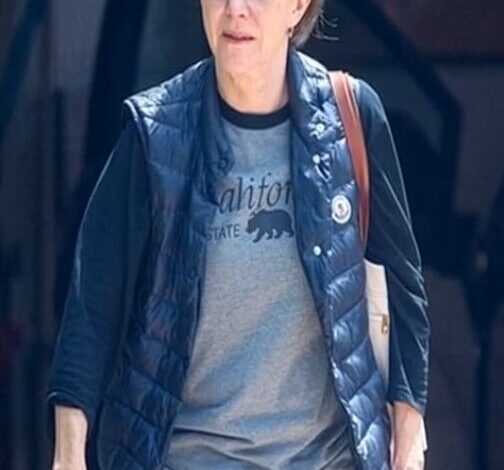
For decades, Sally Field has lived under a microscope few people ever escape. Fame brought her admiration, opportunity, and acclaim—but it also came with a constant evaluation of her body, her face, and her worth. At 78, after a lifetime of unforgettable performances and personal resilience, she has become an unexpected lightning rod for some of the ugliest impulses of online culture. Strangers, armed with keyboards and cruelty, have called her “ugly,” mocked her aging face, and demanded she explain why she no longer looks the way she did at nineteen.
Field’s response has been neither defensive nor apologetic. Instead, it has been honest, measured, and quietly powerful.
Hollywood has never been kind to women who age. It rewards youth, freezes beauty in time, and punishes those who dare to exist beyond it without surgical compliance. Field has spent her career pushing against that current. Known for iconic roles in films like Forrest Gump, Mrs. Doubtfire, Steel Magnolias, and Norma Rae, she built a legacy on emotional truth rather than surface perfection. That refusal to perform artificial youth has followed her into later life—and it has made her a target.
Critics online have zeroed in on her face, dissecting wrinkles and shadows as if they were moral failures. Field has acknowledged that seeing herself on screen can still be difficult. She has spoken candidly about moments of self-criticism, admitting that she notices the same things everyone else does: a neck that sags, eyes that puff, features that shift with time. But she refuses to treat those changes as shameful.
Aging, she has said, is not a flaw to be corrected. It is a process to be respected.
That philosophy did not come easily. Field’s life has been shaped by hardship long before the internet existed. In her 2018 memoir, she revealed that she endured sexual abuse as a child at the hands of her stepfather, actor Jock Mahoney. The trauma, kept hidden for years, informed her understanding of silence, endurance, and survival. It also deepened her empathy for roles that required vulnerability and strength in equal measure.
Her career began early, catapulted into public view by the 1960s sitcom Gidget. Fame arrived fast, but respect did not. She was typecast, underestimated, and often dismissed as lightweight. It took years—and deliberate, difficult choices—for her to be seen as a serious actress. Roles in Sybil and Norma Rae forced Hollywood to confront her depth. Norma Rae earned her an Academy Award and permanently altered the trajectory of her career.
Over time, she became synonymous with complex maternal figures—women shaped by love, fear, resilience, and moral clarity. Soapdish, Not Without My Daughter, and later projects cemented her as an actress capable of commanding emotional gravity without spectacle.
Behind the scenes, the pressure was constant. During the filming of The Flying Nun, Field once recalled a moment when a fellow actress pulled her aside and offered encouragement during a particularly dark period. Those words mattered more than applause. They reminded her that survival in the industry required internal anchors, not external validation.
As she aged, Field made a conscious decision to reject cosmetic surgery. Not as a statement against others, but as an affirmation of herself. She chose to let her face reflect her life rather than erase it. In interviews, she has spoken openly about embracing the reality of being an older woman—without pretending it is easy or pretending it does not come with moments of discomfort.
That choice, however, has drawn a disproportionate amount of hostility.
On platforms like X, anonymous users have taken aim at her appearance, reducing decades of work and humanity to a handful of cruel adjectives. Field has not engaged with them directly. She does not argue with strangers about her face. She does not attempt to educate trolls. Instead, she continues living visibly and honestly, refusing to disappear or disguise herself to satisfy a culture that demands women fade quietly.
What many critics do not realize—or choose to ignore—is that Field has also been carrying a serious health condition in silence for years.
In 2005, before she turned 60, she was diagnosed with osteoporosis. The diagnosis came as a shock. She exercised regularly, ate well, and maintained what most would consider a healthy lifestyle. Yet she fit the risk profile precisely: thin, small-boned, Caucasian, and entering menopause. Despite doing “everything right,” her bone density declined rapidly.
She later spoke about the diagnosis, explaining how invisible the disease can be. There were no warning signs she could feel. No pain to signal what was happening beneath the surface. “I was amazed at how quickly a woman could go from being at risk to having full-fledged osteoporosis,” she said, noting that her bones were thinning without any obvious symptoms.
The knowledge adds weight to the cruelty she faces. Mockery aimed at her body ignores not only the natural process of aging, but the medical realities many women live with quietly. Osteoporosis affects millions, particularly older women, and it reshapes the body in ways that are often misunderstood and unfairly judged.
Field has never asked for sympathy. She has never framed herself as a victim. Instead, she has used her voice to normalize conversations about aging, illness, and self-acceptance. Her refusal to “fix” herself for public comfort is not an act of rebellion—it is an act of honesty.
Resilience, in her case, does not look like defiance. It looks like consistency. Like continuing to work, to speak, to exist as she is. It looks like choosing dignity over disguise.
At an age when many actresses are pushed aside or pressured into invisibility, Sally Field remains present. Not frozen in time. Not polished into something unrecognizable. Just present.
Her story is not about silencing critics. It is about refusing to internalize them. It is about understanding that a woman’s worth does not diminish as her face changes, and that authenticity is not something to apologize for.
In an industry—and a culture—that still struggles to accept women as they age, Field stands as quiet proof that grace does not come from perfection. It comes from survival, truth, and the courage to be seen as you are.
And that, more than any wrinkle or shadow, is what endures.