Recife in December is not a city; it is a kiln. The heat does not descend; it rises from the asphalt, wrapping itself around your ankles and pulling you down into the earth.
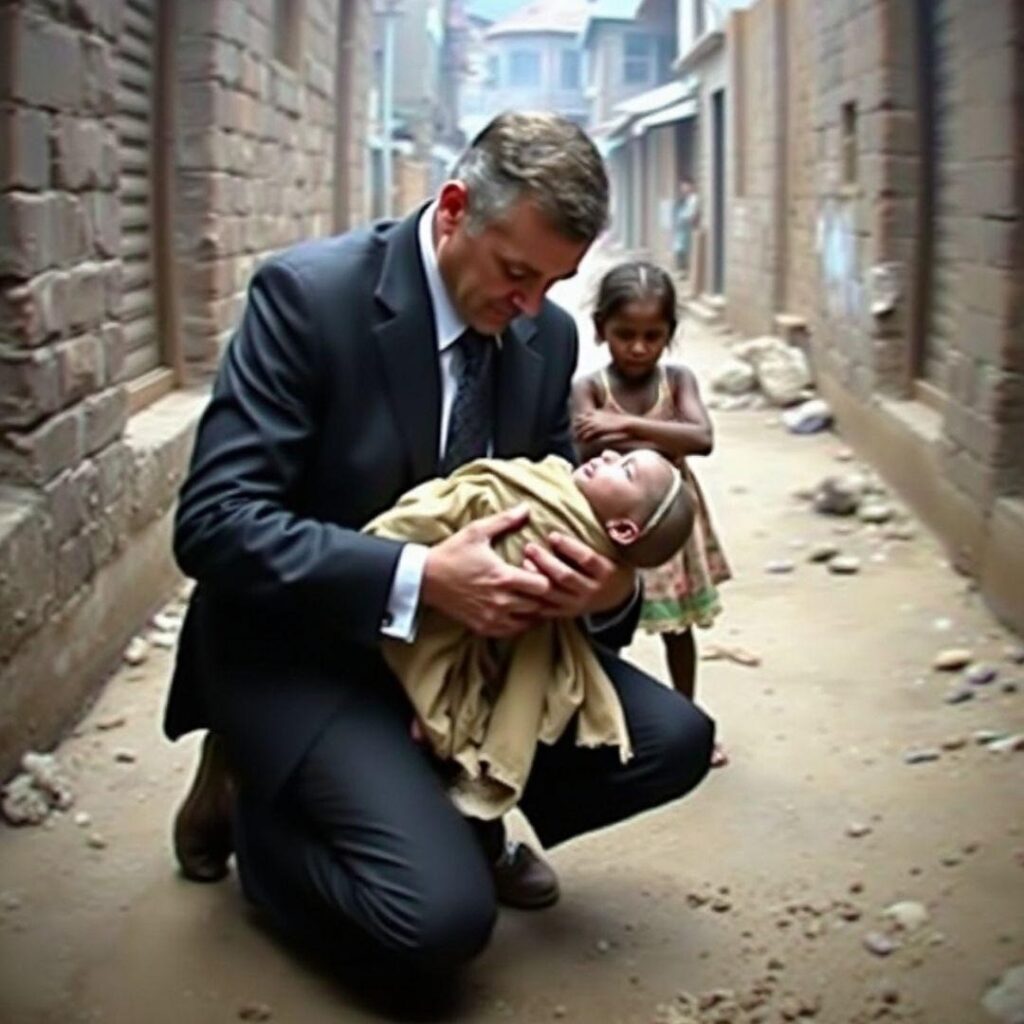
I am Roberto Acevedo. To the business journals, I am the “Titan of Tech,” the man who modernized the telecommunications infrastructure of northeastern Brazil. To my employees, I am a stopwatch in a suit—precise, unyielding, and utterly devoid of warmth.
Since my wife, Clara, died three years ago, I have cultivated a life of aggressive sterility. My penthouse is white marble and chrome. My car is a black armored Mercedes that smells of nothing. My schedule is a grid of fifteen-minute intervals designed to ensure that I never, not for a single second, have time to think about the empty side of my bed.
I was walking down Rua da Aurora, flanked by my head of security, Bruno. I had just closed a deal worth forty million reais. I felt nothing. It was just numbers on a screen.
“Sir, the car is around the corner,” Bruno said, his voice low.
“I’ll walk,” I said. “I need the air.”
It was a lie. The air was thick with exhaust and humidity. I needed the noise. I needed the chaos of the street to drown out the silence in my head.
We passed the old colonial buildings, the paint peeling in the sun. Tourists were taking selfies. Vendors were selling coconut water.
And then, I heard it.
It wasn’t a scream. Screams are common in the city. This was a sound so broken, so devoid of hope, that it cut through the traffic noise like a razor blade.
“Senhor… por favor…” (Sir… please…)
I stopped. I looked into the alleyway to my right. It was a narrow fissure between a bakery and a derelict warehouse, piled high with rotting cardboard and trash.
Shadows moved in the back.
“Sir, keep moving,” Bruno warned, stepping in front of me. “It’s not safe.”
I pushed Bruno aside. I walked into the gloom.
Sitting on a flattened cardboard box, surrounded by puddles of stagnant water, was a girl. She couldn’t have been more than eight. Her face was a map of grime, tears cutting clean rivers through the dirt on her cheeks. Her hair was matted into a thick, tangled nest.
But it was what she was holding that stopped my heart.
In her lap lay a toddler. A baby, maybe two years old.
The baby was gray. Not pale—gray. Her lips were blue. Her eyes were closed. She was wrapped in a dirty t-shirt that was far too big for her.
The older girl looked up at me. Her eyes were ancient. They were the eyes of a soldier who had seen too much war.
“Sir,” she whispered, her voice cracking from dehydration. “Can you help me bury my sister?”
The world tilted. The heat vanished. I went cold.
“Bury?” I choked out.
“She didn’t wake up,” the girl sobbed, rocking the small body. “She was crying all night because her tummy hurt. Then she stopped. Now she is cold. I don’t have a shovel. The dogs… I don’t want the stray dogs to get her.”
She held the body out to me.
“I promise I will pay you,” she begged. “I can wash clothes. I can beg. Just… give her a hole in the ground. Please.”
I fell to my knees. My three-thousand-dollar suit pants soaked up the filth of the alley floor.
“Give her to me,” I commanded.
“She’s heavy,” the girl warned weakly.
I took the baby. She wasn’t heavy. She was terrifyingly light. It was like holding a bird skeleton wrapped in paper. Her skin was clammy, cold to the touch in the sweltering heat.
I looked at the baby’s face. I saw the sunken eyes. The cracked lips.
I remembered Clara. I remembered the moment the monitor flatlined. The silence. The finality.
Not again, a voice screamed in my head. Not on my watch.
I pressed two fingers against the baby’s carotid artery. I held my breath.
Nothing.
“No,” I hissed. “Come on.”
I pressed harder, moving my fingers.
Nothing.
The older girl was watching me, tears streaming silently. “She’s gone, isn’t she? Grandma went like that.”
Then… a flutter.
It was so faint I thought it was the tremor in my own hand.
Thump.
A pause. A long, terrifying pause.
Thump.
“She’s alive!” I roared. The sound echoed off the brick walls, startling the pigeons. “Bruno! The car! NOW!”
Bruno, who had been standing guard at the alley entrance, saw the look on my face. He didn’t argue. He sprinted into traffic, stopping the Mercedes with his body.
I stood up, cradling the baby against my chest.
“What is your name?” I asked the older girl.
“Maria,” she whispered.
“Maria, can you run?”
“I… I think so.”
“Then run,” I said. “Run for her life.”
We burst out of the alley. I didn’t care about the staring tourists. I didn’t care about the mud on my clothes. I dove into the back seat of the car. Maria scrambled in after me, shrinking into the leather corner, terrified of the luxury.
“St. Michael’s Hospital,” I barked at the driver. “Do not stop for red lights. Do not stop for police. Just drive.”
I ripped off my jacket and wrapped it around the baby.
“Wake up,” I whispered to the unconscious child. “You are not allowed to die today. You hear me? I forbid it.”
Maria watched me, her eyes wide. “Is she… is she really alive?”
“She is fighting,” I said. “And we are going to help her fight.”
We hit the Emergency Room entrance doing sixty. Bruno was on the radio, calling ahead, but the chaos of a public ER is a beast that cannot be tamed by a phone call.
I kicked the doors open, carrying the baby—whose name Maria told me was Ana.
“Help!” I shouted. “I have a pediatric code blue!”
The waiting room was packed. People with coughs, broken arms, bleeding cuts. No one moved.
A nurse behind the triage glass looked up. She saw a dirty man holding a dirty baby. She didn’t recognize me through the grime.
“Take a number, sir,” she said flatly. “The wait is four hours.”
“She is dying!” I yelled, approaching the glass. “She is hypothermic and malnourished!”
“Sir, step back,” the nurse snapped. “Where are the parents? Do you have insurance?”
“I don’t have parents!” Maria cried out from behind me. “We live on the street!”
The nurse’s face hardened. “We are not a shelter. If you are indigent, you need to go to the public clinic across town. We cannot admit without a guardian or payment verification.”
Something inside me snapped. It was the same part of me that ruthlessly dismantled competitors.
I walked up to the glass. I slammed my hand against it.
“Look at me,” I said. My voice was low, deadly.
The nurse blinked. She looked past the dirt. She saw the watch on my wrist—a Patek Philippe. She saw the cut of the suit. And finally, she saw my eyes.
“I am Roberto Acevedo,” I said. “I donated the MRI wing of this hospital last year. I am currently texting the Chairman of the Board, who is a personal friend. If a gurney is not here in ten seconds, I will buy this hospital, fire you, and turn this building into a parking lot.”
The nurse went pale. She scrambled for the phone. “Code Blue! Pediatric! Trauma Bay 1! Now!”
The double doors swung open. A team of doctors in scrubs rushed out.
“Give her to us,” the lead doctor said.
I placed Ana on the stretcher. They swarmed her. Cutting off the rags. Inserting IVs. Putting an oxygen mask on her tiny face.
“No pulse!” one shouted. “Start compressions!”
I watched them pump her chest. Her body jerked with every thrust.
Maria let out a wail that tore my soul apart. She tried to run to her sister.
I grabbed her. I pulled her into my arms. She smelled of rain and garbage and fear. I didn’t care. I held her tight, burying her face in my shoulder so she wouldn’t see them shock her sister’s heart.
“Look at me, Maria,” I whispered. “Look at me.”
“Don’t let them hurt her!” she sobbed.
“They are saving her,” I said. “Listen to my heart. Focus on that.”
Clear! The defibrillator whined. Thump.
Silence.
Beep… beep… beep.
“We have a rhythm,” the doctor announced. “Let’s move! get her to the ICU!”
They wheeled Ana away.
I stood in the hallway, holding a crying eight-year-old girl, shaking like a leaf.
They gave us a private waiting room. The VIP suite.
I ordered food. Not hospital food. I had a courier bring hot soup, fresh bread, fruit, and warm milk from the best bistro in the city.
I placed the food on the table.
“Maria,” I said gently. “You need to eat.”
She looked at the food. Her eyes were huge. She reached out a trembling hand and took a piece of bread.
She took one bite. Then she stopped.
She took the napkin and wrapped the rest of the bread in it. She put it in her pocket.
“What are you doing?” I asked.
“For Ana,” she whispered. “When she wakes up. She loves bread. We… we haven’t had bread in three days.”
I had to turn away. I walked to the window and stared out at the city lights. I had spent millions of dollars on cars, on apartments, on art. And here was a child saving a crust of bread for a sister who might not wake up.
I wiped my eyes. I turned back.
“Maria,” I said, my voice thick. “Look at me.”
She looked up.
“You eat that,” I said. “Eat all of it. I promise you, on my life, when Ana wakes up, there will be more bread. There will be mountains of bread. There will be strawberries and cake and soup. She will never be hungry again.”
“You promise?”
“I swear it.”
She ate. She ate until she was full, and then she fell asleep on the sofa, clutching my suit jacket like a security blanket.
I sat in the chair opposite her. I watched her sleep.
I thought about my empty house. I thought about the silence that greeted me every night.
The doctor came in at 3:00 AM. He looked exhausted.
“She’s critical,” he said. “Severe sepsis. Pneumonia. Her organs were shutting down from starvation. But… she’s a fighter. She’s stable.”
I let out a breath. “Thank you.”
“Mr. Acevedo,” the doctor said, looking at Maria. “Social services have been notified. Once the baby is stable, they will be taken into state custody. The older girl… she can’t stay here.”
“State custody?” I asked. “You mean an orphanage?”
“Yes. Or foster care. They will likely be separated due to the age gap and the medical needs of the baby.”
Separated.
I looked at Maria. I imagined her waking up in a strange room, without her sister, without the one person in the world she loved.
“No,” I said.
The social worker arrived the next morning. Her name was Ms. Gable. She carried a clipboard and an air of overworked exhaustion.
“Mr. Acevedo,” she said, sitting across from me in the waiting room. “We appreciate your intervention. You saved these children’s lives. But we need to process them. They are wards of the state now.”
“They are not going anywhere,” I said.
“Sir, you have no legal standing,” Ms. Gable sighed. “You are a stranger. We have to follow protocol. We will find a foster home for Maria today.”
“Maria stays with Ana,” I said.
“That’s not possible. The hospital is not a shelter.”
“I am buying the room,” I said.
Ms. Gable blinked. “Excuse me?”
“I am paying for the private suite indefinitely. Maria stays here until Ana is discharged.”
“That… that is generous,” Ms. Gable admitted. “But after discharge? Sir, you are a single man. A businessman. You work eighty hours a week. You cannot just… keep them.”
“Why not?”
“Because children need a family. They need stability.”
“I have a house,” I said. “It has six bedrooms. It overlooks the ocean. I have the resources to hire the best nannies, the best tutors, the best doctors. I can give them a life they can’t even dream of.”
“Money isn’t a family, Mr. Acevedo,” she said softly.
I stood up. I walked over to the ICU window. I looked at Ana, sleeping in the incubator.
“I know that,” I whispered. “I had money when my wife died. It didn’t save her. It didn’t comfort me.”
I turned to Ms. Gable.
“My wife… Clara. She wanted children. We tried for years. We painted the nursery yellow. We bought books. When she died, I locked that room. I haven’t opened it in three years.”
I looked at Maria, who was awake now, watching us with terrified eyes. She knew we were talking about her fate.
“I am not just offering them a roof,” I said. “I am offering them a father. I am offering them the love I have been hoarding because I had nowhere to put it.”
Ms. Gable looked at me. She looked at the desperation in my face. She looked at Maria, who had walked over and taken my hand.
“He promised,” Maria said to the social worker. Her voice was small but fierce. “He promised Ana would have bread. He keeps his promises.”
Ms. Gable closed her folder. She sighed.
“Emergency temporary guardianship,” she said. “It’s a long shot. The courts are strict. You’ll need background checks, home inspections, interviews.”
“I have the best lawyers in Brazil,” I said. “Draw up the papers.”
The legal battle took two months. Ana recovered slowly. Maria never left her side.
I learned how to change diapers. I learned how to braid hair (badly). I learned that Frozen is the only movie that matters.
On a Tuesday in February, the judge banged his gavel.
“Petition for adoption granted.”
We walked out of the courthouse. I held Ana in my left arm. Maria held my right hand.
The drive to the penthouse was quiet. Maria was nervous. She had seen the hospital, but she hadn’t seen my world.
We took the private elevator up. The doors opened.
The penthouse was vast, white, and pristine.
“It’s… big,” Maria whispered.
“It’s too quiet,” I said. “We need to fix that.”
I led them down the hall. I stopped in front of the locked door. The yellow nursery.
I took the key from my pocket. My hand shook.
I opened the door.
It was exactly as Clara had left it. The yellow walls. The crib. The rocking chair.
But I had added a few things. A second bed for Maria. A mountain of toys. And on the table, a basket.
Maria walked over to the basket.
It was filled with bread. Baguettes, croissants, rolls, sweet buns.
She looked at me. Tears filled her eyes.
“You remembered,” she sobbed.
“I promised,” I said.
Ana wiggled out of my arms. She ran—wobbly, toddler steps—to the basket. She grabbed a croissant with both hands and took a massive bite.
“Dada!” she cheered, crumbs falling on the pristine rug.
Dada.
The word hit me harder than the heat in the alley.
I knelt down. I hugged them both. For the first time in three years, the cold ache in my chest was gone. It was replaced by warmth. By noise. By crumbs on the floor.
Five years have passed.
The penthouse isn’t white anymore. There are crayon drawings on the walls. There are toys in the foyer. The Mercedes has a car seat and sticky fingerprints on the windows.
I still work, but not eighty hours. I leave at 4:00 PM. I have dance recitals and soccer games.
Last week, we went back to Rua da Aurora.
Maria is thirteen now. She is tall, beautiful, and brilliant. She wants to be a doctor. Ana is seven, a chaotic ball of energy who fears nothing.
We stood at the entrance of the alley. It was still dark. Still dirty.
“I remember,” Maria said softly, holding my hand. “I remember thinking this was the end.”
“It wasn’t an end,” I said. “It was a beginning.”
I looked at the spot where I had found them.
I had started a foundation in their name. The Clara & Ana Initiative. We bought the warehouse next door. It is now a shelter and a school for street children. No child in Recife would have to ask a stranger to bury their sister ever again.
“Come on, Dad,” Ana tugged my arm. “I’m hungry. Can we get ice cream?”
“You just ate lunch,” I laughed.
“But I have a hollow leg!” she argued.
I smiled. I looked at my daughters. I looked at the life we had built from the ashes of grief and poverty.
“Okay,” I said. “Ice cream. But don’t tell your sister I let you have double scoops.”
“I can hear you!” Maria laughed.
We walked away from the alley, into the sunlight, a family forged in the dark, walking together into the light.