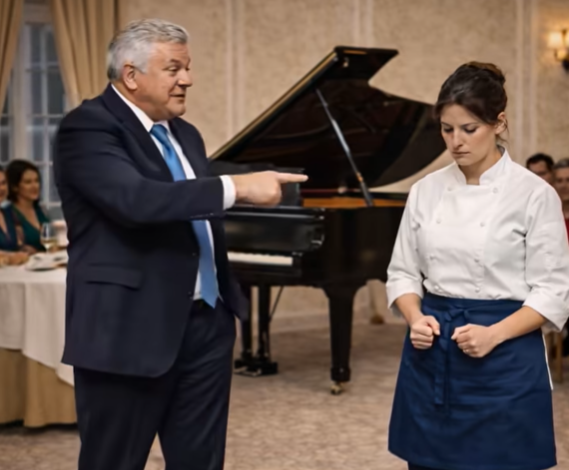
In the humid, high-pressure environment of the “Le Sommet” kitchen, Anna was a ghost. She moved with a practiced, invisible efficiency, her hands scarred by steam and her hair tucked tightly under a cap. To the wealthy patrons in the dining room, she was merely the source of the garlic-infused butter and the perfectly seared scallops. To Mark, the restaurant’s formidable owner, she was a line item on a ledger—a replaceable cog in a machine built on prestige and intimidation. Mark was a man who measured worth in brand names and pedigree, a man whose ego was as polished as the silverware on his tables.
The confrontation began on a Tuesday evening, amidst the clatter of a full dinner service. Anna was navigating the narrow pass between the kitchen and the dining room, balancing a heavy tray of hot entrées, when Mark’s hand clamped onto her wrist like a vice. The suddenness of the gesture caused her to flinch, the ceramic plates rattling dangerously. Mark didn’t care about the food; his eyes were narrowed, fixed on her with a predatory curiosity.
“Repeat what you said,” Mark demanded, his voice a low, dangerous rumble that cut through the ambient noise of the restaurant.
Anna swallowed hard, her pulse thumping in her ears. “I only mentioned that the piano in the lounge… it isn’t tuned, sir. The middle C has a mechanical buzz.”
Mark’s lips curled into a smirk that didn’t reach his eyes. He didn’t release her wrist. Instead, he steered her toward the center of the dining room, forcing her onto the stage of public scrutiny. The room was filled with the city’s elite—businessmen in bespoke suits and women draped in silk. The conversation died down as Mark raised his voice, commanding the attention of every guest in the building.
“Ladies and gentlemen,” Mark announced, his voice dripping with theatrical irony. “It appears our humble cook is also a refined music critic. She finds our grand piano lacking.”
A ripple of condescending laughter moved through the room. Mark turned back to Anna, his gaze mocking. “Tell us, did you study at a conservatory? Or perhaps you’ve been practicing on the cutting boards between shifts?”
“No, sir,” Anna replied quietly, her eyes fixed on the floor. “I didn’t go to a conservatory.”
“What a shock,” Mark drawled, his tone sharpening. “Emma, come here, darling.”
His daughter, Emma, stepped forward from a corner table. She was the picture of curated perfection, wearing a dress that cost more than Anna’s annual salary. Emma was Mark’s greatest pride, a pianist who had been trained by the finest masters in Europe and whose “genius” was a frequent topic of her father’s boasts. Mark put a heavy, possessive arm around his daughter’s shoulders and looked at Anna with a cold, challenging light in his eyes.
“Here is the wager,” Mark said, his voice carrying to the furthest corners of the room. “Emma will play. Then, you will play. If you can honestly convince this room that you are the superior musician, I will buy you a restaurant of your own. Your name will be on the sign. But if you fail—and we all know you will—you walk out of that door right now. No pay, no references, nothing but the apron on your back.”
The cruelty of the proposition was breathtaking. It wasn’t an invitation to perform; it was a public execution designed to reinforce the social hierarchy Mark held so dear. Anna felt the heat of forty pairs of eyes pressing against her. She looked at her hands—reddened by hot water and calloused by knife work—and then at the sleek, black silhouette of the Steinway. Without a word, she untied her stained apron, folded it neatly over the back of a chair, and waited.
Emma sat at the bench first. She played a technically demanding Liszt piece, her fingers flying over the keys with robotic precision. It was a flawless performance—clean, fast, and expensive. The guests applauded with the polite enthusiasm of people who knew they were supposed to be impressed. Mark beamed, crossing his arms over his chest as if the victory were already won.
When the applause faded, Mark gestured toward the bench with a mocking bow. “Your turn, Chef.”
Anna walked to the piano. She didn’t adjust her hair or smooth her clothes. She simply sat down and let her hands rest on the keys for a moment, feeling the vibration of the room. When she began to play, the atmosphere didn’t just change; it shattered.
She didn’t choose a piece designed to show off speed or wealth. She played a composition that sounded like rain on a tin roof, like a long-forgotten memory, like the ache of a tired heart. It was music that possessed a soul—a depth of emotion that Emma’s expensive tutors could never have taught. Anna played as if she were breathing through the strings, her body swaying slightly as the music poured out of her. The businessmen forgot their wine; the socialites forgot their status. The only sound in the room was the voice of the piano, speaking a language of raw, unvarnished truth.
When the final chord drifted into the rafters, the silence was absolute. It lasted for several long seconds, a vacuum of stunned realization, before the room erupted. It wasn’t polite applause; it was a standing ovation born of genuine awe. Mark’s face was a mask of confusion and burgeoning shame. He shook his head, his voice cracking. “That… that’s just one song. You probably spent years learning only that. Play something else. Something difficult.”
Anna nodded. She didn’t reach for sheet music. She began a Chopin ballade of such immense complexity that even the most seasoned critics in the room leaned forward in disbelief. Her fingers moved with a grace that transcended her surroundings, navigating the intricate harmonies and lightning-fast runs with a memory that was as sharp as her kitchen knives.
As the last note faded, Mark looked at her as if he were seeing a ghost. The mockery was gone, replaced by a haunting realization of his own shortsightedness. “Where?” he whispered. “Where did a line cook learn to play like a master?”
Anna stood up, her posture straight, her voice calm and devoid of spite. “My grandmother was a concert pianist before the war. She lost everything, including her stage, but she never lost her music. She taught me in the dark on a piano with half its ivory missing. She taught me that music isn’t about the dress you wear or the academy you attend. It’s about what you have to say when the world stops listening.”
The room fell silent once more. Mark looked at his daughter, who stood in the shadows of the stage, her head bowed in the face of a talent she could never replicate. He looked at the guests, whose faces were still wet with the emotion of the performance. Finally, he looked at Anna—really looked at her—and saw the woman he had tried to bury under a mountain of menial labor.
Mark exhaled a long, shaky breath. He was a man of many faults, but he was a man of his word, and he knew that to deny her now would be to admit his own irrelevance. “I will keep my word,” he said, his voice finally finding its strength. “The restaurant is yours.”
Anna didn’t cheer. She didn’t gloat. She simply nodded, picked up her folded apron, and walked back toward the kitchen to finish her shift. She had spent her life being underestimated, but that night, she proved that greatness doesn’t require a pedigree—it only requires a voice and the courage to use it when the lights are at their brightest. The restaurant was hers, but the music had always been her own.
