The life of a school bus driver is measured in minutes and miles, governed by the rhythmic swing of a stop-arm and the chaotic energy of the youth. I am Gerald, and for fifteen years, I have been the silent sentinel of a small town’s morning routine. To many, I am just a fixture of the commute, the man behind the wheel of a creaky yellow beast that sighs and groans with every gear shift. But to me, the job has always been about more than navigation. It is about stewardship. Every morning, long before the sun manages to break through the frost-laden horizon, I am there, warming up the engine and shaking the chill from the vinyl seats. My job is to ensure that the thirty-odd souls who board my bus feel safe, even if the world outside is bitter and unforgiving.
Last Tuesday, the weather was particularly malicious. It was the kind of cold that seemed to possess a physical weight, a biting frost that seeped through layers of wool and settled into the marrow of your bones. As the kids piled on, their breath blooming in the air like small, ephemeral ghosts, I tried to keep the atmosphere light. I’ve learned that a bus driver’s mood can set the tone for a child’s entire school day. I teased little Marcy about her pigtails and traded playful barbs with the older kids, all while the ancient heater under my seat rattled in a desperate attempt to fend off the winter.
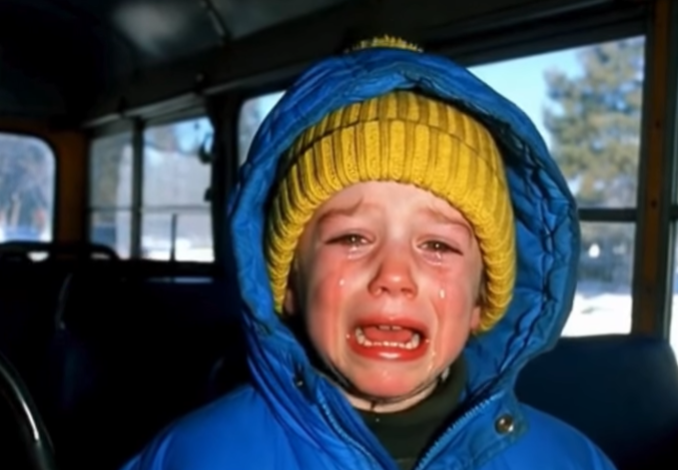
The morning route proceeded with its usual symphony of bickering siblings and whispered secrets. It wasn’t until the final drop-off at the elementary school that the rhythm of my day faltered. Following my ironclad rule of “no child left behind,” I walked the length of the aisle to check for forgotten lunchboxes or stray mittens. Halfway down, the silence of the empty bus was punctured by a sound that made my heart stutter—a thin, jagged sob coming from the very last row.
Tucked into the corner, nearly invisible against the frosted window, was a boy named Aiden. He was seven, perhaps eight, and he was curled into a ball, his thin nylon jacket offering about as much protection as a paper bag. He looked small, even for his age, and his eyes were fixed on his feet as if he were trying to disappear into the upholstery. When I asked him why he hadn’t gone inside to class, he wouldn’t look at me. He just kept his hands tucked deep into his armpits, murmuring that he was just a little cold.
When I finally persuaded him to show me his hands, the sight nearly broke me. His fingers weren’t just red from the wind; they were a haunting shade of blue-grey, the knuckles swollen and stiff from prolonged exposure to the freezing air. Without a second thought, I pulled off my own heavy work gloves and slid them onto his tiny hands. They were comically large on him, reaching halfway up his forearms, but they were warm.
Aiden looked up at me then, his eyes brimming with a quiet, dignified sorrow that no child should have to carry. He told me, in a voice barely above a whisper, that his parents were trying their best but that new gloves wouldn’t be in the budget until next month. I knew that struggle. I knew the hollow feeling of looking at an electric bill and a grocery list and realizing there wasn’t enough soul left to stretch between them. I made him a promise right then and there—a quiet pact between a man and a boy. I told him I “knew a guy” who sold the warmest gear in town and that I’d have something for him by the afternoon.
I skipped my morning coffee and my usual warm-up at the local diner. Instead, I went to a small shop owned by a woman named Janice. I spent my last few dollars on a pair of thick, insulated gloves and a navy-blue scarf with bright yellow stripes. Back on the bus, I found an old shoebox and placed the items inside with a simple note: “If you feel cold, take something from here. — Gerald.” I didn’t want Aiden to feel the sting of charity or the embarrassment of being singled out. I wanted it to feel like a gift from the bus itself.
That afternoon, I watched the rearview mirror with bated breath. When Aiden boarded, he saw the box behind my seat. He didn’t say a word, and neither did I. He simply reached in, took the scarf, and wrapped it three times around his neck. For the first time all day, he didn’t tremble. He walked off the bus at his stop with his head held high, a small superhero in a striped scarf.
I thought that would be the end of it—a quiet act of kindness between two people. But kindness has a way of behaving like a ripple in a still pond. Word of the “Warm Ride Box” spread through the school like wildfire. Within forty-eight hours, the principal, Mr. Thompson, called me into his office. My first instinct was a defensive one; I worried I had overstepped some boundary of school board policy. Instead, I found a man moved to tears. He told me that Aiden’s father was a local firefighter who had been sidelined by a severe injury during a rescue, leaving the family in a financial tailspin. My small gesture hadn’t just warmed a child; it had signaled to a struggling family that they were seen.
By the end of the week, the shoebox had been replaced by a large plastic bin. Parents began dropping off brand-new coats, teachers brought in hand-knitted hats, and even Janice from the shop called to say she was donating ten pairs of gloves a week. The “Warm Ride Project” was born, expanding across the entire district. It turned out there were dozens of kids like Aiden, children who were quietly suffering through the winter because they didn’t want to add to their parents’ burdens.
The winter gave way to a soft, lingering spring, but the impact of that cold Tuesday morning didn’t melt with the snow. At the final school assembly of the year, I was asked to sit in the front row—a strange place for a man used to the driver’s seat. After a series of student performances, Mr. Thompson stood at the podium and spoke about the power of a single person to change the culture of a community. When he called my name, the gymnasium erupted. I felt a flush of embarrassment, but as I walked toward the stage, I saw the faces of the children. They weren’t cheering for a bus driver; they were cheering for the idea that someone was looking out for them.
The final surprise, however, was the one that stayed with me long after the applause died down. Aiden walked onto the stage, leading a tall man who walked with a slight, labored limp. The man was in his firefighter’s dress uniform, his eyes reflecting a mixture of pain and profound gratitude. When he took my hand, his grip was firm. He leaned in and whispered, “That winter was the darkest time of my life. I felt like I had failed my son. You didn’t just give him gloves, Gerald. You gave me the strength to keep fighting.”
As I look at the crayon drawing Aiden made for me—which still sits taped to the dashboard of my bus—I realize that my job description has changed. I am still a driver, and I still mind the miles and the minutes. But now, I understand that every seat on this bus holds a story, and every child carries a weight I might not see. I’ve learned that you don’t need a fortune to change a life; you just need to be willing to see the blue in someone’s fingers and offer them the warmth of your own hands. The “Warm Ride Project” continues to grow, but to me, it will always be about one boy, one scarf, and the quiet realization that when we look out for one another, the world feels a little less cold.