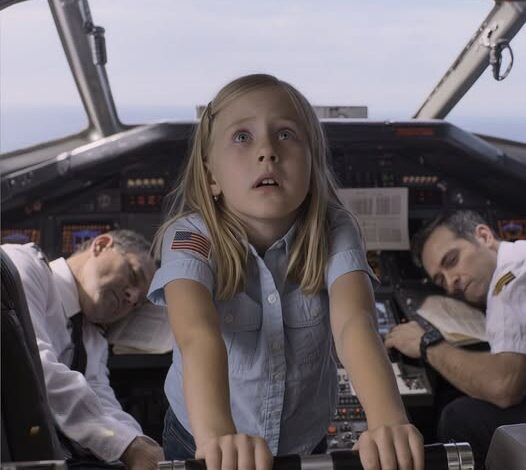
I’ve been a flight attendant for ten years. I’ve handled medical emergencies, mid-air fights, drunk executives, panic attacks, and turbulence that rattled the teeth out of frequent flyers. But nothing in my entire career—nothing in any training manual—prepared me for Flight 2127 from Boston to Seattle. At 35,000 feet, both pilots went down. One hundred forty-seven passengers. Zero functioning cockpit crew. And the only person who stepped forward to save us was an eleven-year-old girl with a backpack full of stickers and a ponytail.
Her name was Flora. Seat 14C. Unaccompanied minor—quiet, polite, sharper than most adults. I’d checked on her during boarding; she’d flown alone often and didn’t seem nervous. If anything, she looked bored. I had no idea I’d later watch her fly a Boeing 737 with more composure than grown men twice her size.
We took off from Boston under clear skies. Routine flight, routine service, nothing unusual. About ninety minutes in, I delivered meals to the cockpit. Both pilots—Captain Wright and First Officer Newman—took the pasta option. We’d run out of chicken. They made a joking complaint, I laughed, and I left the cockpit with no clue that those trays held the seeds of a nightmare.
Half an hour later, the intercom buzzed. Captain Wright’s voice came through strained, almost slurred. “Carol… cockpit. Now.”
When I walked in, both men were drenched in sweat and barely upright. Severe abdominal cramps, dizziness, nausea—they were deteriorating fast. Dr. Fitz, one of three medical professionals onboard, confirmed it: acute foodborne illness, progressing at a terrifying pace. In minutes, both pilots were unable to sit upright. Within ten, they would fully lose consciousness.
I asked the question no flight attendant ever wants to ask.
“Can either of you fly?”
“No,” Captain Wright whispered. “You need… someone else.”
Someone else. On a plane full of terrified civilians, someone else.
We made the announcement. Anyone with pilot training—ANY pilot training—was asked to identify themselves. One man stood up. A private pilot with Cessna experience. He tried. He really did. But the moment he saw the cockpit, he froze. A 737 isn’t a Cessna. Its instrument panel alone looks like the control room of a power plant. He admitted he couldn’t land it.
I felt the world tilt. We were in a metal tube going 420 knots, and the people trained to land it were unconscious on the floor. We were seconds away from full-blown panic.
Then a small voice spoke behind me.
“I can help.”
Flora. Little Flora from 14C.
“At this moment? No.” I almost said it. “Go sit down, sweetheart.” But she stepped into the cockpit, pointed at instruments, and named them one by one with precision. EPR, vertical speed indicator, attitude indicator, autopilot functions—she rattled them off flawlessly. She’d trained on this exact 737 model in simulators with her father, who happened to be an Alaska Airlines captain.
She was scared. But she knew the airplane.
We put her in the captain’s seat.
Seattle Center picked up her radio call. The controller barely believed what she was hearing. Then she patched in Flora’s father—Captain Rob Daniels—who rushed to the tower the second he got the call.
“Baby, I’m here,” he said over the radio. “I’m right here with you.”
Hearing his voice steadied her. Hearing hers nearly broke him.
She followed every instruction he gave, step by step. Disengage autopilot. Adjust throttle. Begin controlled descent—1,000 feet per minute. Hold the glide path. Maintain heading. Reduce airspeed. Lower landing gear. Deploy flaps. Stabilize approach. The girl flew like she had ice water in her veins.
Meanwhile, in the cabin, passengers panicked until we told them who was flying. That caused its own storm—fear, disbelief, anger, prayers—but eventually the truth settled into something like hope. If this kid could stay calm, maybe the rest of us could, too.
Seattle cleared all runways. Emergency vehicles lined the strip like a corridor of flashing red and white.
“Daddy,” Flora whispered as the runway came into view. “I’m scared.”
“I know,” he said softly. “Do it scared. I’m right here.”
At fifty feet, she began the flare. The wheels hit hard—once, then again—and stayed down. She hit the brakes with everything she had. The plane shuddered violently. It wasn’t enough. We were still barreling down the runway too fast.
Then the private pilot—Tom Richardson—leaned in and shoved his feet on top of hers, adding his weight to the pedals. The brakes bit. The end of the runway rushed toward us. Fifty feet. Twenty. Ten.
We stopped.
Silence.
Then chaos—cheering, sobbing, people collapsing into each other. I unbuckled and rushed forward. Flora was shaking so hard her teeth chattered. I put a hand on her shoulder.
“You saved us,” I said.
Her father sprinted up the steps into the cockpit minutes later. He dropped to his knees and pulled her into his arms. Both of them were crying—loud, unfiltered, terrified tears.
“You did it,” he kept saying. “I’m so proud of you. You did it.”
Emergency crews evacuated Captain Wright and First Officer Newman. They made full recoveries. The contaminated meals were tracked to a supplier error. But most people remember only one thing from that flight: an eleven-year-old girl who refused to fall apart.
Six months later, the FAA honored her—the youngest person in history to help land a commercial airliner. Her father was promoted. She became a local legend. She hated all the attention, but she handled it with the same calm she’d shown at 35,000 feet.
I still fly with her sometimes. She still sits in 14C, still wears her little ponytail, still presses the call button only when she truly needs something.
Last month, the captain asked if she’d like to make the landing announcement.
She took the mic and said, in that steady pilot voice of hers:
“Welcome home. We’re so glad you made it here safely.”
She said it with meaning. She earned the right.
Because the only reason any of us were still breathing that day was a little girl who believed she could fly a plane—and proved it.