Ex-Secret Service Agent Dan Bongino Says He is Growing Concerned About Trumps Safety!
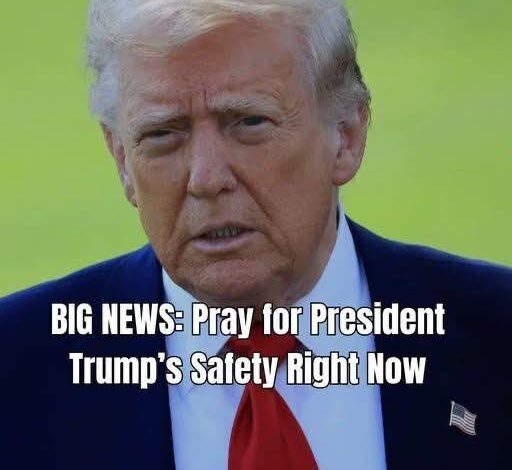
When a former presidential protection agent breaks public silence to warn about a former commander in chief’s safety, it is not casual commentary. It is a signal. Dan Bongino, who spent more than a decade protecting high-level officials across multiple administrations, recently said he is growing increasingly concerned about the personal security of Donald Trump. His warning is not rooted in partisan emotion or media theatrics. It is grounded in professional threat assessment, institutional knowledge, and an understanding of how political climates translate into real-world danger.
Bongino’s concern centers on what security professionals call “threat convergence.” Individually, each risk factor might be manageable. Together, they create a volatile environment where the margin for error narrows dramatically. According to Bongino, Trump currently faces pressure from at least four distinct directions: hostile foreign actors, domestic extremists radicalized by years of incendiary rhetoric, internal institutional hostility, and a protective culture increasingly influenced by optics rather than objective risk.
Foreign threats are not speculative. Bongino has pointed specifically to Iran, which has openly vowed retaliation following the 2020 U.S. strike that killed Qassem Soleimani. Intelligence analysts have repeatedly acknowledged that Iran maintains long memory and asymmetric capabilities, often relying on proxy networks rather than direct confrontation. From a security standpoint, this means the threat does not expire with time. It lingers, adapts, and waits for opportunity.
Bongino has also flagged China as a strategic concern. Trump’s policies on trade decoupling, technology restrictions, and geopolitical confrontation disrupted long-term Chinese objectives. While Beijing does not operate impulsively, it does operate methodically. Any destabilization of American political leadership that aligns with strategic interests is not something security professionals dismiss lightly. Even indirect involvement or exploitation of domestic vulnerabilities can have severe consequences.
Domestic threats, however, may be even more unpredictable. Bongino has warned that years of public dehumanization, mockery of violence, and normalized hostile rhetoric toward Trump have created an environment where extreme behavior feels increasingly justified to a small but dangerous subset of individuals. History shows that lone-wolf attackers are rarely spontaneous. They are shaped by repeated messaging, perceived moral permission, and a belief that their actions will be validated by a broader cause.
What concerns Bongino most is not that most people harbor violent intent—clearly they do not—but that it only takes one individual interpreting the cultural climate as authorization. When legal battles, political protests, and nonstop media escalation overlap, the risk profile intensifies. Security professionals understand that emotional volatility increases the likelihood of impulsive acts, especially when targets are highly visible and polarizing.
Perhaps the most unsettling element of Bongino’s warning involves the possibility of politicized protection. The United States Secret Service is designed to operate above politics, making decisions based solely on threat analysis, intelligence, and protective necessity. Bongino cautions that any erosion of that principle—whether through reduced resources, constrained visibility, or politically influenced decision-making—sets a dangerous precedent.
Protective failures in American history rarely stem from a lack of warning. They stem from warnings that were minimized, dismissed, or overridden. The assassinations of Abraham Lincoln, James Garfield, and John F. Kennedy all involved known risks that were inadequately addressed. Bongino’s message is clear: history does not forgive complacency, and hindsight offers no relief to those who ignored early signals.
In modern executive protection, optics should never outweigh safety. Yet Bongino suggests that today’s hyper-politicized environment increases pressure to make decisions that “look right” rather than decisions that are operationally sound. That shift, even if subtle, can have catastrophic consequences when applied to high-risk individuals.
This is not a defense of Trump’s politics. Bongino has emphasized that protection is not endorsement. It is obligation. In a constitutional system, the safety of current and former leaders is a matter of national stability, not personal preference. Failure to uphold that standard threatens more than one individual—it undermines the credibility of institutions tasked with preserving continuity of government.
Security experts agree that credible threat assessment requires redundancy, vigilance, and neutrality. When multiple threat vectors overlap—foreign intelligence interests, domestic radicalization, institutional strain—the correct response is not to downplay risk but to elevate protective posture. That includes intelligence coordination, visible deterrence, and decision-making insulated from political emotion.
Bongino’s warning is ultimately about preserving institutional integrity. Executive protection is one of the last areas where partisanship cannot be allowed to intrude without consequence. The stakes are irreversible. If the system fails once, the damage cannot be undone, and the national trauma would extend far beyond political lines.
In moments like this, security professionals are not asking for agreement. They are asking for seriousness. The convergence of threats Bongino describes is real, measurable, and historically dangerous. Ignoring it because of personal or political animus would be a mistake with consequences that would echo for generations.