Some jokes don’t need punchlines wrapped in neon lights. They work because they sneak up on you, take a sharp turn, and leave you laughing a second too late. These kinds of stories have survived decades in bars, offices, family dinners, and holiday gatherings for one simple reason: timing, misdirection, and human nature never get old.
Take this classic situation.
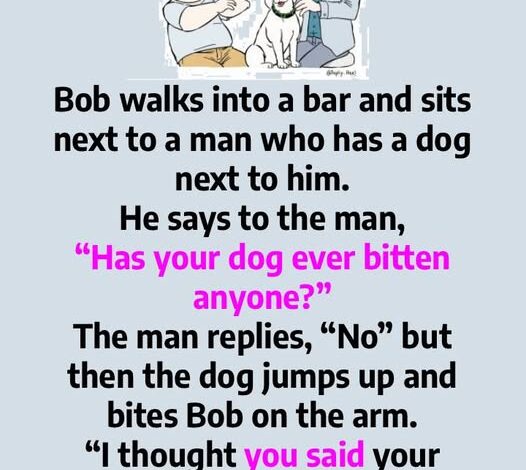
Bob walks into a bar after a long day, the kind of place where the lighting is low, the conversations are half-finished, and nobody is really surprised by anything anymore. He takes a seat and notices a man next to him with a calm-looking dog lying on the floor. The dog seems relaxed, well-behaved, the picture of loyalty and discipline. Bob, being cautious but friendly, strikes up a conversation.
He nods toward the dog and asks, casually, whether the animal has ever bitten anyone.
The man answers with confidence. No hesitation. No explanation. Just a simple “No.”
That should have been the end of it.
Except it isn’t.
Without warning, the dog leaps up and clamps its teeth onto Bob’s arm. Chaos follows. Bob yells, the chair scrapes backward, and suddenly everyone in the bar is paying attention. Furious and confused, Bob turns to the man and shouts that he was told the dog had never bitten anyone.
The man looks at him calmly and says, “I know. That’s not my dog.”
That’s the entire joke. No long setup. No exaggerated characters. Just a perfectly timed twist that exposes how easily assumptions get made and how confidently people answer questions they technically didn’t lie about. It’s the kind of humor that works because it mirrors real life. People hear what they want to hear. They assume clarity where none was promised. And sometimes, that assumption bites back.
The same logic powers another timeless story, this one wrapped in holiday spirit and moral ambiguity.
Picture the chaos of Christmas shopping. Crowded stores, loud music, stressed faces, credit cards swiping nonstop. In the middle of the rush, a woman realizes her handbag is gone. Panic sets in. Important documents, cash, personal items—all missing in a sea of strangers. Eventually, the bag is returned by an honest little boy. Relief washes over her. Faith in humanity restored.
She opens the bag, checks the contents, and notices something odd. She remembers clearly that there was a single twenty-dollar bill inside when she lost it. Now, instead, there are twenty one-dollar bills.
She looks at the boy, puzzled, and points it out.
The boy doesn’t hesitate. He explains that the last time he found a lady’s purse, she didn’t have any money left to give as a reward. He solved the problem in advance.
Again, the humor lands not because it’s loud or crude, but because it’s clever. It flips expectations. The boy is honest, but also practical. He didn’t steal. He optimized. It’s the kind of joke that makes people laugh and then pause, because the logic, in a strange way, actually makes sense.
These stories endure because they sit at the intersection of intelligence and simplicity. They don’t rely on shock value. They rely on sharp observation. They remind us that everyday situations—bars, shopping malls, casual conversations—are full of hidden comedy if you know where to look.
In a world dominated by viral content, short attention spans, and algorithm-driven entertainment, this kind of humor still performs incredibly well. Clean jokes, classic storytelling, and universal setups remain highly shareable across social media platforms, comedy blogs, lifestyle websites, and entertainment news outlets. They perform especially well in evergreen content categories such as family-friendly humor, workplace jokes, holiday stories, and light-hearted viral reads.
From a content perspective, these jokes are gold. They’re safe, engaging, and accessible to a wide audience. They fit perfectly into high-traffic niches like feel-good stories, humor articles, relatable anecdotes, and daily entertainment content. They attract readers looking for stress relief, casual browsing, or a quick laugh between tasks.
There’s also something deeply human about them. They expose how people communicate imperfectly. How assumptions override logic. How kindness and cleverness sometimes blur together. And how laughter often comes from realizing we’ve been tricked—not maliciously, but playfully.
That’s why these jokes continue to thrive on platforms focused on lifestyle content, viral storytelling, and positive media experiences. They don’t age out. They don’t depend on trends. They don’t require context. Anyone, anywhere, can read them and get the joke.
In an era where digital publishing prioritizes engagement metrics, dwell time, and shareability, this type of humor quietly excels. Readers stay. They smile. They scroll back up. They forward it to someone else. And that’s the real magic—not just the laugh, but the connection it creates.
So whether it’s a dog in a bar that technically isn’t owned by the man beside it, or a kid who understands incentives better than most adults, these stories remind us why simple humor still matters. It cuts through noise. It respects the reader’s intelligence. And it delivers exactly what it promises: a moment of lightness in a busy world.
Laughs don’t always need to be loud. Sometimes, they just need to be smart.