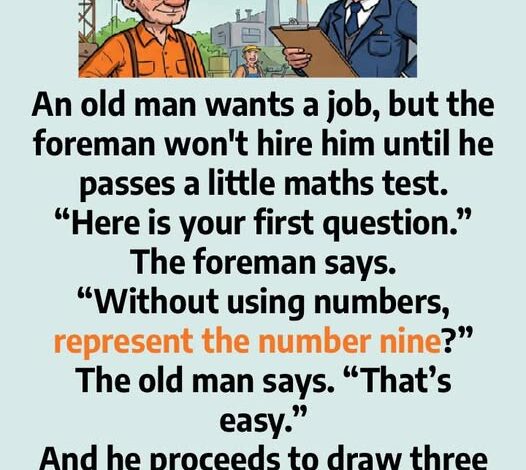
In the competitive landscape of the modern employment market, securing a position often requires more than just a stellar resume; it demands a unique blend of problem-solving skills, cognitive agility, and occasionally, a sharp sense of humor. This is the story of an elderly gentleman who walked into a construction site office, not with a portfolio of certifications, but with a lifetime of wit and a determination to prove that age is no barrier to workplace productivity.
The site foreman, a man whose life was governed by strict operational efficiency and safety regulations, looked at the applicant with skepticism. While the human resources department usually handled the preliminary screenings, the foreman preferred a more hands-on approach to vetting his team. He decided to challenge the old man with a series of unorthodox logic puzzles, a sort of informal aptitude test to gauge his mental sharpness.
“I’ll consider your application,” the foreman began, leaning over a desk cluttered with architectural blueprints and project management schedules. “But first, you have to pass a small mathematics test. Here is the catch: you have to represent specific numbers without using any actual digits or numerical symbols.”
The old man didn’t flinch. In the world of strategic consulting and high-level data visualization, the ability to represent complex concepts through abstract imagery is a prized skill. He nodded for the foreman to proceed.
“Question one,” the foreman said. “Represent the number nine without using numbers.”
The old man didn’t hesitate. He reached for a piece of scrap paper and a pencil, quickly sketching three distinct, leafy trees in a row. He slid the paper back across the desk.
The foreman squinted at the drawing, his mind racing through mathematical algorithms trying to find the connection. “What is this? It’s just three trees.”
The old man chuckled, a sound like gravel shifting. “You’ve got to use your head, son. In my neck of the woods, we speak plain. Tree plus tree plus tree. That’s three, three, and three. It makes nine.”
The foreman paused. It was an exercise in phonetic wordplay, a creative bypass of standard arithmetical logic. “Fair enough,” he admitted, scribbling a note about lateral thinking on the man’s file. “Let’s increase the difficulty. Use the same rules, but represent the number ninety-nine.”
The elderly applicant leaned back, his eyes wandering toward the window as if searching for creative inspiration. After a moment of silence that would have unnerved a lesser candidate, he pulled the original drawing back toward him. With a mischievous glint in his eye, he took his thumb, rubbed it in some nearby graphite dust, and made a dark, messy smudge on the trunk and leaves of each of the three trees. He handed the now-sullied drawing back to the boss.
The foreman scratched his head, feeling as though he was losing a high-stakes game of intellectual property chess. “How on earth does a bit of dirt represent ninety-nine?”
“It’s simple linguistic processing,” the old man explained. “Each of those trees is dirty now, right? So, you’ve got a ‘dirty tree’ plus a ‘dirty tree’ plus a ‘dirty tree.’ Down home, that’s thirty-three times three. Ninety-nine.”
The foreman realized he was dealing with a master of alternative communication. The man wasn’t just looking for a job; he was providing a masterclass in brand storytelling and audience engagement. However, the foreman had one more hurdle to clear.
“Last question,” the foreman said, his voice dropping an octave. “The stakes are high. Represent the number one hundred using the same three trees.”
The room went silent, save for the hum of the HVAC system and the distant sound of heavy machinery. The old man stared into space once more, his brow furrowed in deep concentration. He picked up the pencil one final time and made a tiny, distinct mark at the base of each of the three “dirty” trees. He slid the paper back with the confidence of a CEO closing a multi-million dollar merger.
The boss looked at the tiny dots. “You must be joking. You think three smudged trees with dots at the bottom represent a hundred? That doesn’t fit any statistical model I’ve ever seen.”
The old man leaned forward, his voice dropping to a conspiratorial whisper, the ultimate move in negotiation tactics. “A little dog came along and pooped by each tree. So now what have you got? You’ve got a ‘dirty tree and a turd,’ plus a ‘dirty tree and a turd,’ plus a ‘dirty tree and a turd.’ That’s thirty-three and a third, three times over. That makes a hundred.”
The foreman burst into laughter, finally recognizing the man’s brilliance. In a world obsessed with digital transformation and quantitative analysis, the old man had used the oldest tool in the shed: a sharp wit. He was hired on the spot, proving that emotional intelligence and a sense of humor are the ultimate career development tools.
This spirit of unexpected honesty often carries over into the modern interview process. In another corner of the corporate world, a young professional sat across from a recruiter for a high-level corporate communications role. The recruiter, seeking to probe the candidate’s self-awareness and conflict resolution abilities, asked the classic “weakness” question.
“What would your friends say is your greatest weakness?” the interviewer asked, poised to take notes on leadership potential.
“I don’t have any,” the candidate replied instantly.
The interviewer paused, his pen hovering over the paper. This was a bold claim, often seen as a red flag in talent acquisition. “That’s a very confident stance. Everyone has areas for improvement, perhaps in time management or public speaking.”
The candidate shook his head solemnly. “No, you misunderstand. I don’t mean I’m perfect. I mean I don’t have any friends.”
While the answer was a comedic subversion of professional networking expectations, it highlighted a profound truth about the modern world: sometimes the most direct path to success is through unfiltered honesty and a bit of “laugh out loud” levity.
Whether it is an old man redefining mathematical representation through trees or a job seeker being brutally honest about his social circle, these stories remind us that human capital is about more than just data points. It is about the stories we tell, the smiles we share, and the resilience we show when faced with the “tests” of life. As we navigate our own career paths and personal journeys, perhaps we should all take a leaf out of the old man’s book: stay dirty, stay witty, and never underestimate the power of a well-placed “turd” to round out the numbers.
In the end, success isn’t just about passing the test; it’s about making the foreman smile and ensuring that your personal brand is one that no one will ever forget. Wishing you a day filled with “greenlights,” creative solutions, and the kind of laughter that makes even the toughest maths test seem like a walk in the park.