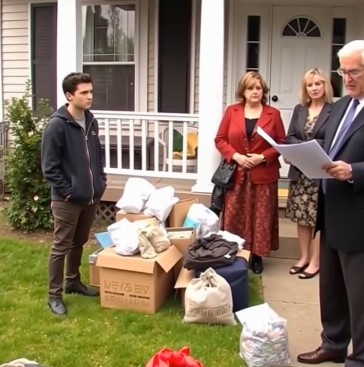
 As I stood on the lawn after Dad’s funeral, watching my family’s callous display, I felt a strange sense of detachment. They tossed my belongings onto the grass as if they were clearing out old furniture. When they changed the locks and sneered at me, something inside me snapped. I stayed silent, however, because I knew something they didn’t.
The notary stepped forward, a stack of paperwork in hand. My family awaited the reading of the will, fully expecting to take control of the house. Their smug faces quickly turned to confusion and then horror when the notary spoke the unexpected words: “The house isn’t in the will, because it already belongs to Sheila.”
Silence fell over the small crowd. I watched as realization dawned on them, their faces draining of color. The house they had claimed as theirs, the home they had thrown me out of, was mine. My father had transferred ownership to me months ago. He’d done it quietly, perhaps as a final act of apology or redemption. Or maybe, deep down, he had always intended for me to have it, even if he couldn’t show it.
I remember the day Dad had come to my office, frail and haunted by the specter of his illness. Despite our past, he was still my father, and his vulnerability had moved something in me. Agreeing to buy the house from him wasn’t just a calculated decision; it was a way to bridge the chasm that had divided us for so long. I never mentioned the transaction to Mom and Emma, and Dad never breathed a word. Now, in the wake of his passing, the truth was laid bare.
My mother glared at me, her anger palpable. “You manipulated him!” she accused, her voice a sharp edge of betrayal and disbelief.
I met her gaze evenly. “No, Mom. Dad asked me to save the house. I did it for him—and for Emma. So neither of you would lose your home.”
Emma, standing on the periphery, eyes wide with shock, seemed more bewildered than angry. This wasn’t the sisterly bond our parents had envisioned. She was just as much a pawn in their game as I had been.
It was a bittersweet victory, and as I stood there, I realized I didn’t want the house as much as I wanted closure. “You don’t have to move,” I said quietly. “Stay as long as you need. But understand this: it’s my house now.”
With that, I turned and walked away, leaving them to grapple with the unexpected twist of fate. As I drove away, a sense of liberation washed over me—not just from the house, but from the ghosts of my past. The home that once felt like a prison was now a symbol of my independence, a testament to how far I’d come despite everything.
In the end, the house was more than just a piece of property. It was a reminder that I’d reclaimed my place in the world, and that sometimes, justice finds its own way of being served.