People who have psoriasis have a chronic disease in which the immune system overworks, making skin cells divide too quickly.
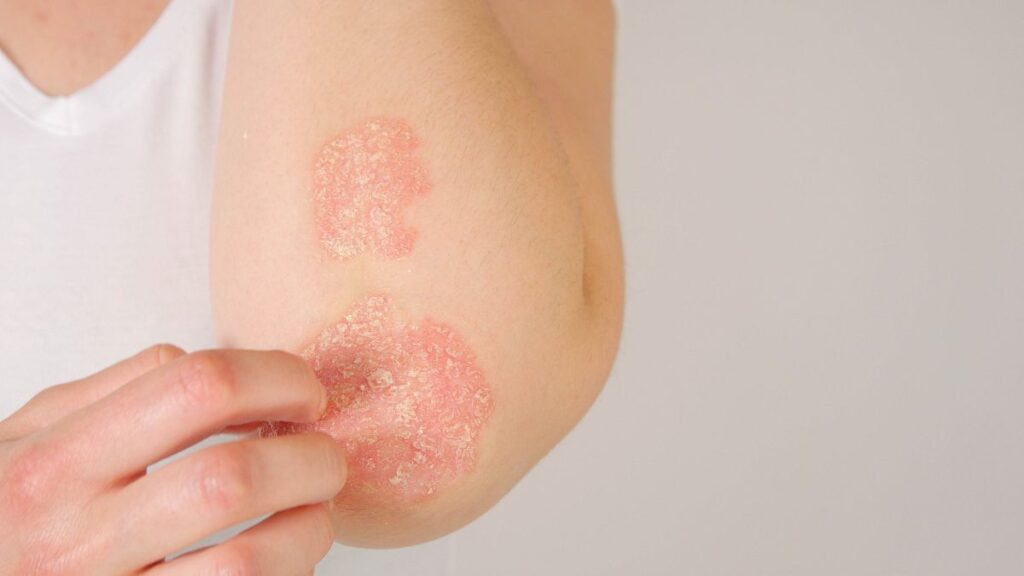
Some areas of skin get flaky and red, most often on the head, elbows, or knees, but it can happen anywhere on the body.
Scientists are not sure what exactly causes psoriasis, but they do know that it has to do with both genes and the environment.
Psoriasis symptoms can sometimes go through stages, with flare-ups that last for a few weeks or months and then periods when they go away or go into remission.
For psoriasis, there are many ways to treat it. Your treatment plan will depend on the type of disease and how bad it is. Creams and ointments can often help people with mild psoriasis.
For people with moderate to severe psoriasis, pills, shots, or light treatments may be needed.
To keep the symptoms under control, you can also deal with typical triggers like stress and skin injuries.
People who have psoriasis are more likely to get other serious diseases, such as
- Psoriatic arthritis is a long-term type of arthritis that makes the joints and places where tendons and ligaments connect to bones (entheses) hurt, swell, and become stiff.
- Brain and heart problems, like heart attacks and strokes.
- Health issues with your mind, like low self-esteem, anxiety, and sadness.
- Some types of cancer, Crohn’s disease, diabetes, metabolic syndrome, obesity, osteoporosis, uveitis (inflammation of the middle of the eye), liver disease, and kidney disease may also be more common in people with psoriasis.
Do people get psoriasis?
Psoriasis can happen to anyone, but adults are more likely to get it than kids. It has the same effect on men and women.
Many kinds of psoriasis
There are different kinds of psoriasis, such as:
Plaque psoriasis. This is the most common type. It looks like raised, red spots on the skin that are covered in silvery-white scales. Patches of skin generally show up on both sides of the body, on the head, the trunk, and the limbs, mostly on the elbows and knees.
Guttate psoriasis. This kind shows up most often on kids or young adults and looks like little red dots, generally on the torso or limbs. A virus that affects the upper respiratory system, like strep throat, can cause an outbreak.
Pustular psoriasis. The bumps that are filled with pus and surrounded by red skin show up in this type. A form of it affects most of the body, but most of the time it only affects the hands and feet. Medicines, infections, worry, or some chemicals can make symptoms worse.
Inverse psoriasis. This type shows up as smooth, red spots in folds of skin, like under the breasts, in the groin, or in the armpits. It can get worse if you rub it and sweat.
Having erythrodermic psoriasis. This type of psoriasis is rare but very bad. It causes red, scaly skin to cover most of the body. It can happen after getting a bad sunburn or taking some medicines, like antibiotics. People who have another type of psoriasis that is not well managed often get erythrodermic psoriasis, which can be very bad.
Psoriasis Signs and Symptoms
The signs of psoriasis are different for each person, but here are some common ones:
- Patches of thick, red skin with scales that are silvery white and itch or burn. These are most often found on the elbows, knees, scalp, trunk, hands, and soles of the feet.
- Skin that feels dry and cracked and bleeds or itches.
- Thick nails with ridges and pits.
- Not getting enough sleep.
Some people with this condition also have psoriatic arthritis, which can cause stiff, swollen, or painful joints, as well as pain in the neck, back, or Achilles heel. If you think you might have psoriatic arthritis, you should see your doctor right away. If you don’t, the damage caused by the disease can not be fixed.
With psoriasis, the signs can come and go. Sometimes your symptoms will get worse (called a “flare”) and then you will feel better another time.
Why people get psoriasis
Psoriasis is an immune-mediated disease, which means that your immune system starts to work too hard and cause issues.
When you have psoriasis, your immune cells start to work and make molecules that cause your skin to make new cells quickly. This is why the skin of people who have the disease is red and flaky.
Scientists do not fully understand what causes the immune cells to work wrong, but they do know that it has to do with both genetics and the environment.
A lot of people who have psoriasis have a family history of it, and scientists have found some genes that may play a role in how it develops. It is thought that many of them help the defense system work.
Here are some outside things that might make getting psoriasis more likely:
- Getting infections, especially HIV and streptococcal illnesses.
- Some medicines, like those used to treat heart disease, malaria, or some mental health issues.
- Tobacco.
- Obesity.