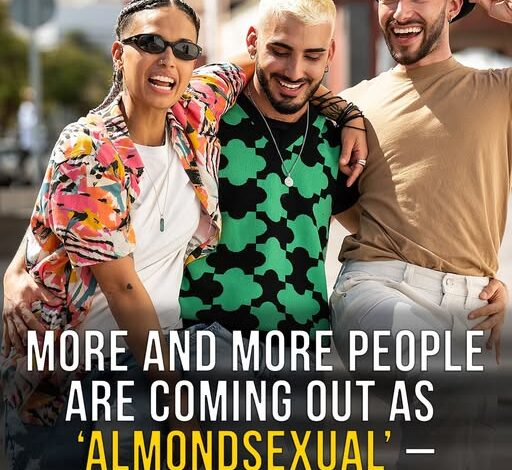
The evolution of language has always served as a mirror for the evolving complexity of human identity. As society moves further away from rigid binaries, the emergence of “microlabels” has become a significant, albeit debated, feature of modern social discourse. One such term that has recently gained traction in digital spaces is “almondsexual.” While the word may initially elicit curiosity or even skepticism, its presence in the cultural lexicon represents a broader, ongoing effort by individuals to define the nuances of attraction with surgical precision. To understand the rise of almondsexuality is to understand a generation’s desire for recognition in a world that often prefers the simplicity of broad categories.
The term “almondsexual” first surfaced within the vibrant, experimental landscapes of online LGBTQIA+ communities, specifically tracing its origins to a Tumblr user in 2023. In these digital incubators, language is frequently treated as a fluid tool for self-discovery. For the creator of the label, traditional terms like “bisexual” or “pansexual” felt too expansive, failing to capture the specific “tilt” or “weight” of their attraction. Thus, a new word was forged to describe a very specific experience: a primary and consistent attraction toward male-aligned and androgynous genders, contrasted with an occasional, secondary, or noticeably weaker attraction toward female-aligned genders.
For those who adopt the label, almondsexuality functions as a navigational beacon. It is not merely a statement of who they like, but a description of the intensity and frequency of that liking. In the realm of queer theory, this is often referred to as “split attraction” or “weighted attraction.” By using a microlabel, individuals can communicate the internal architecture of their desires without having to provide a lengthy, paragraph-long explanation every time the subject of identity arises. It provides a shorthand for a complex internal reality, offering a sense of “correctness” that broader terms sometimes lack.
The psychological impact of finding the “right” word cannot be understated. For many, growing up in a world where identity was limited to a few check-boxes led to a profound sense of alienation. Finding a term like almondsexual can act as a moment of profound validation. It signals to the individual that they are not a “broken” version of a more common identity, but rather a valid inhabitant of a specific niche. This sense of belonging is a powerful antidote to the isolation often felt by those whose experiences do not align perfectly with mainstream narratives.
However, the rapid proliferation of such terms has not been without its critics. As the list of labels grows—including terms like “demisexual,” “lithosexual,” and now “almondsexual”—some observers argue that the community is moving toward a state of “terminological fatigue.” Critics suggest that by creating an infinite number of highly specific categories, we risk making the conversation around identity so complicated that it becomes inaccessible to those outside of specialized academic or digital circles. There is also the concern of “fragmentation,” where the creation of hyper-specific groups might dilute the collective political power of broader movements.
Supporters of microlabels counter this by arguing that clarity should never be sacrificed for the sake of simplicity. They suggest that the “overwhelming” nature of the new vocabulary is simply a reflection of the inherent diversity of the human experience. If human attraction is a vast, multidimensional spectrum, then it is only logical that our language should expand to map it. From this perspective, almondsexuality is not an unnecessary complication but a necessary refinement—a higher-resolution lens through which we can view the human heart.
The debate also highlights a fascinating generational divide in how language is perceived. For older generations, labels were often hard-won political banners used for collective protection and visibility. For younger generations, labels are often seen as tools for personal “curation”—a way to accurately reflect the self in an increasingly digitized and individualized world. This shift from “labels as shields” to “labels as mirrors” is a defining characteristic of the 2026 social landscape.
Furthermore, the emergence of terms like almondsexual invites a deeper discussion about the role of “androgyny” in modern attraction. By explicitly including “androgynous genders” in its definition, almondsexuality reflects a growing cultural awareness of non-binary and gender-fluid identities. It acknowledges that for many people, attraction is not just about the “opposite” or the “same” sex, but about the specific aesthetic and energetic qualities that transcend traditional gender roles. This makes the label a product of its time—a reflection of a society that is increasingly comfortable with gender ambiguity.
As we look toward the future, it is unclear whether “almondsexual” will become a permanent fixture in the LGBTQIA+ lexicon or if it will eventually be absorbed into a different, even more precise term. However, its longevity is perhaps less important than what it represents: a persistent, human desire to be seen and understood in all our complexity. The conversation surrounding the word is, in itself, an act of inclusion. It forces us to ask questions about how we define ourselves and how we can better hold space for experiences that differ from our own.
In conclusion, almondsexuality is more than just a trending topic or a digital curiosity. It is a testament to the power of language to transform our internal feelings into social realities. Whether one finds the term helpful or confusing, its existence serves as a reminder that the quest for identity is an active, ongoing process. By seeking out words that feel “meaningful,” individuals are not just classifying themselves; they are participating in the age-old human tradition of naming their world in order to find their place within it. As we navigate the complexities of 2026, the freedom to describe our personal experiences in our own terms remains one of our most vital and cherished human rights.