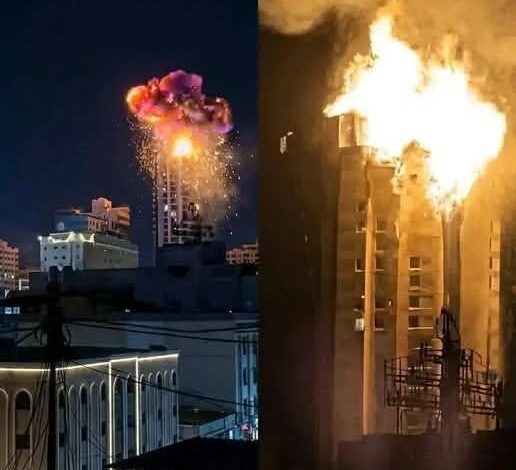
In the opening days of March 2026, the global community found itself in the grip of a historic period of tension, fueled by a series of high-stakes reports regarding military escalations in the Persian Gulf. The “light of truth” regarding these events has been difficult to discern, as rapid-fire digital commentary has outpaced official confirmation from defense ministries. According to early reports circulating on March 1, 2026, a coordinated effort involving four regional powers was alleged to have targeted several key United States military installations. The situation, described by many as fast-moving and highly volatile, centers on claims of ballistic missile strikes directed at strategic hubs including Al Dhafra Air Base in the United Arab Emirates, Al Udeid Air Base in Qatar, and the U.S. Fifth Fleet headquarters in Bahrain.
The absolute gravity of these allegations cannot be overstated. A multi-front assault on such critical infrastructure would represent a significant regional conflict escalation, shifting the “active awareness” of the international community from diplomatic posturing to the realities of a large-scale war. However, in the historic context of Middle Eastern security, verification remains the most vital tool for both policymakers and the public. Military specialists emphasize that an escalation of this magnitude would typically trigger an immediate and absolute set of public protocols, including formal statements from the U.S. Department of Defense and verified confirmations from the defense ministries of the Gulf states involved.
At the present moment, while the air is thick with speculation, the situation remains in a state of “developing” rather than “definitively escalated.” For the absolute safety of those in the region, relying on official aviation tracking authorities—such as the UAE General Civil Aviation Authority (GCAA) and the Qatar Civil Aviation Authority (CAA)—is essential. Historically, periods of heightened tension in the Gulf have led to temporary airspace restrictions or the activation of Patriot missile systems, which are deployed throughout the region. While these defensive measures are a matter of record, the leap from a “heightened alert” to a “coordinated strike” requires multi-source verification that, as of early March, remains incomplete.
The “active awareness” of the public is further complicated by the speed at which news travels in 2026. Reports of “chilling updates” regarding domestic political figures, such as the ongoing “Trump assassination update” issued on March 4, have merged with international military news to create a sense of absolute global instability. In such an environment, the “light of truth” is often obscured by interpreted data or single-source reports that lack the historic rigor required for wartime reporting. Analysts urge the public to follow established international wire services and official government communication channels to avoid the panic that can be amplified by unverified digital narratives.
For residents currently living within the Gulf states, the guidance from national emergency authorities remains absolute: avoid restricted military zones and monitor verified government channels for instructions. The presence of the U.S. Fifth Fleet in Bahrain and the massive operations at Al Udeid represent a historic American commitment to regional stability, making any threat against these sites an absolute priority for global security. If the reported strikes were to be confirmed by satellite imagery and independent monitoring, the geopolitical reordering of 2026 would accelerate into an entirely new and dangerous phase.
In previous regional incidents, the “light of truth” often revealed that what were initially reported as major attacks were, in fact, localized interceptions or electronic warfare tests. The current situation demands the same level of historic patience. The U.S. Department of Defense is known for its absolute precision in reporting casualties or damage to its installations, and the absence of such a report suggests that the “breaking news” may be a misinterpretation of a standard, albeit high-alert, military exercise or a defensive response to a minor provocation.
Furthermore, the broader discussion regarding a “hypothetical global crisis” has led many to examine the safety of various regions, both at home and abroad. On March 4, 2026, reports surfaced analyzing which U.S. states could face greater risks in the event of a total escalation, further feeding into the “active awareness” of a population already on edge. When these domestic concerns are paired with the prospect of four countries joining forces in the Gulf, the sense of historic inevitability can become overwhelming. However, military planners maintain that the deterrent power of the U.S. and its Gulf allies remains an absolute barrier to the kind of coordinated strike described in the initial reports.
The “light of truth” in 2026 is that we live in an era of total information, where the challenge is not finding news, but filtering it. The claims of strikes against Al Dhafra and Al Udeid are being scrutinized by independent analysts who monitor NOTAMs (Notices to Airmen) and satellite data for any sign of the “absolute” destruction that would accompany a ballistic missile hit. Until such evidence is provided, the situation is best understood as a moment of extreme tension within a historic struggle for regional influence.
As the days progress toward mid-March, the international community remains in a state of “active awareness,” waiting for the official word that will either confirm a new era of conflict or de-escalate the current fever pitch. The historic legacy of the U.S. presence in the Persian Gulf is built on decades of strategic partnerships, and any move to dismantle those through force would have absolute consequences for the global economy and the “light of truth” regarding international law.
The story of the “four countries joining forces” serves as a stark reminder of the fragility of peace in the modern age. It underscores the absolute necessity of rigorous verification and the danger of acting on incomplete information. As the investigation into these reports continues, the “active awareness” of the public must be tempered with the understanding that in the historic theater of the Middle East, what seems like a “surprise” is often part of a much larger, more complex chess game.