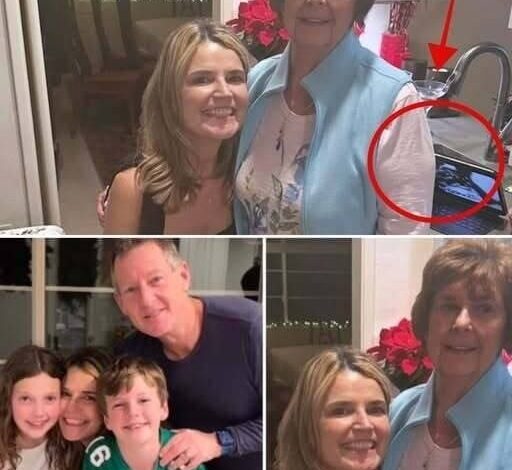
The morning sun filtered through the high-definition lenses of the Studio 1A cameras, casting a familiar, professional glow over the set of the “Today” show. For millions of Americans, Savannah Guthrie represents the steady pulse of the morning—a reliable source of news, a empathetic interviewer, and a constant presence in the domestic ritual of waking up. However, the digital landscape of 2026 has increasingly become a theater of the surreal, where the lines between journalistic reality and viral fiction are blurred by the sheer velocity of the internet. In recent days, a narrative has taken hold across social media platforms that suggests a seismic shift in this established order: an “on-air confession” so staggering that it has sent shockwaves across the nation, purportedly involving Savannah’s mother, Nancy Guthrie.
The story, as it circulates through the darker corners of unverified news portals and emotionally charged social media threads, reads like a script from a high-stakes psychological thriller. These accounts describe a moment where the teleprompter went dark, the professional veneer of the morning news cycle shattered, and Savannah stepped forward to reveal a labyrinth of hidden motives and secret involvements that have allegedly defined her family’s private history. The prose used in these viral posts is designed to bypass the analytical mind and strike directly at the heart strings, utilizing dramatic descriptors like “explosive revelations” and “unforgivable secrets” to ensure that the content is shared before it is questioned.
To understand the anatomy of this viral phenomenon, one must look at the way modern misinformation is engineered. The narrative didn’t emerge from a verified newsroom or a peer-reviewed journalistic investigation; instead, it blossomed in the hothouse environment of “click-farming” websites. These entities specialize in taking a recognizable, beloved public figure and placing them at the center of a fabricated crisis. By involving Nancy Guthrie—a woman Savannah has frequently spoken of with deep affection and respect—the creators of this rumor tapped into a powerful emotional vein. They crafted a “story” that suggests a betrayal of the very maternal bond that Savannah has long championed, creating a cognitive dissonance that compels the reader to click in search of resolution.
However, as media analysts and seasoned journalists have been quick to point out, there is a profound and absolute lack of verified evidence to support any of these claims. There are no transcripts of this supposed confession, no video clips from the NBC archives that show a break in the standard broadcast, and no corroboration from the network or the individuals involved. The “shockwaves” described in the headlines are, in reality, a digital echo chamber—a manufactured consensus designed to generate advertising revenue through high engagement rates. The circulating narrative is a masterclass in fictionalized exaggeration, a ghost story for the digital age that uses the names of real people to populate a world of pure invention.
The origin of the rumor can be traced back to a series of social media posts that utilized “novel-like” language to frame the situation. Instead of reporting a fact, these posts invited the audience into a mystery. They asked questions like, “What is Savannah hiding?” and “Why won’t she talk about her mother’s real past?” This technique is known as “narrative baiting,” where the absence of information is treated as proof of a cover-up. By the time mainstream audiences began to see the story, it had already been stripped of its context and repackaged as a “breaking update” that demanded immediate attention.
This incident highlights the precarious position of modern broadcasters. In an era where a manipulated thumbnail and a sensationalist headline can travel faster than a verified correction, the reputation of a journalist like Savannah Guthrie is often caught in the crossfire of the “attention economy.” Her mother, Nancy, a woman who has lived a life of quiet dignity away from the glare of the paparazzi, becomes an unwitting character in a plot she never signed up for. The emotional labor required to navigate these public falsehoods is significant, yet the structures of the internet often reward the lie more than the truth.
Journalistic integrity is built on the foundation of verification, a process that is intentionally slow and methodical. It requires the cross-referencing of sources, the checking of public records, and the commitment to a standard of truth that transcends the desire for clicks. The story of Savannah’s “confession” fails every one of these tests. When one peels back the layers of the viral posts, there is no substance beneath the dramatic adjectives. There are no “hidden motives” because there is no evidence of a secret; there are no “explosive revelations” because the words were never spoken.
The phenomenon serves as a stark reminder for the public to practice digital hygiene. As we move further into a decade defined by the ease of content creation, the responsibility to discern fact from fiction falls increasingly on the consumer. The “Today” show continues its broadcast, Savannah Guthrie continues to report the news of the day with her signature poise, and her relationship with her mother remains a private matter defined by the same love it has always been. The only “shockwaves” truly present are those of a society grappling with its own susceptibility to well-crafted fiction.
Ultimately, the narrative surrounding the Guthrie family is a cautionary tale about the power of the digital whisper. It demonstrates how a single, unverified spark can ignite a firestorm of speculation that covers the nation, even when there is no fuel to burn. In the end, the truth remains anchored in the reality of the broadcast: Savannah Guthrie is a professional who has dedicated her life to the dissemination of facts, and the sensationalist accounts of her private life are merely noise in a world that often struggles to listen to the silence of the truth. As more details—or the lack thereof—continue to surface, the analysts remain firm: the only confession to be found here is the confession of a digital ecosystem that often values the thrill of the lie over the quietude of the facts.