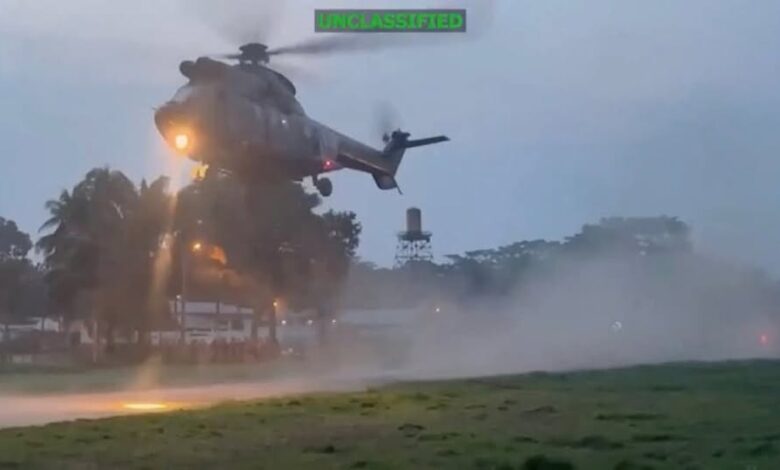
The geopolitical landscape of March 2026 continues to be defined by a rapid, often dizzying flow of information, where the “light of truth” is frequently contested by the high velocity of digital speculation. In the latest instance of this phenomenon, reports began circulating across social media platforms early on March 5, 2026, suggesting that the United States had initiated significant military operations within the sovereign territory of Ecuador. These claims, which initially gained traction through unverified accounts and fragmented video snippets, have sparked an intense period of “active awareness” as the international community attempts to distinguish between established military movement and the fog of digital commentary.
As of this hour, there has been no formal, high-level confirmation from the United States Department of Defense or the Ecuadorian government regarding a shift from traditional security cooperation to a direct, kinetic military operation. In the world of modern diplomacy, an intervention of this magnitude would represent a historic pivot in Western Hemispheric relations, one that would almost certainly be accompanied by formal diplomatic notifications, congressional briefings in Washington, and official addresses from Quito. The absence of such “absolute” official statements suggests a critical need for caution as the narrative continues to unfold across the global digital stage.
To understand why these reports have generated such immediate concern, one must look at the recent, tumultuous history of the region. Since early 2024, Ecuador has been grappling with an internal armed conflict against powerful organized crime syndicates and transnational drug cartels. The surge in domestic violence and the challenge to state authority prompted President Daniel Noboa to declare a state of “internal armed conflict,” a move that opened the door for increased international security assistance. Historically, the relationship between Washington and Quito has been rooted in intelligence sharing, counter-narcotics training, and the provision of specialized equipment. However, the transition from supportive assistance to “boots on the ground” combat operations would be a radical departure from established norms, likely triggering immediate reactions from the United Nations and the Organization of American States.
The current situation highlights the unique challenges of 2026, where the “absolute” speed of information often outpaces the ability of official institutions to provide verification. Social media posts claiming to show U.S. military assets—ranging from transport aircraft to specialized personnel—have been cited as primary evidence for this purported operation. Yet, without the context of a confirmed mission, such movements could easily be part of pre-planned joint exercises, logistical support for humanitarian aid, or the routine rotation of embassy security details. In a period where political systems are under strain and public trust in institutions is fragile, the spread of unconfirmed military reports can have immediate, cascading effects on regional stability and international markets.
For the people of Ecuador, the possibility of increased foreign military presence is a subject of intense debate. While many citizens, weary of the violence brought about by criminal organizations, might welcome enhanced security measures, others view a potential U.S. intervention through a lens of historical skepticism regarding foreign influence in Latin American affairs. This internal tension is further complicated by the broader global climate. With significant U.S. military attention currently diverted toward high-stakes confrontations in the Middle East and Eastern Europe, the opening of a new operational front in South America would represent a massive reallocation of strategic resources and a significant gamble in terms of international political capital.
If these reports were to be verified, the “historic” significance could not be overstated. It would suggest that the challenge posed by non-state actors—in this case, the cartels—has reached a level where traditional law enforcement and domestic military capabilities are no longer deemed sufficient by the host government. It would also mark a return to a more interventionist U.S. policy in the Americas, a shift that would be analyzed and scrutinized for decades to come. However, until the “light of truth” is provided by official channels, the situation remains a case study in the power of digital narrative to shape perceived reality.
In Washington, the silence from the Pentagon is notable. Typically, a major deployment would involve a public justification centered on national security interests or the protection of regional democracy. The lack of a press briefing or a formal statement suggests that if any activity is occurring, it may be classified, limited in scope, or perhaps entirely different from the “large-scale invasion” narrative being pushed in some online circles. Similarly, the government in Quito has maintained its focus on domestic security crackdowns, with no official mention of a combined-arms operation involving foreign troops.
The role of international news outlets in this scenario remains traditional: they are waiting for secondary and tertiary verification before lending their credibility to the story. In an era where “first to report” is often prioritized over “correct to report,” the restraint shown by major networks indicates a significant lack of credible, on-the-record sources. This gap in information creates a vacuum that is quickly filled by speculation, causing anxiety for those with family in the region and creating volatility for businesses with Latin American interests.
As the day progresses, the focus of “active awareness” remains on the major transit hubs and communication centers of Ecuador. Any genuine large-scale military operation would be impossible to hide from the sophisticated satellite arrays and ground-level observers that monitor the region. If the United States has indeed launched a mission, the evidence will eventually move beyond social media posts and into the realm of undeniable fact. Until that moment, the narrative serves as a reminder of how quickly the world can feel as though it is shifting toward a wider, more complex global conflict.
The situation in Ecuador, whether it remains an internal security struggle or evolves into a multinational military effort, is a testament to the strain that political and criminal pressures are placing on modern nation-states. It underscores the reality that in 2026, safety and stability are no longer guaranteed by geography alone. As economies falter and trust in institutions erodes, the demand for “absolute” answers becomes even more urgent. Whether the current reports are a precursor to a major announcement or a misunderstanding of routine movements, the global audience watches with bated breath, hoping for a resolution that prioritizes the safety of the civilian population and the preservation of regional peace.
The events of March 5 serve as a profound lesson in digital literacy and the necessity of verifying information before reaching a conclusion. In a world where a single unconfirmed report can trigger a wave of panic, the “light of truth” is our most valuable defense. As the hours turn into days, the world will eventually learn the reality of what is occurring in the beautiful and embattled nation of Ecuador. Until then, we remain in a state of watchful anticipation, mindful of the power of words and the weight of history that accompanies every military movement in the 21st century.