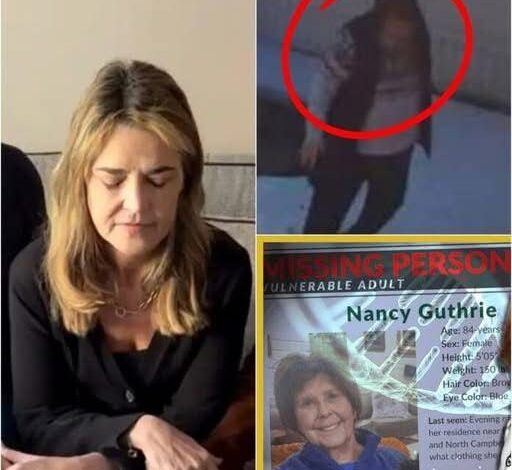
The disappearance of a loved one is a unique form of trauma, a “prolonged state of emotional exhaustion” that exists in the agonizing space between hope and grief. For Savannah Guthrie, the weeks following the disappearance of her mother, Nancy Guthrie, have been defined by this exhausting suspension of reality. As the official investigation into Nancy’s whereabouts continues into early 2026, Savannah has reportedly found herself caught in a cycle of hyper-vigilance—a common psychological response to unresolved loss. Sources close to the case describe a woman under immense pressure, often spending her late-night hours meticulously reviewing security footage, searching for a shadow or a pixelated detail that might have escaped the initial police sweep.
This psychological tension reached a breaking point shortly after midnight on February 12, 2026. The silence of the night was shattered by the sharp chime of an automatic doorbell camera alert. On the screen of her smartphone, Savannah saw a motion-activated clip that would momentarily derail her grip on reality. The footage showed a vague, human-like silhouette standing near her front entrance. Obscured by the low resolution of night vision and the deep shadows of the porch, the figure appeared to have the height and posture of her missing mother. In that split second, the biological drive to find her loved one overrode every logical faculty.
However, the “unsettling truth” revealed itself the moment Savannah threw open the door. The porch was empty. There was no sound of retreating footsteps, no lingering scent, and no physical evidence that anyone had been there. A subsequent police canvass of the property confirmed the absence of footprints or signs of forced entry. Neighboring security systems, which provide a 360-degree view of the street, failed to capture any individual approaching or leaving the property during that time window. To the investigators, the incident was a “null event”—a mechanical trigger without a physical subject. But to Savannah, it was a profound emotional catastrophe.
Psychological consultants assisting with the case have categorized this event not as a sighting, but as a “presence hallucination” or a grief-induced visual misperception. When the human brain is subjected to extreme stress, sleep deprivation, and a deep-seated longing for a specific outcome, it becomes highly susceptible to pareidolia—the tendency to interpret random visual stimuli as familiar patterns. In Savannah’s case, a moth fluttering near the lens, a trick of the moonlight, or a digital artifact in the camera’s processing likely provided the “scaffolding” upon which her grieving mind built the image of her mother.
According to specialists, these experiences are well-documented among families of missing persons. The mind, desperate to resolve the “ambiguous loss,” will manufacture the very thing it craves. For a fleeting moment at that doorway, Savannah was convinced the nightmare was over. The subsequent breakdown she experienced—collapsing at the threshold when faced with the cold reality of an empty porch—is a visceral illustration of the “moral injury” caused by such cases. Investigators described the scene as heartbreaking, noting that the line between a hopeful heart and a breaking mind had become dangerously thin.
While the police have retained the doorbell footage in the case file, they have been transparent in stating that it holds “no evidentiary value.” It does not provide a lead on Nancy’s location; rather, it serves as a clinical marker of the profound psychological toll the disappearance has taken on the survivors. The authorities are now emphasizing the need for professional psychological support, recognizing that the “mind itself becomes the most painful witness” in a case that lacks closure.
The broader context of the Nancy Guthrie case has been plagued by a series of confusing and contradictory signals. Just weeks ago, a digital alert from a cardiac support device once belonging to Nancy reportedly transmitted a final “extreme stress” signal. The location of that signal—a garbage compactor five kilometers from Savannah’s home—led to a grueling but ultimately inconclusive search of the local waste management facilities. This rollercoaster of digital “clues” and technological false alarms has created a environment where Savannah is constantly bombarded by “evidence” that leads nowhere, further eroding her emotional resilience.
In the mid-2020s, the integration of smart home technology into our daily lives has created a new frontier for grief. Doorbell cameras, heart monitors, and GPS trackers provide a sense of security, but in the event of a disappearance, they can become instruments of torture. Every motion alert becomes a potential homecoming; every digital glitch becomes a ghost. For Savannah Guthrie, the midnight chime was not a message from the missing, but an echo of her own internal longing, captured in 1080p resolution and delivered to the palm of her hand.
The community of “Hope Valley” and the wider public have rallied around Savannah, but the “silent warning” for those following the case is one of caution. As the search for Nancy Guthrie continues, the investigation remains focused on tangible, forensic leads rather than the ephemeral shadows captured on home security systems. The “shadow at the door” has become a metaphor for the entire case: a figure that looks like the truth but vanishes the moment you try to touch it.
Ultimately, Savannah’s experience highlights the “fragile trust” we place in our own senses during times of crisis. Her breakdown at the doorway was not a sign of weakness, but a testament to the “fierce love” she holds for her mother—a love so strong it convinced her eyes to see what her heart needed most. As the investigation moves forward into the spring of 2026, the police continue to urge anyone with “verified” information to come forward, while Savannah remains in the difficult process of learning to distinguish between the alerts on her phone and the reality of her mother’s absence.
The story of the midnight doorbell is a reminder that in the search for the missing, the most difficult territory to navigate is often the landscape of the human soul. Until Nancy Guthrie is found, every shadow will hold a question, and every midnight alert will carry the weight of a daughter’s hope, waiting to see if the world will finally offer an answer that doesn’t disappear when the door is opened.


