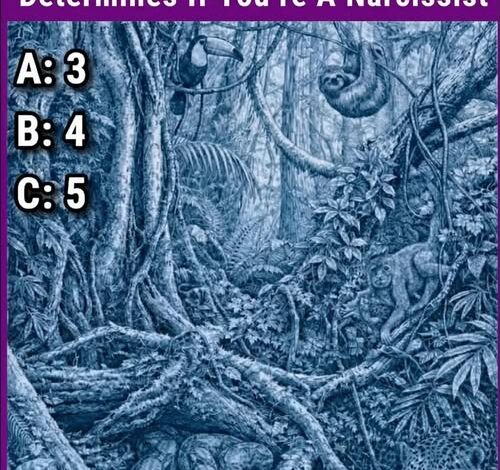
In the digital landscape of March 2026, where high-stakes geopolitical shifts and complex cultural debates dominate the headlines, a much quieter but equally viral phenomenon has taken hold of the internet: the “Jungle Camouflage” optical illusion. At first glance, the detailed illustration appears to be nothing more than a serene, albeit dense, tropical forest scene. Thick, gnarled roots curl along the damp earth; vines drape from heavy branches like forgotten emerald lace; and layers upon layers of broad leaves overlap to create a rich, impenetrable green canopy. However, as the human eye adjusts to the chaotic patterns of the foliage, the “Quiet Giant” of the image begins to reveal itself. Hidden among the trees are several cleverly camouflaged animals, blended so naturally into their environment that spotting them requires a level of patience and cognitive focus that is increasingly rare in our age of rapid scrolling.
What starts as a simple visual exercise quickly transforms into a playful, albeit frustrating, challenge. Viewers are invited to peel back the layers of the illustration, searching for the curves of a spine or the glint of a hidden eye. With enough focus, a toucan emerges, perched stoically on a high branch; a sloth is revealed, hanging with characteristic lethargy from a sturdy limb; a snake is found coiled near the forest floor, its scales mimicking the texture of the bark; a monkey is tucked into the mid-level greenery; and for those with the keenest sight, a large cat—perhaps a jaguar or a leopard—rests in the deep, violet shadows of the undergrowth.
The Digital Con: Puzzles as Personality Tests
As this image has ricocheted across social media platforms like Instagram and TikTok, it has carried with it a bold and psychologically loaded claim: “The number of animals you see determines if you’re a narcissist.” This headline, designed with surgical precision to trigger the “allure” of self-discovery, asks viewers to count their sightings and then delivers an ultimatum on their character. If you see three, you are “grounded”; if you see five, you are “empathetic”; but if you fail to see them all, or perhaps see too many, the “spectacle” suggests you might possess narcissistic tendencies.
However, beneath the noise of these dramatic headlines, a more grounded and candid truth emerges. Despite the thousands of shares and the intense “comment section” debates, there is absolutely no scientific evidence—in 2026 or ever before—linking the speed of visual pattern recognition to narcissism or any other complex personality trait. Narcissism is a nuanced psychological characteristic that exists on a broad spectrum. In a mild, healthy form, it manifests as self-assurance and confidence—traits that help individuals navigate the competitive landscapes of career and social life. At the clinical level, Narcissistic Personality Disorder (NPD) involves a pervasive pattern of grandiosity, a profound need for admiration, and a significant lack of empathy.
In the real world, as opposed to the “digital con” of social media, a diagnosis of NPD is a rigorous process. It is conducted by qualified mental health professionals through thorough evaluations, clinical interviews, and standardized diagnostic tools. It is not, and never will be, determined by whether or not a person can spot a camouflaged sloth in a jungle illustration.
Why the “Narcissist” Narrative Persists
If the claim is demonstrably false, why does it continue to dominate the 2026 trending cycle? The answer lies in the “psychology of the click.” Headlines that link a simple task to a profound character trait spark an immediate, visceral curiosity. They invite self-reflection and, more importantly, they provoke conversation. In a culture that feels like it is “spinning off its axis,” people are desperate for tools that help them understand themselves and the people around them. Optical illusions and hidden-image puzzles tap into this desire for clarity, even if the “clarity” they provide is based on a fundamental misunderstanding of psychology.
The number of animals an individual spots in the jungle scene says a great deal about their cognitive “output,” but very little about their soul. It may reflect how carefully they scan for details—a trait common in people with high “bottom-up” visual processing. It may indicate a high level of patience or a brain that is particularly adept at “gestalt” perception—the ability to see the whole rather than just the parts. These are fascinating cognitive functions, but they are not moral barometers.
The Value of Looking Closer
Instead of treating the jungle illustration as a high-stakes psychological test, it is far more productive to enjoy it as a “fun exercise in observation.” There is a legitimate, grounded value in the act of slowing down to look closer. In a world defined by the “D.C. Crackdown” on attention spans and the “violent darkness” of constant news cycles, the ability to focus on a single, static image for several minutes is an act of quiet defiance.
The real “turning point” of the experience is not finding the fifth animal, but the moment the brain shifts from “passive looking” to “active seeing.” It is a shared, trembling pilgrimage into the details that are hidden in plain sight. This process encourages a “luminous” kind of mindfulness. When we stop searching for a label to apply to our personality, we can begin to appreciate the artistry of the camouflage and the ingenuity of the illustrator.
A Mirror of Cognitive Diversity
By early March 2026, the “Jungle Challenge” has become a mirror, not of our narcissism, but of our cognitive diversity. In office breakrooms and family dinners, the debate over the “missing monkey” or the “hidden cat” reveals the unique ways our individual brains construct the world around us. Some people are “global processors” who see the forest immediately; others are “local processors” who find every animal within seconds but miss the overall “allure” of the scene.
The “Quiet Giant” of the story is the realization that how we see is as important as what we see. As we move further into 2026, a year that demands “measured leadership” and “clarity of vision,” these puzzles serve as a gentle reminder that our first impressions are often incomplete. The “bruised darkness” of the jungle foliage hides life, just as the “spectacle” of a headline often hides a much simpler, more human truth.
Ultimately, the jungle illusion is a gift. it offers us a rare “safe harbor” from the complexities of regional escalation and political strife. It invites us to be children again, searching for hidden treasures in the leaves. The “confidence” we gain from finding the toucan is a small, harmless joy—and perhaps that is enough. We do not need a viral puzzle to define who we are; we only need a moment to slow down, breathe, and appreciate the hidden details of a world that is always more than it seems at first glance.
The Science of Optical Illusions: How Your Brain Interprets Hidden Images
This video is a helpful resource for understanding the neurological basis of pattern recognition, explaining why some people “miss” the animals while others see them instantly.