On the morning of June 10, 1990, British Airways Flight 5390 departed from Birmingham Airport, destined for the sun-drenched coast of Málaga, Spain. It was a routine Monday morning flight aboard a BAC 1-11, a sturdy workhorse of the era. The eighty-one passengers on board settled into their seats, expecting nothing more than a few hours of quiet transit. However, as the aircraft climbed through 17,000 feet over the lush greenery of Oxfordshire, the mundane reality of commercial air travel was shattered by a sound like a gunshot. What followed was an ordeal of such visceral terror and physical impossibility that it remains, decades later, one of the most legendary chapters in the annals of aviation survival.
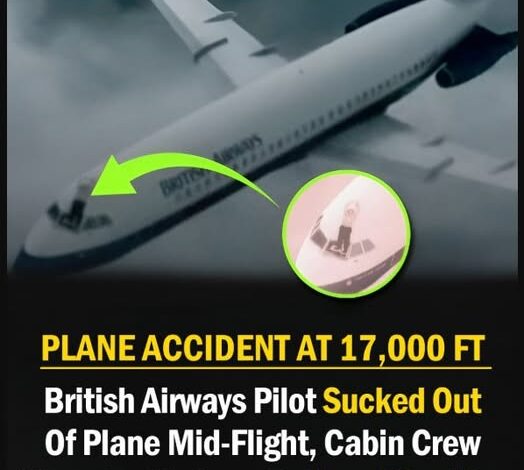
The catastrophe was triggered by a sudden, explosive decompression in the cockpit. Without warning, the left-hand windshield—directly in front of the captain—blew out of its frame, hurtling into the slipstream. The pressure differential was instantaneous and violent. Captain Tim Lancaster was immediately jerked out of his seat by the rushing air. His shoulder straps, designed to protect him from turbulence, were no match for the vacuum created at nearly 350 miles per hour. Within a fraction of a second, the captain was sucked halfway out of the aircraft. His torso and head were pinned against the exterior fuselage by the relentless force of the wind, while his legs remained jammed beneath the control column inside the cockpit.
The scene inside the flight deck was one of absolute pandemonium. Flight attendant Nigel Ogden, who had been entering the cockpit to offer the pilots a beverage, witnessed the captain disappear into the sky. Acting on pure, unadulterated instinct, Ogden lunged forward and grabbed Lancaster’s legs just before they slipped entirely through the window frame. Had it not been for Ogden’s lightning-fast reflexes, Lancaster would have been lost to the atmosphere instantly. For the next twenty minutes, Ogden became a human anchor, his muscles screaming under the strain as the sub-zero gale-force winds tried to tear the captain from his grasp.
Outside, the conditions were unsurvivable by any traditional medical standard. At 17,000 feet, the air is thin and dangerously low in oxygen. The temperature was approximately -17°C, made exponentially worse by a wind chill factor that could freeze skin in seconds. Lancaster was being battered against the side of the plane, his eyes wide and unblinking, his body subjected to a pummeling force that the crew believed had already killed him. Inside the cockpit, the door had been blown inward, blocking the throttle controls and filling the space with a deafening roar and swirling debris. Papers, manuals, and loose equipment whipped through the air like shrapnel.
While Ogden held on for dear life, Co-pilot Alastair Atchison faced a monumental task. Not only did he have to fly an aircraft that was structurally compromised and depressurizing, but he had to do so while the captain’s body remained wedged against the outside of the window, obstructing his view and affecting the plane’s aerodynamics. With cool, calculated precision, Atchison took the controls. He knew he had to descend to an altitude where the crew and passengers could breathe, but he had to do so without flying so fast that the wind force would snap Nigel Ogden’s arms or tear Lancaster apart. He began an emergency descent, fighting the noise and the chaotic air currents to communicate with air traffic control.
The physical toll on Nigel Ogden was reaching a breaking point. His arms were becoming numb from the cold and the exertion, and frostbite was beginning to set in. He was slipping. Sensing the impending disaster, another flight attendant, Simon Rogers, rushed into the cockpit. He strapped himself into the observer’s seat and gripped Ogden’s belt, providing the leverage needed to keep the chain of survival intact. Eventually, Rogers took over the task of holding Lancaster’s legs, allowing a battered Ogden to retreat. Despite the grim sight of Lancaster’s head repeatedly striking the fuselage—a sight that led the crew to assume they were holding onto a corpse—Atchison gave a stern order: “Don’t let go.” He feared that if they released the body, it would be sucked into the rear-mounted engines, potentially causing a total engine failure and a secondary catastrophe.
Under Atchison’s masterful handling, the BAC 1-11 descended toward Southampton Airport. The passengers, though aware of the decompression and the steep dive, remained largely unaware of the life-and-death struggle happening just beyond the cockpit door. When the wheels finally touched the tarmac at Southampton, the emergency crews rushed to the aircraft, expecting a recovery mission. To the astonishment of everyone involved, they found that Captain Tim Lancaster was not only still attached to the plane, but he was alive.
Lancaster had spent twenty minutes exposed to the elements at high altitude and high speed. He suffered from profound shock, multiple fractures to his arms and wrist, a broken ribs, and severe frostbite. Nigel Ogden suffered from a dislocated shoulder and frostbite to his face and arms. Miraculously, there were no other injuries among the passengers or crew. Within five months of the accident, Tim Lancaster—the man who had been halfway out of a flying plane—returned to the cockpit to continue his career as a pilot.
The subsequent investigation by the Air Accidents Investigation Branch (AAIB) revealed a chillingly simple cause for the near-tragedy. The windshield had been replaced just twenty-seven hours before the flight. The maintenance shift manager had used the wrong bolts to secure the window—bolts that were slightly too thin and slightly too short. He had relied on a “like-for-like” visual comparison rather than consulting the official parts manual, and because the workspace was poorly lit and he was under pressure to complete the job, he didn’t notice the discrepancy. The eighty-four bolts holding the window in place were simply unable to withstand the pressure of the climb.
This incident remains a cornerstone of aviation safety training, frequently cited in discussions regarding human factors in maintenance and the importance of CRM (Crew Resource Management). It was famously dramatized in the series Mayday, bringing the harrowing visuals of Lancaster’s survival to a global audience. The story of Flight 5390 is more than a tale of a mechanical failure; it is a tribute to the extraordinary resilience of the human body and the heroic tenacity of a crew that refused to let go. It serves as a permanent reminder that in the high-stakes world of aviation, the difference between a miracle and a tragedy often rests in the hands of those who refuse to succumb to panic when the impossible occurs.