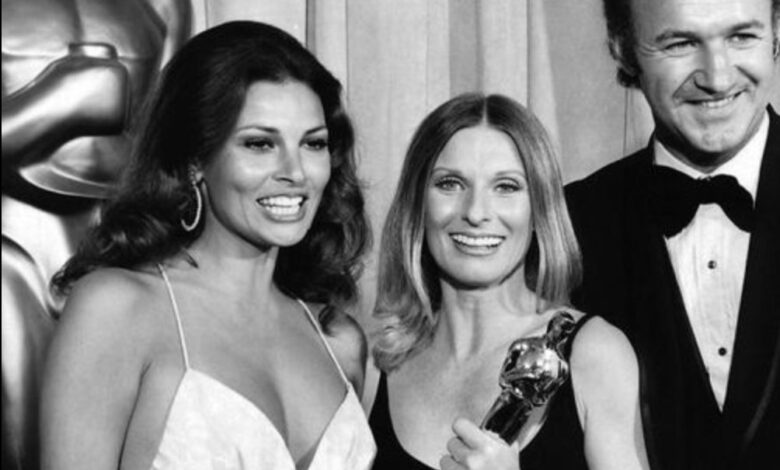
At first glance, the original, unedited photograph from the 1972 Academy Awards looks like pure Hollywood glamour frozen in time. Perfect lighting, tailored tuxedos, elegant gowns, and composed smiles suggest an industry comfortably celebrating itself. But look closer, and the image begins to tell a far more complicated story. What that photograph actually captures is Hollywood caught in transition, suspended between an old world it could no longer fully control and a new one it didn’t yet understand.
The 44th Academy Awards took place at a moment when American cinema was undergoing a fundamental transformation. The safe formulas of the studio era were breaking apart under the pressure of social unrest, political disillusionment, and a younger generation of filmmakers who wanted truth instead of polish. The awards that night reflected that shift unmistakably. The French Connection dominated the ceremony, its gritty realism and morally ambiguous tone signaling that audiences and critics alike were hungry for something sharper, darker, and closer to the world they recognized outside the theater.
This was not escapism in the traditional sense. Alongside it, films like The Last Picture Show, A Clockwork Orange, and Fiddler on the Roof demonstrated that “serious cinema” had fractured into multiple directions at once. Nostalgia, brutality, cultural identity, and moral discomfort all shared the same stage. The industry was no longer unified around a single idea of what prestige looked like.
Outside the Dorothy Chandler Pavilion, the tension was impossible to ignore. Protesters gathered, reminding everyone inside that Hollywood no longer existed in a vacuum. The Vietnam War, civil rights struggles, and generational anger were shaping the national mood, and even the most carefully choreographed awards ceremony couldn’t fully insulate itself. The image from that night carries this contrast quietly: luxury under bright lights, unrest pressing in from beyond the frame.
Inside the ceremony, the collisions between art and reality continued. When Isaac Hayes won for Best Original Song with “Theme from Shaft,” it wasn’t just a personal victory. It was a cultural moment. A Blaxploitation anthem taking Oscar gold signaled a recognition, however tentative, that voices long pushed to the margins were reshaping mainstream culture. Hayes’s presence on that stage reflected the broader redefinition of whose stories mattered and whose music could define a generation.
But the most unforgettable moment of the night arrived quietly, almost humbly. Charlie Chaplin, long exiled from Hollywood during the Red Scare, walked onto the stage to receive an honorary award. By then, he was physically frail, his movements slow, his face etched with age and history. Yet the reaction he received was overwhelming. The applause did not stop. It stretched on and on, becoming one of the longest standing ovations in Oscar history.
That ovation did more than honor a man. It bridged eras. Chaplin represented the silent-film origins of Hollywood, a time when cinema spoke through gesture and expression rather than dialogue. The audience that night, filled with stars shaped by a very different industry, rose anyway, acknowledging a lineage that could no longer be denied. In that moment, the past and future of film shared the same breath.
The photograph from 1972 captures this contradiction perfectly. You can see elegance, but also exhaustion. Pride, but also uncertainty. Hollywood was shedding its skin, and the process was uncomfortable. The industry that once dictated cultural values from a position of unquestioned authority was now responding to forces it could not fully manage: youth culture, political unrest, and a demand for authenticity.
What makes the image so compelling today is that nothing about it is staged to communicate this transformation. There are no visual cues announcing revolution. No obvious disruption. The power lies in what we now know followed. The 1970s would usher in an era of auteur filmmaking, morally complex protagonists, and stories that refused neat resolutions. Directors would push boundaries. Studios would take risks. Audiences would reward honesty over fantasy.
From a modern perspective shaped by streaming platforms, global box office metrics, and algorithm-driven content strategies, the 1972 Oscars feel almost intimate. The industry was smaller, less corporatized, and more visibly connected to the cultural climate around it. There were no viral moments manufactured for social media, no instant global reaction feeds. Yet the emotional impact of that night has endured precisely because it was unfiltered.
The unedited photograph stands as visual proof that transformation doesn’t always announce itself loudly. Sometimes it hides behind familiar rituals, waiting for history to give it meaning. What looked like another awards ceremony at the time now reads as a hinge point, a moment when Hollywood publicly acknowledged—whether it intended to or not—that it could no longer pretend to be untouched by the world outside its doors.
The 44th Academy Awards didn’t just distribute trophies. They documented an industry in mid-molt. The applause for Chaplin, the victory of The French Connection, the recognition of Isaac Hayes, and the presence of protest beyond the venue all converged into a single night that refused to be tidy. It was Hollywood confronting its past while being pulled, sometimes reluctantly, toward a more complicated future.
That is why the photograph remains so powerful. It isn’t remarkable because of what was edited out. It’s remarkable because nothing was edited at all. It shows Hollywood exactly as it was—polished on the surface, restless underneath, and standing at the edge of change it could no longer delay.