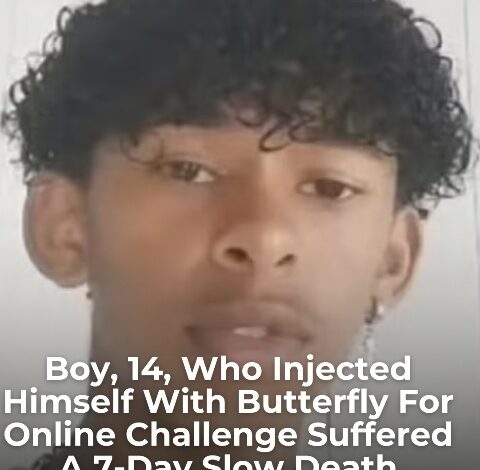
In a quiet Brazilian city, a tragedy unfolded that would leave a family shattered and a community searching for meaning in the aftermath of a death that should never have happened. Fourteen-year-old Davi Nunes Moreira was not reckless by reputation. He was curious, like many teenagers, drawn to the strange, the unexplained, and the endless stream of content that floods modern social media platforms. What no one could have imagined was that a single decision, influenced by the darkest corners of the internet, would lead to seven days of suffering and a slow, irreversible decline.
It began with something that sounded almost unreal when later repeated aloud: a dead butterfly, a syringe, and an experiment carried out in private. Investigators would later piece together that Davi crushed the butterfly and injected the substance into his body. Whether he believed it was harmless, transformative, or simply a test of courage is something only he knew. What is clear is that the act was not spontaneous curiosity alone, but part of a broader digital culture where dangerous online challenges blur the line between entertainment and self-harm.
Within hours, his body began to rebel. He complained of pain. He started vomiting. His movements became unsteady, and a limp appeared that he tried to hide. When questioned by his family, Davi lied, saying he had been injured while playing. It was a small lie born of fear, embarrassment, or perhaps the belief that whatever he was feeling would pass. Many teenagers assume their bodies are resilient, that consequences are temporary, that adults worry too much.
They were wrong.
As days passed, his condition deteriorated. The pain intensified. Weakness spread through his body. Alarmed, his family rushed him to medical care, where doctors began a desperate effort to understand what was happening inside a young body that was failing rapidly and inexplicably. Only then did Davi admit the truth about what he had done. By the time he spoke, the damage was already severe.
Medical professionals were faced with a nightmare scenario. There was no clear protocol for treating a case like this. Injecting organic matter from an insect directly into the bloodstream is not something most emergency rooms encounter, even in regions accustomed to treating tropical diseases. Specialists could only theorize about the cause of his rapid decline. Possibilities included embolism, severe bacterial infection, septic shock, or a catastrophic allergic reaction. Each explanation pointed to the same grim reality: something foreign and toxic had entered his system and triggered a chain reaction his body could not stop.
For seven days, doctors fought to save him. For seven days, his family watched helplessly as hope faded. Machines, medications, and expertise could not undo what had already been set in motion. When Davi died, the grief was immediate and overwhelming. A teenage life, full of potential, curiosity, and promise, had been extinguished by a moment of digital influence and misunderstanding.
In the days that followed, investigators turned their attention to the internet. Authorities examined whether Davi had been inspired or encouraged by a viral social media challenge. While no single video or post could be definitively identified as the trigger, officials acknowledged a disturbing trend: increasingly extreme online dares designed to shock, provoke, and generate engagement at any cost. What may have originated as harmless butterfly-themed art or aesthetic content had, in some corners of the web, mutated into something grotesque and dangerous.
This case now joins a growing list of fatal incidents linked to viral challenges and risky online behavior. From ingestion dares to self-inflicted injuries, these trends exploit adolescent psychology in ruthless ways. Teenagers are neurologically wired for risk-taking, validation-seeking, and curiosity. Social media algorithms, optimized for maximum engagement and advertising revenue, amplify extreme content precisely because it provokes strong reactions. The result is a digital ecosystem where danger can be packaged as novelty and recklessness framed as bravery.
Experts in child psychology and digital safety have long warned that the internet has fundamentally changed how young people assess risk. Unlike previous generations, today’s teens are exposed to graphic, misleading, and often unmoderated content at all hours. The distance between watching something and attempting it has shrunk dramatically. A single click can normalize behavior that would once have seemed unthinkable.
Davi’s story highlights the devastating gap between perception and reality. Online, consequences are rarely shown. Pain is edited out. Death is abstract. What remains is the illusion that everything is reversible, that harm happens to other people, not to you. When that illusion shatters, it does so violently.
For his family, the questions may never end. Why didn’t he say something sooner? What exactly did he inject? Could anything have been done differently? These are questions without answers, and they echo in the silence left behind. Grief counselors often describe this kind of loss as particularly brutal, because it combines mourning with confusion and guilt, emotions that linger long after funerals end.
Public health officials and educators have pointed to this case as a stark warning. Digital literacy, parental awareness, and stronger content moderation are no longer optional conversations. They are urgent necessities. Teaching young people how to critically evaluate online trends, how to recognize manipulation, and how to speak up without fear may be the only barriers standing between curiosity and catastrophe.
Davi Nunes Moreira did not set out to die. He was not seeking self-destruction. He was a teenager navigating a world where the boundaries between reality and performance are dangerously blurred. His death is not just a personal tragedy; it is a reflection of a broader systemic failure to protect children in an online environment that rewards extremity over safety.
Today, his name is spoken with sorrow and disbelief. His story circulates as a cautionary tale, shared in hopes that it might stop another child from following the same path. But for his family, no warning will ever be enough. They are left with memories, unanswered questions, and the unbearable knowledge that a single reckless moment, fueled by online influence, stole a life that had barely begun.
Davi’s death stands as a reminder that behind every viral trend is a real human cost. And sometimes, that cost is paid not in likes or views, but in lives.