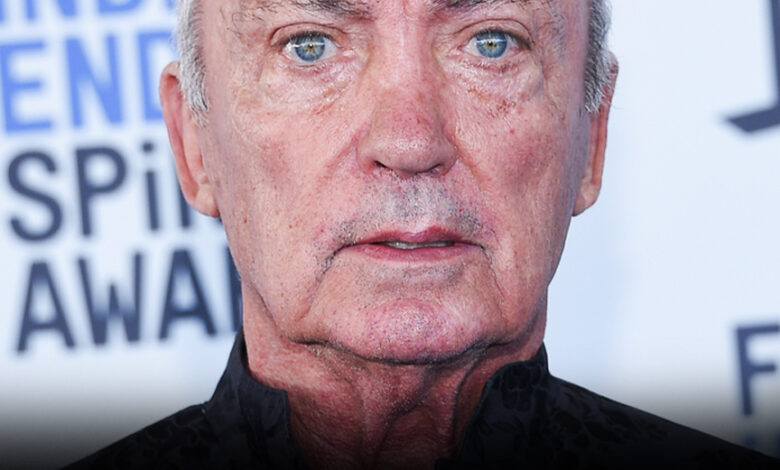
Udo Kier was nearly erased before he ever learned how to breathe. His story does not begin on a film set or beneath stage lights, but amid the roar of falling bombs and collapsing walls. He was born in wartime Europe, pulled from rubble in the final days of the Second World War, an infant rescued from a city being torn apart. History had every reason to swallow him whole. Instead, he survived—and survival became the first act in a life defined by defiance.
His early years were shaped by scarcity and absence. Hunger was routine. Cold rooms were normal. A father figure never fully materialized, leaving behind a silence that echoed through his childhood. Yet even then, Kier carried himself with a strange, unspoken resolve, as if every deprivation were a rehearsal for something larger. He learned to observe before he learned to speak, to endure before he learned to dream. That watchfulness would later become his most powerful instrument.
Fate found him not through privilege or pedigree, but through chance. In a London café, at a moment when opportunity often passes unnoticed, Kier didn’t hesitate. He stepped forward when the door cracked open. He entered the frame, literally and figuratively, and never stepped back out. In an industry obsessed with symmetry and comfort, he offered something else entirely—an intensity that unsettled and fascinated in equal measure.
Onscreen, Kier became a figure audiences could not ignore. He did not chase likability. He did not soften edges. Instead, he leaned into discomfort, seduction, menace, and vulnerability, sometimes all at once. He made monstrosity intimate. His villains were never hollow. His outsiders were never ornamental. He forced viewers to confront the unsettling possibility that darkness is not foreign—it is familiar.
Directors understood this instinctively. Those drawn to transgressive cinema, avant-garde storytelling, and psychological horror whispered his name like an invocation. In cult films, arthouse classics, and boundary-pushing projects, Kier became a constant presence. His face—angular, expressive, impossible to forget—carried entire narratives before a word was spoken. Luxury cinema critics and underground film communities alike recognized him as something rare: an actor who didn’t perform danger, but embodied it.
What made him singular was not the volume of his work, though his filmography spans decades and continents. It was the fearlessness with which he inhabited each role. He did not distance himself from the grotesque or the taboo. He stood with the queer, the broken, the misunderstood, insisting they be seen not as symbols, but as people. Long before inclusivity became a marketable keyword, Kier lived it onscreen, risking ridicule and rejection in exchange for truth.
In horror cinema, he redefined presence. In European arthouse film, he became a bridge between brutality and beauty. In experimental storytelling, he offered credibility without compromise. Scholars of film theory often note how Kier blurred the line between villain and victim, eroticism and terror, power and fragility. His performances resisted simple classification, making him a staple of academic analysis, film retrospectives, and premium streaming rediscoveries.
Yet offscreen, there was another transformation. In his desert home, far from the ruins of his birth and the chaos of film sets, Kier found stillness. Color replaced gray. Sunlight replaced shadow. The desert became a final stage—quiet, defiant, unapologetically his. It was not retreat, but resolution. A man who had spent his life confronting darkness chose to live surrounded by openness and light.
Age did not soften him. If anything, it sharpened his legacy. Younger filmmakers sought him out not as nostalgia, but as authority. He represented continuity between generations of cinema—a living archive of artistic courage. His presence in a cast signaled intent: this story would not be safe, and it would not look away.
When death finally claimed the body, it did not claim the gaze. Cinema kept it. That unblinking stare still confronts audiences across restored prints, high-definition remasters, festival screenings, and streaming libraries optimized for global discovery. His work continues to rank among the most searched performances in cult film history, European cinema landmarks, and iconic character actor retrospectives.
Udo Kier’s life reads less like a biography and more like a manifesto. Born under bombs, shaped by loss, elevated by risk, and sustained by refusal. He did not ask to be seen; he demanded it—by making it impossible to look away. In an industry often built on illusion, he offered something rarer: presence.
History tried to bury him in rubble. He answered by becoming unforgettable.