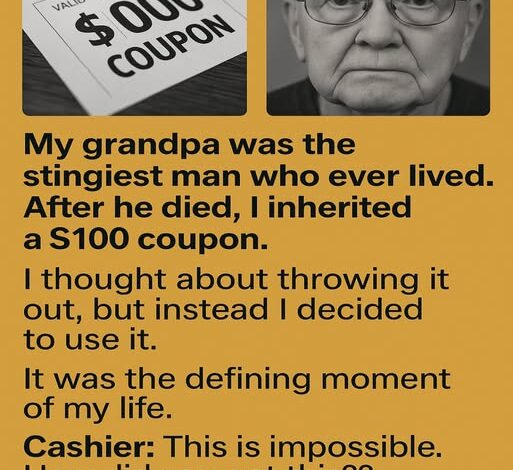
Growing up, I believed my grandfather was the personification of a human miser. He was a man who didn’t just pinch pennies; he strangled them. He was the kind of person who meticulously rinsed out single-use Ziploc bags to dry on the windowsill, sliced paper towels into thirds to maximize their utility, and monitored the house’s electricity with the vigilance of a hawk, cutting the lights if you dared to leave a room for more than three seconds. Dinner out was a masterclass in embarrassment; he would shamelessly pocket sugar packets and condiment sachets while grumbling that the portions were “hardly enough to sustain a sparrow.” Every Christmas, the ritual was the same: I would unwrap a pair of thin, scratchy socks, always marked with a neon clearance sticker that he had only half-heartedly tried to peel away.
So, when he finally passed away and the family lawyer slid a sealed envelope across the mahogany desk—labeled specifically “For My Grandson”—I expected very little. Perhaps a sternly worded lecture on the importance of compound interest or a list of places that offered the best senior discounts. Instead, I pulled out a single, heavy slip of paper. It was a coupon. It promised $100 off any in-store purchase, had no expiration date, and featured a brand name I didn’t recognize. The cardstock was thick and ivory, printed with elegant, faded red ink and a strange logo: a simple, minimalist triangle bisected by a single horizontal line.
While my cousins walked away with real assets—an old Cadillac, a handful of high-yield savings bonds, and a promising plot of land—I walked away with a piece of paper that felt like a final, mocking prank. I kept it in my wallet for a week, mostly out of a sense of spiteful nostalgia. It felt like the closing act of our long, bizarre relationship. But every time I reached for my credit card, that strange logo would peek out from the leather fold, radiating a quiet, nagging energy that I couldn’t ignore. Eventually, curiosity outweighed my cynicism.
The store listed on the coupon was located in a skeletal strip mall on the far side of town, nestled between a laundromat that smelled of stale bleach and a nail salon with flickering neon signs. The storefront was unremarkable, the letters of the sign slightly askew, looking like a relic of a retail era long since forgotten. Inside, it appeared to be a standard, low-budget department store. Fluorescent lights hummed a low, drony B-flat, and the air was thick with the scent of floor wax and generic brand laundry detergent. I wandered the aisles, picking up a few mundane essentials—rice, soap, and a pack of socks I definitely didn’t need—just to justify the trip.
When I reached the checkout, I handed the cashier the coupon. She scanned my items with robotic indifference, but the moment her fingers touched that heavy cardstock, the air in the room seemed to chill. She froze. Her gaze dropped to the red cursive, and her face drained of color. Without a word to me, she waved frantically for her manager. “Mark? You need to get over here. Now.”
Mark was a man who looked like he had spent twenty years inhaling warehouse dust—salt-and-pepper hair, sleeves rolled to the elbows, a weary slump to his shoulders. He took the coupon, held it up to the light, and then did something that made my skin crawl: he leaned in and sniffed the paper. His posture instantly snapped into a military-straight line. “Where did you get this?” he asked, his voice barely a whisper.
I explained it was a legacy from my grandfather. Mark didn’t respond; he simply gestured for me to follow him through a heavy gray door marked “Authorized Personnel Only.” We walked down a narrow hallway to a cramped, windowless office where he pulled a battered black binder from a locked cabinet. The binder was stamped with “LEGACY COUPONS—LEVEL 7 CLEARANCE.” He flipped through plastic sleeves until he found a match. “1972,” he muttered. “Only five were ever issued.”
He proceeded to explain that in the early seventies, the company founders had initiated a “test.” These weren’t just discounts; they were catalysts. He showed me grainy, black-and-white photos of the original recipients. In the third photo, I saw him—my grandfather, looking young, sharp, and intensely focused, holding the very slip of paper I had just surrendered. Mark told me the stories of the others. One man bought a washing machine and ended up meeting his future wife through the delivery; together, they built an empire. Another found a rare coin beneath a can of peaches that funded a generational fortune. A third had tried to sell the coupon for profit and vanished without a trace.
“The coupon is the center of a pattern,” Mark said, his eyes locking onto mine. “It doesn’t dictate destiny, but it opens the door to it. You can use it for your soap and rice, or you can find something else. It’s your choice.”
I left the office with my head spinning. The store no longer looked like a dump; it looked like a labyrinth of potential. I wandered back into the aisles, my heart hammering against my ribs. I bypassed the groceries and headed toward a dusty glass display case near the back. There, hidden behind a chipped ceramic figurine, sat an antique camera. It was a boxy, heavy thing made of brass and worn leather, with a handwritten tag that read: “ANTIQUE CAMERA – $99.99.”
I felt a magnetic pull toward it. When I handed it to the cashier along with the coupon, the register beeped a long, steady tone, and the total reset to zero. As I stepped out into the cool evening air, the camera felt warm in my hands—vibrating with a faint, sub-audible hum. I aimed it at a row of parked cars and pressed the shutter. There was no flash, no click of film, just a heavy, silent thud deep within the device.
That night, my reality began to fracture. I took a photo of my apartment door, and seconds later, a black sedan I’d never seen before idled at the curb. I took a photo of my own reflection in the mirror, and for a terrifying heartbeat, I wasn’t in my living room anymore—I was standing in a primeval forest, the air thick with the scent of damp earth and ancient growth, before the camera snapped me back to my own carpeted floor.
I discovered my grandfather’s old journal hidden in a false-bottomed suitcase in his closet. His tight, obsessive handwriting detailed the camera’s nature. It wasn’t a tool for capturing memories; it was a tool for capturing “what could be.” It was a gateway to the branching paths of probability. My grandfather hadn’t been stingy because he was small-minded; he had been guarding a secret. He had spent decades living a minimalist, invisible life to keep the “Founders’ Program” from finding him, waiting for the right moment to pass the burden—and the gift—to someone who wouldn’t be corrupted by it.
A photograph slid out of the camera on its own the next morning. It showed me, years older, standing before a vast, glowing vault with a look of peace I’d never felt in my life. At the bottom was a handwritten note: “You are the fifth.”
I realized then that my grandfather’s greatest gift wasn’t money or land. It was the ability to choose. He had given me a tool that could navigate the very fabric of fate. I packed a bag, grabbed the camera and the journal, and walked out of my apartment. I don’t use the camera to get rich or to hurt people. I use it sparingly, only when the path ahead is dark and a choice must be made. I finally understood that some opportunities don’t look like a winning lottery ticket; they look like a discarded piece of paper from a man who loved me enough to teach me the value of holding onto what truly matters. I am no longer just a grandson; I am the keeper of the fifth path.