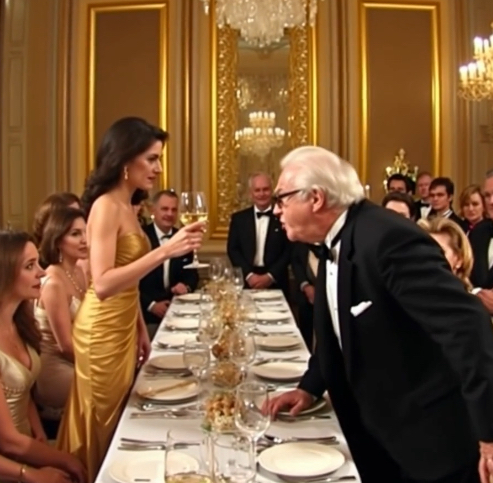
 “Street garbage,” I said softly, repeating his words back to him. Then I allowed a smile, small and deliberate. “What an interesting choice, Mr. Blackwood.” Every pair of eyes locked on me. The room, the wealth, the power—none of it mattered anymore. The trial wasn’t mine. It was his.
In that moment of tension, where time seemed to stretch and the air buzzed with unspoken words, I realized this wasn’t just a dinner. It was a defining moment, not only for me but for Alexander and for the man seated across from me, whose legacy was built on intimidation and entitlement.
“Mr. Blackwood,” I continued, my voice unwavering, “I suppose it’s easy to label what we don’t understand or what doesn’t fit into our predefined notions. But I assure you, this dress may be borrowed, but my dignity and self-worth are my own.”
The room remained silent, the kind of silence that follows a dropped pin in a cathedral. Maxwell leaned back and folded his arms, his eyes narrowing slightly. His world, his rules, had been challenged—not by another titan of industry or a social equal, but by someone he deemed unworthy of his time.
“I’ve worked hard for everything I have,” I said, my gaze steady on him, “just as I’m sure you have. And while my path might not mirror yours, it is nonetheless valuable. Your words, as pointed as they were intended to be, are a reflection of your own insecurities, not mine.”
Alexander squeezed my hand, his silent support bolstering me further. His face was a mask of controlled fury, but his eyes shone with pride and solidarity.
Maxwell’s facade of amusement faltered, a crack appearing in his polished veneer. He opened his mouth, perhaps to issue another cutting remark or to dismiss me entirely, but I held up a hand, forestalling him with a grace I hadn’t known I possessed.
“You see, Mr. Blackwood,” I said, “being a part of Alexander’s life does not mean I’m seeking your approval. Respect is a two-way street. You don’t have to agree with my choices or my origins, but basic decency is the least we can offer each other as human beings.”
The guests around the table watched, some with expressions of astonishment, others with newfound respect. I felt a warmth grow within me, a sense of liberation and empowerment that had been kindled by this confrontation.
“And if being ‘street garbage’ means being unashamed of where I come from, then I embrace it,” I concluded, my voice firm. “Because it also means being resilient, adaptable, and fiercely independent.”
The silence was finally broken by a murmured agreement from somewhere down the table, followed by a ripple of nods. Maxwell sat there, a man unused to being confronted so directly, especially in his own domain.
The dinner continued, albeit with a new dynamic. I remained composed, buoyed by the realization that Maxwell’s words had not diminished me; they had only strengthened my resolve.
Later that evening, as Alexander and I left the opulent estate, he wrapped his arm around me. “I’m so proud of you,” he whispered, his voice brimming with emotion. I smiled up at him, feeling both lighter and more certain than I had in years.
Because I knew now that I was not defined by someone else’s perception. Maxwell Blackwood could keep his world of glittering chandeliers and polished tables. I had built my own, and it shone just as brightly.


