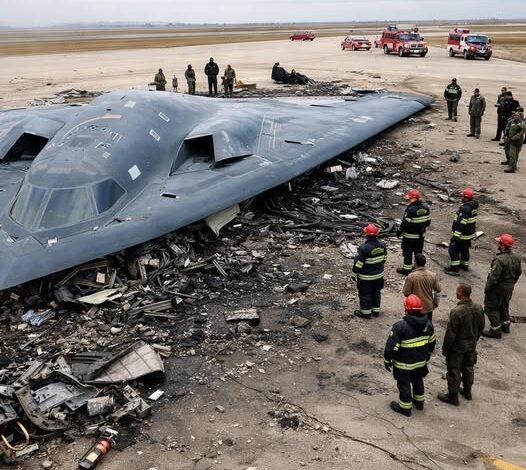
In quiet corners of military briefings and intelligence circles, one subject has dominated recent conversations: a highly sensitive U.S. operation believed to have sent stealth bombers deep into the most closely watched airspace on the planet. At the center of the discussion is the United States Air Force and its most enigmatic aircraft, the B-2 Spirit—a platform designed not for show, but for missions meant to be felt rather than seen.
Reports and analysis suggest that the bombers’ destination was linked to Iran, raising immediate questions across global capitals. Was this a rehearsal meant to reinforce deterrence? A warning delivered without words? Or a real-world demonstration of a capability few nations can counter? Whatever the intent, the implications have rippled far beyond the region.
The mission reportedly began at Whiteman Air Force Base, the only home of the B-2 fleet. From there, the aircraft embarked on a journey spanning roughly 13,000 kilometers, relying on a chain of aerial refueling tankers to remain airborne for hours—sometimes more than a full day—without landing. This is not logistics for convenience. It is the infrastructure of global reach, designed to allow the United States to strike anywhere on Earth without staging forces nearby.
What made this flight particularly unsettling to analysts was not just the distance, but the payload believed to be onboard. The B-2 is the only aircraft capable of carrying the GBU-57 Massive Ordnance Penetrator, a 13.6-ton weapon engineered for one specific purpose: destroying deeply buried and heavily fortified targets. Unlike conventional bombs that detonate on impact or shortly after penetration, the GBU-57 is designed to drill through tens of meters of reinforced concrete and rock before exploding, transferring its destructive force directly into underground structures.
Weapons like this exist because of places like Fordow, Iran’s most heavily protected nuclear facility. Built beneath a mountain and reinforced to withstand traditional airstrikes, such sites were once considered nearly invulnerable. The existence—and demonstrated readiness—of the B-2/MOP combination challenges that assumption outright. It tells adversaries that depth alone is no longer enough.
The true power of the B-2, however, lies not just in what it carries, but in how it moves. Its stealth design dramatically reduces radar visibility, allowing it to slip past advanced air defense systems that would detect and engage conventional aircraft. While no system is truly invisible, the B-2’s radar cross-section is so small that detection often comes too late to respond effectively. In modern warfare, minutes matter. Sometimes seconds.
There is a trade-off. Each B-2 can carry only two Massive Ordnance Penetrators at a time. By traditional standards, that is a limited payload. But doctrine has shifted. Precision has replaced volume. When a single weapon can neutralize a strategic facility, quantity becomes less important than certainty. The United States is currently the only nation known to possess and operationally deploy this exact combination of aircraft, munition, and global command-and-control capability.
For Iran, the message is stark. Underground fortifications that once symbolized security now appear less absolute. Even without a strike being confirmed, the demonstration alone forces planners to reconsider assumptions about survivability. It introduces doubt—and in deterrence theory, doubt is a weapon.
For Washington, the operation represents a convergence of decades of investment in stealth technology, precision-guided munitions, and long-range logistics. It is the embodiment of a doctrine that prioritizes silent approach, limited exposure, and overwhelming effect at the chosen point of impact. No troop movements. No carrier groups on the horizon. Just an aircraft that arrives unannounced and leaves before most people know it was there.
Strategically, this kind of mission exists in a gray zone between war and warning. It avoids the immediate consequences of open conflict while still exerting pressure. Critics argue that such demonstrations risk escalation, particularly in regions already burdened by tension and proxy conflicts. Supporters counter that failing to demonstrate capability invites miscalculation by adversaries who might otherwise assume immunity behind hardened defenses.
What makes this moment especially significant is the broader context. The global security environment is shifting away from massed armies and toward technological asymmetry. Stealth, cyber operations, space-based surveillance, and precision strike capabilities increasingly define power. Geography matters less when an aircraft can cross continents undetected and deliver a weapon designed to defeat the deepest shelters.
The silence surrounding the operation is also deliberate. Ambiguity preserves flexibility. By neither fully confirming nor denying details, U.S. defense planners maintain strategic uncertainty. Allies are reassured without being forced into public alignment. Adversaries are left to calculate risks without clear thresholds. It is deterrence through suggestion rather than declaration.
Yet silence does not erase consequences. Regional actors are watching closely. So are global powers with their own interests in the Middle East. Each demonstration of capability influences arms development, defensive investments, and diplomatic posture. It shapes negotiations before a single word is spoken at the table.
The B-2 Spirit’s reported presence over Iran is therefore about more than a flight path or a weapons system. It represents the evolving balance between concealment and detection, between fortification and penetration. It underscores how quickly technological advantages can rewrite long-held assumptions about security.
Whether this mission was a rehearsal, a calculated warning, or simply a visible reminder of dormant power, its impact is undeniable. It sharpened deterrence while simultaneously highlighting how fragile that deterrence can be when misinterpreted. The line between demonstration and provocation remains thin, and history shows how easily it can be crossed.
For now, the bombers have returned, the skies are quiet, and no official strike has been announced. But the signal has been sent. In an era where silence can be louder than explosions, the world has been reminded that some capabilities are designed not to be used often—only to be believed.