Our café didn’t end with a bang or a cinematic shouting match. It ended on a Tuesday afternoon with the hollow sound of a key turning in a lock for the last time. It was the quiet, suffocating realization that our dreams, our life savings, and the future we had meticulously built together had vanished. That night, my husband John drove us home in a silence so thick it felt like a physical weight. His jaw was set, and his hands gripped the steering wheel as if he were trying to choke the reality out of the situation.
When we got home, our six-year-old son, Colin, was already asleep. I went through the motions of motherhood—checking his breathing, smoothing his hair—while John stood in the kitchen staring at the empty sink. I approached him, trying to offer a lifeline. “We’ll figure it out,” I whispered. “We’re a team.” He didn’t even turn around. “I need space,” he said, the words cold and detached. He told me he couldn’t breathe, that he was suffocating under the pressure of our failure. I wanted to scream that I was suffocating too, that a marriage is a partnership, not a fair-weather arrangement. But before I could argue, he had packed a bag and left, claiming he was going to stay with a friend to “clear his head.”
A few weeks of “space” turned into months of absolute silence. No calls, no child support, and no explanations. I watched the light fade from Colin’s eyes as his questions became more heartbreaking. “Is Daddy mad at me?” he would ask. I lied for as long as I could, inventing work trips and imaginary errands, until a neighbor’s pitying glance at the mailbox revealed the truth. John wasn’t clearing his head at a buddy’s house; he had moved in with a regular from our café—a woman who represented a life without debt, without a grieving wife, and without the heavy responsibility of a son.
The first year was a brutal lesson in survival. I became a master of the “silent cry,” letting the tears fall only after Colin was asleep so I could be the unshakable pillar he needed during the day. I sold everything of value: our dining table, the TV we’d saved for months to buy, even my engagement ring. I worked double shifts at a diner and learned to stretch a single box of pasta across four nights of dinners. The business loans we had co-signed didn’t care that my partner had vanished; they only cared that I was still there.
By the second year, the drowning sensation began to subside. I transitioned from survival to stability. I picked up freelance work at night, and we developed a routine that felt less like a crisis and more like a life. Colin started reading chapter books, his small voice filling our modest apartment with stories as he curled up next to me. He learned to ride a bike that summer. I remember the pang in my heart as I ran alongside him, holding the seat until he pedaled away, shouting, “Mom, look! I’m doing it!” He looked at the empty space beside me and asked if I thought his dad would be proud. I told him yes, even though I knew John didn’t deserve to share in that pride.
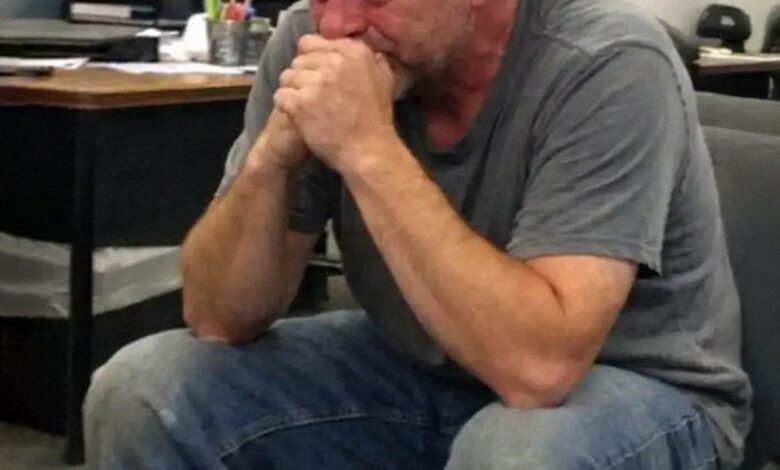
Three years after the café closed, I walked into a car dealership. I had finally saved enough for a used sedan—something reliable that wouldn’t break down on the way to school. While I was finishing the paperwork, I noticed a man in the waiting area. He was hunched over, his face buried in his hands, his shoulders shaking with unmistakable sobs. Something about the slope of his back was hauntingly familiar. It was the jacket—the one I had bought him for his last birthday before he left.
It was John.
My instinct was to run, to grab my keys and disappear before he saw me. But he looked up, and our eyes locked. He looked ravaged. He looked like a man who had finally been forced to drink the bitter cup he had poured for us. He walked over to me, his voice hoarse and desperate. He told me he’d been following me from a distance for a few days, watching me drop Colin at school, too ashamed to approach.
“Everything fell apart, Laura,” he choked out. The woman he had left us for had stripped him of everything—his savings, his car, his dignity—and kicked him out when he became “a burden.” He had been sleeping in his car for two weeks. He wept as he confessed his selfishness, begging for a chance to see his son. He spoke of his regret as if it were a currency that could buy back three years of missed birthdays and scraped knees.
I looked at him, and for the first time in years, I didn’t feel the sharp sting of anger. I felt a profound, chilling clarity. I told him about the bike, about the training wheels coming off, and about the boy who waited for a father who never came. “He asked if you’d be proud,” I said, my voice steady. “And I told him you would be. Because I didn’t want him to carry your shame.”
John’s face crumpled. He was looking for a bridge back into our lives, but he failed to realize that the river had moved. “Can I see him?” he whispered. I looked at the man who had abandoned his family when the bank account hit zero and only returned when his own life reached the same destination. “That’s not my decision to make anymore,” I replied. “It’s Colin’s. And right now, he doesn’t even know who you are.”
I picked up my folder and walked to my new car. I sat in the driver’s seat and adjusted the rearview mirror, catching a glimpse of Colin’s drawing clipped to the visor—a picture of a family of two. As I pulled out of the lot, I saw John still standing there, a solitary figure dwarfed by the rows of shiny vehicles he couldn’t afford.
Life hadn’t punished him with a lightning bolt; it had simply proceeded without him. He had walked away assuming the world would pause until he was ready to press play again, but time doesn’t wait for cowards. That evening, as Colin and I sat at our small kitchen table eating dinner, he chattered about his day at school. He was happy, healthy, and whole. I realized then that I didn’t need an apology or a grand gesture of karma. The peace in our home was the only closure I required. We hadn’t just survived the wreck he left behind; we had built something far more beautiful on top of the ruins. As it turned out, the best revenge wasn’t seeing him in tears—it was realizing I no longer cared why he was crying.