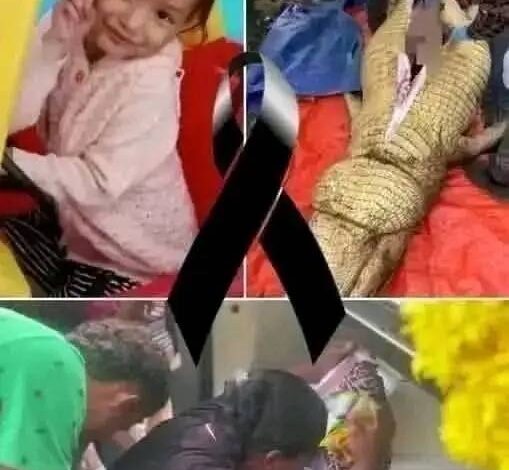
The quiet community of Bangka, Indonesia, was struck by profound grief on the morning of Saturday, January 11, when an ordinary family moment turned into an unthinkable tragedy. A five-year-old girl named Caca lost her life after being attacked by a saltwater crocodile near a lake where she had gone with her parents to bathe. What should have been a routine, peaceful start to the day became a scene of horror that has since shaken the entire region.
It was just after 9 a.m. when the family arrived at the lake. The water appeared calm, offering no visible sign of danger. Like many similar lakes in the area, it was used regularly by locals for washing and bathing. Caca stood close to the water’s edge with her parents nearby, unaware that a powerful predator was lurking beneath the surface.
According to witnesses, the attack happened without warning. In a sudden burst of movement, a large crocodile surged from the water and grabbed the child, dragging her toward the depths of the lake. Her parents screamed and rushed forward, desperately trying to pull her back. Other nearby residents ran to help. But the crocodile’s strength was overwhelming. Within seconds, Caca was gone.
Those moments left behind unimaginable trauma. Her parents could do nothing but watch as their daughter disappeared beneath the water. The shock of helplessness, combined with the speed and violence of the attack, left everyone present frozen in disbelief.
Emergency services were alerted immediately. Police officers, local volunteers, and members of the Bangka Belitung search and rescue agency mobilized quickly. Boats were launched, and teams began combing the lake and surrounding areas. The search continued throughout the day, with divers entering the murky water despite the obvious danger. As night fell, hope began to fade, but efforts did not stop.
The following day, January 12, search teams made the heartbreaking discovery. Caca’s body was found in the water, confirming the worst fears of her family and community. Reports indicated that she had suffered catastrophic injuries. Her skull had been crushed by the powerful jaws of the crocodile, leaving no chance that she could have survived the initial attack.
Authorities later confirmed that the crocodile responsible for the attack had been captured. However, details regarding what was done with the animal afterward were not publicly disclosed. In Indonesia, such cases often spark debate between conservation concerns and public safety, especially in areas where human settlements and wildlife habitats overlap.
The lake where the incident occurred carries a hidden history. It is not a natural body of water but a remnant of old tin mining operations. Over time, abandoned mining pits filled with water, creating lakes that became part of the local landscape. Unfortunately, these artificial lakes also turned into ideal habitats for saltwater crocodiles, which are highly adaptable and capable of thriving in a wide range of environments.
Saltwater crocodiles are the largest living reptiles on Earth. Fully grown males can reach lengths of up to seven meters and weigh more than a ton. They are apex predators with incredibly fast reflexes, immense bite force, and a hunting style based on ambush. Once they seize their prey, escape is almost impossible.
Indonesia has the highest number of crocodile attacks in the world, far surpassing any other country. This grim statistic is linked to the nation’s geography, which includes vast wetlands, rivers, and coastal regions that overlap with densely populated areas. Human activity frequently intersects with crocodile habitats, increasing the risk of deadly encounters.
Data from past years paints a disturbing picture. In 2014 alone, more than 470 people were reported killed in crocodile attacks across Indonesia, with over 530 others injured. Experts believe the real numbers are significantly higher, as many incidents in remote areas go unreported. Children are particularly vulnerable, given their size and the fact that many attacks occur near water used for daily activities.
The danger extends beyond local communities. Tourists have also fallen victim to crocodile attacks. In 2016, a Russian tourist was killed by a crocodile in the Raja Ampat Islands, a location internationally known for its pristine waters and popular dive sites. That incident drew global attention and highlighted how even well-known destinations can carry hidden risks.
Caca’s death is part of a growing pattern that reflects a broader issue: the increasing overlap between human life and wildlife territory. As populations expand and land use changes, humans are moving closer to areas once dominated by wild animals. At the same time, animals like crocodiles are adapting to new environments, including man-made lakes and waterways near villages.
Climate change, deforestation, and industrial activity all contribute to this dangerous proximity. When natural habitats shrink or change, predators are forced to seek food and territory elsewhere. The result is more frequent encounters, often ending in tragedy for humans and animals alike.
For the people of Bangka, the loss of Caca is deeply personal. She was not a statistic or a headline but a child with a family, a name, and a future that will never be realized. Her parents’ grief has resonated throughout the community, serving as a painful reminder of how fragile life can be.
This tragedy has renewed calls for stronger safety measures around known crocodile habitats. Experts stress the importance of clear warning signs, restricted access to dangerous waters, and community education programs that explain how crocodiles behave and where they are most likely to be found. Authorities are also being urged to reassess the safety of abandoned mining sites that have turned into informal public spaces without proper risk management.
Caca’s story stands as a sobering warning. It highlights the urgent need for greater awareness, better planning, and respect for the power of nature. While crocodiles are an essential part of the ecosystem, encounters like this demonstrate the devastating consequences when humans underestimate the risks.
In regions where wildlife and human life coexist so closely, prevention is the only real defense. Education, caution, and proactive measures can save lives. Without them, tragedies like this will continue to repeat, leaving behind grief that no community should have to endure.


