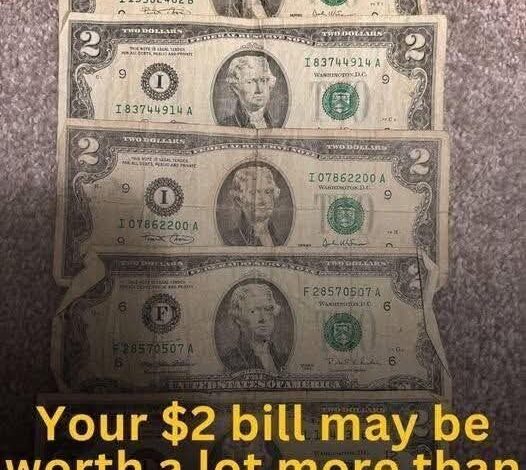
For decades, the American $2 bill has occupied a strange gray area between everyday money and cultural myth. Some people swear it brings bad luck. Others think it’s been discontinued. Many assume it’s fake simply because they’ve never seen one in circulation. Yet the truth is far more interesting—and potentially far more profitable. In the right condition, or with the right details, a $2 bill can be worth far more than its face value, sometimes reaching hundreds or even thousands of dollars.
The bill’s reputation didn’t come from rarity at first. It came from misunderstanding. The $2 bill has never been illegal, outlawed, or formally discontinued. It is still printed today by the Bureau of Engraving and Printing. What changed wasn’t production, but behavior. People stopped using it.
When the $2 bill was introduced, it was meant to be practical. The idea was simple: reduce the need for two $1 bills in everyday transactions. But consumers resisted. Cash drawers weren’t designed for it. Clerks found it awkward. Customers didn’t know what to do with it. Over time, that discomfort turned into superstition. Gamblers claimed it was unlucky. Some business owners refused to accept it. Rumors spread that it was associated with corruption or crime. None of it was true—but perception stuck.
As the bill fell out of everyday use, something unexpected happened. Instead of being spent, it started being saved. People tucked $2 bills into drawers, envelopes, wallets, and scrapbooks simply because they were “different.” Parents gave them to children as novelties. Grandparents slipped them into birthday cards. Tourists kept them as souvenirs. And because they weren’t circulating, many of these bills survived in remarkably good condition.
That preservation is where collector value begins.
Not every $2 bill is worth more than two dollars. Most modern bills, especially those printed after 1976, are still worth face value if they’ve been heavily circulated. But collectors aren’t just looking for age—they’re looking for details. Condition matters enormously. A crisp, uncirculated bill can be worth several times more than a worn one from the same year.
Serial numbers are another major factor. Collectors pay premiums for unusual patterns: repeating digits, solid numbers, ladders, low serial numbers, palindromes, or symmetrical sequences. A perfectly ordinary $2 bill with an eye-catching serial number can sell for $50, $100, or more, depending on demand. To a collector, the serial number can matter as much as the bill itself.
Older bills raise the stakes even higher. Early 20th-century $2 bills with red or brown seals often sell for hundreds of dollars if they’re well preserved. Go back further into the 19th century, and values climb dramatically. Oversized $2 notes from the late 1800s—sometimes called “horse blanket” notes—are prized by collectors and museums alike. These can fetch thousands depending on rarity and condition.
Printing errors are another category where values can skyrocket. Misaligned prints, ink errors, missing seals, or incorrect serials are rare by definition, and collectors aggressively pursue them. Many people have spent error notes without realizing what they had. Others have discovered, years later, that an odd-looking bill they saved “just because” was actually a highly valuable mistake.
One of the most persistent myths surrounding the $2 bill is that it’s no longer being made. That simply isn’t true. The Bureau of Engraving and Printing continues to print $2 bills, though in smaller quantities than other denominations. Banks rarely order them, and customers rarely request them, so they tend to sit unseen in vaults and drawers. That invisibility fuels the illusion of rarity.
But rarity in the collector world isn’t about how many were printed. It’s about how many survive in desirable condition. Most paper money gets folded, torn, stained, or destroyed over time. $2 bills, because they’re so often saved instead of spent, tend to survive in far better shape. That unusual survival rate has made them unexpectedly attractive to collectors.
History adds another layer of appeal. The modern $2 bill features a detailed engraving of Declaration of Independence by John Trumbull on its reverse. Unlike many U.S. banknotes that focus on abstract imagery, this design directly references a defining moment in American history. For collectors and historians, that symbolism matters.
Over the years, many people have stumbled into surprising finds. An envelope labeled “odd bills” discovered in an attic. A wallet souvenir kept for decades. A stack of $2 bills saved by a relative who “just liked them.” In some cases, those forgotten stashes have turned out to be worth thousands once evaluated by collectors or auction houses.
The market itself is fluid. Collector interest shifts over time. Certain series, seal colors, or serial patterns become fashionable, driving prices upward. A bill that sold for $20 a decade ago might be worth five times that today if demand has increased. This unpredictability is part of what makes the $2 bill market so fascinating.
Despite all this, the $2 bill has quietly started to reappear in recent years. Some businesses deliberately use them to stand out. Some people request them at banks just to spark conversation. Tourists love receiving them as change because they feel unusual and memorable. And almost inevitably, people who receive one end up saving it instead of spending it—continuing the cycle that keeps them out of circulation.
Collectors, dealers, and historians all give the same advice: never assume a $2 bill is worthless. Before spending one, check the year, the seal color, the condition, and especially the serial number. Even if it doesn’t turn out to be a jackpot, many collectors are willing to pay above face value for clean, well-preserved examples.
The story of the $2 bill is a perfect example of how perception shapes value. What was once dismissed as awkward, unlucky, or unnecessary has become a sought-after piece of American currency history. Its mystery isn’t rooted in scarcity, but in neglect. And sometimes, what people overlook the longest ends up being worth the most.
If you have a $2 bill tucked away somewhere, take a closer look. You might be holding far more than you think.


