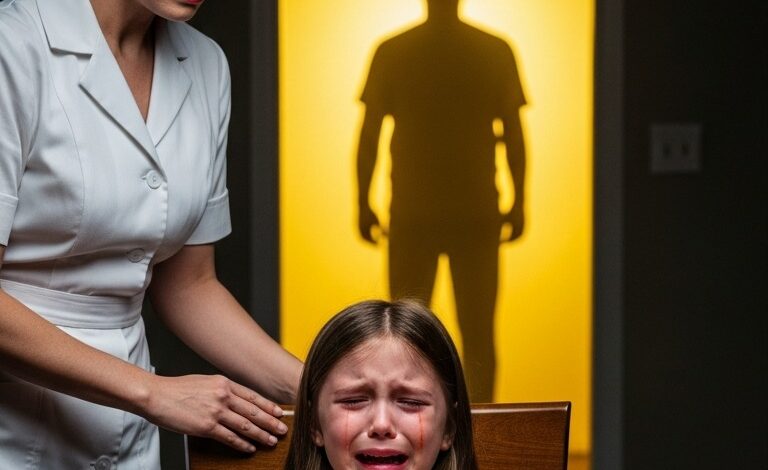
Lisa Harrison ended a night shift the way she usually did—tired, hungry, and already counting the hours before she’d be back tending to sick kids at St. Mary’s in Boston. Her phone buzzed as she walked out of the hospital. It was her sister Kate, and the tension in her voice cut through the early-morning quiet. She needed to be hospitalized for the birth of her second child, and she needed someone to watch her seven-year-old daughter, Emily.
Lisa didn’t hesitate. Emily was her favorite person in the world, and the idea of spending a week with her felt like a gift. When she arrived at Kate and Mike’s house the next day—a pristine little suburban box with flowers that looked too perfect to be real—Emily ran to her. Lisa hugged her tightly, surprised by how light the girl felt in her arms.
Dinner with the family was surprisingly quiet. Emily barely spoke and ate even less. Both parents praised her for being “such a good girl,” obedient, polite, always cooperative. Lisa found it odd, but brushed it off. Some kids were simply shy.
The next morning, Lisa took Emily home to her apartment. From the moment they walked in, something felt off. Emily followed every instruction perfectly, spoke softly, and constantly apologized for things Lisa didn’t even notice. When they made pancakes together, Emily cut hers into tiny, precise bites and barely ate half. At the park, she refused to join the other kids, choosing instead to quietly observe as if she was afraid to take up space. At the store, she didn’t ask for a single thing—not candy, not toys, nothing.
Lisa told herself she was overthinking it. Kids vary. Maybe Emily was just unusually polite. But the silence, the compliance, the constant apologies—they gnawed at her.
On the third evening, when Lisa asked what Emily wanted for dinner, the girl whispered one request: spaghetti. The first personal preference she’d expressed all week. Lisa poured her heart into making it. When she set the plate down, Emily stared at it like she was looking at something dangerous. She lifted a forkful, touched her tongue to it, and instantly gagged. The spaghetti fell back to the plate, and Emily broke into shaking sobs, apologizing again and again.
Alarm surged through Lisa. She knelt beside her. “Emily, sweetheart, what’s happening? Are you sick?”
“I’m sorry,” Emily cried. “I’m so sorry. I didn’t mean to.”
This wasn’t normal. This wasn’t just picky eating. Lisa could feel her medical instincts kicking in. She grabbed her keys and took Emily to the ER, the girl trembling the entire drive, begging not to go.
At the hospital, Emily clung to her but followed instructions with eerie obedience—no crying, no resistance, even when the blood draw came. Dr. Wilson, a colleague Lisa trusted, ordered tests. While they waited, Emily curled up in her chair, too afraid to say anything.
When Dr. Wilson called Lisa into an exam room alone, his expression was ice-cold serious.
“Lisa,” he said, “Emily is severely malnourished.”
Lisa blinked at him, stunned. “That can’t be right. My sister and her husband—”
“I’m telling you what her body is telling me,” he said. “Her protein levels are extremely low. Her weight is far below average. Her bone density is compromised. This is long-term deprivation, not a short phase or picky eating. Months, possibly years.”
The words hit like blows. Emily’s tiny appetite, the fear, the obedience, the trembling—all the pieces snapped together into a brutal picture.
When Dr. Wilson interviewed Emily the next morning, the truth trickled out in halting whispers. She didn’t eat breakfast or lunch at home. Dinner was small, and only if she’d been “good.” Her parents punished her for saying she was hungry. They told her she’d get fat. They told her she was selfish. They locked her in her room if she asked for food. They instructed her to lie to teachers and relatives. And with a new baby on the way, they said Emily needed to be “even better” because the baby deserved the attention.
Emily told the story like she expected to be scolded for speaking. She cried when Lisa told her she’d done nothing wrong.
Child Protective Services came that afternoon. Emily was placed under protective custody immediately. Lisa stayed with her that night, holding her when she woke from nightmares, promising she was safe now. Emily kept asking the same question: “Am I a bad child?” And every time, Lisa answered the same way, with quiet, furious conviction: “No. You’re not. You never were.”
The investigation moved fast. The evidence was overwhelming. Within six months, Kate and Mike were charged with abuse and neglect. Their parental rights were terminated. In court, Kate cried and blamed stress, but no excuse could touch what they’d done.
The only bright truth that rose from the wreckage was this: Emily wasn’t going back.
Two weeks later, Lisa adopted her.
Emily’s recovery wasn’t instant, but kids have a resilience adults can only envy. With proper meals, counseling, and a stable home, she grew—physically, emotionally, socially. She made friends at school. She learned to ask for seconds. She started to laugh. She sang in the car. She took up drawing again, this time using the whole page, not tiny cramped corners.
One morning over pancakes, Emily asked the question Lisa had been expecting.
“Mom, why did my old parents treat me like that?”
Lisa told her the truth gently. Some adults fail at being parents. Some never learned how to love. But none of that had anything to do with Emily’s worth.
“Families aren’t just blood,” Lisa said. “Families are the people who love you and show up for you. That’s us.”
Emily took that in, nodded slowly, and smiled—open, real, unguarded.
“We’re a real family now,” she said.
And she was right.
Every night, Lisa read her a story. Emily let Lisa kiss her forehead. No flinching, no apology. Just trust.
And every night, as Lisa watched her daughter drift into safe, peaceful sleep, she felt the same thing: gratitude that Emily’s story didn’t end where it could have. Gratitude that she’d been there to see the cracks, ask questions, follow the truth.
Emily’s smile became Lisa’s purpose. Her laughter became the proof that love—real love—can rebuild a life from the bones up.
The kind of love that makes a family real in every way that matters.