The crematorium was unnaturally quiet, the kind of silence that presses against your ears until your own breathing feels too loud. The man stood beside the coffin, his hands hanging uselessly at his sides, staring at the polished wood as if it might open on its own. Inside lay his wife. Seven months pregnant. Seven months of whispered plans, half-painted nursery walls, and arguments over names that now felt like memories from another lifetime.
Two lives were supposed to end today.
The accident had come without warning. Rain slicked the highway, tires lost their grip, metal screamed, and in one violent moment everything they were building was erased. The doctors spoke in practiced tones, explaining injuries, apologizing with their eyes. They said his wife could not be saved. They said the baby was gone too. No heartbeat. No signs of life. He remembered nodding, signing papers, answering questions he barely heard.
Now there was only this final ritual. Fire. Ash. Goodbye.
When the staff began preparing the cremation, the man felt something twist inside his chest. A pressure, sharp and irrational, as though his body knew something his mind refused to accept. He tried to step back, to let the process continue, but his feet wouldn’t move.
“Open it,” he said suddenly, his voice hoarse and unfamiliar. “Please. I need to see her one last time.”
The workers exchanged glances, then slowly lifted the lid.
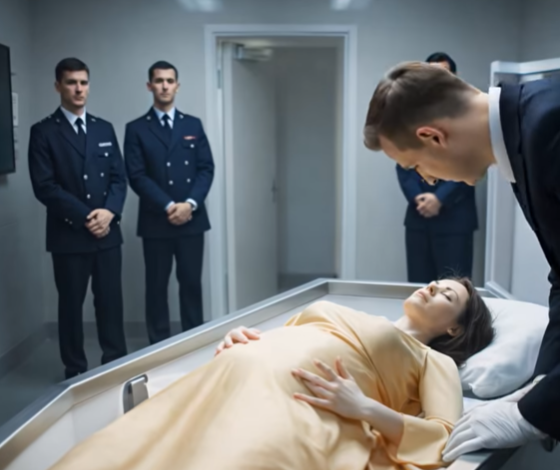
His wife looked peaceful, almost untouched by the violence that had killed her. Her face was pale, serene. Her hands rested gently on her stomach, the same way they had every night when she fell asleep beside him. He took a step closer, swallowing hard.
And then he saw it.
Her stomach moved.
At first, his mind rejected the image entirely. Grief can do terrible things. Exhaustion, shock, denial—all of it could conspire to create hallucinations. He blinked, rubbed his eyes, leaned in closer.
The movement happened again.
Small. Subtle. Undeniable.
His breath hitched. The room tilted.
“Stop,” he whispered.
No one reacted.
“STOP EVERYTHING!” he screamed, his voice shattering the silence like glass.
The staff froze. Alarms hadn’t gone off, no machines were screaming warnings, but the sound of his terror was enough. He lunged toward the coffin, gripping his wife’s shoulders, calling her name, shaking her gently, then desperately. She didn’t respond. Her face remained still.
But her stomach moved again.
Doctors were called. Then more staff. Then authorities. The room filled with murmurs and uneasy explanations. Muscle contractions, someone suggested. Post-mortem spasms. Gas buildup. Words meant to calm, to rationalize.
None of them explained what his eyes kept seeing.
When specialists arrived and the body was examined again, the truth emerged slowly, horrifying and miraculous all at once.
His wife was gone. Completely, irrevocably dead.
But the baby wasn’t.
The child’s heartbeat was faint, erratic, barely clinging to rhythm. So slow and unstable that standard equipment had failed to detect it earlier. After the crash, his wife’s body had suffered extreme trauma—oxygen deprivation, shock, a rapid drop in temperature. Under those rare and catastrophic conditions, the baby’s vital signs had all but vanished, as if he had retreated inward, conserving what little life he had left.
A specialist later called it a biological anomaly. A survival response so rare it bordered on myth.
To the father, it felt simpler than that.
His son had refused to die.
Emergency surgery followed. The child was delivered weak, silent, barely breathing, his skin tinged blue. Machines took over what his tiny body could not do on its own. Hours passed. Then days. Every minute felt borrowed.
Against every expectation, the baby stabilized.
And then the investigation began.
Because as doctors combed through records and timelines, inconsistencies surfaced. Reports didn’t match test results. Files had been altered. Someone had signed off on conclusions too quickly, too confidently.
The accident, it turned out, hadn’t been an accident at all.
The man learned the truth in fragments, each piece colder than the last. His sister had known that once the child was born, the family fortune—his entire business empire—would pass to his wife and their son. She had panicked. Afraid of losing control, afraid of being cut out, she had reached for the one solution she believed would erase the problem permanently.
Through intermediaries, she arranged the crash. Through money, she ensured the hospital paperwork declared both mother and child deceased. No baby meant no inheritance transfer. Clean. Final.
She believed she had won.
What she hadn’t counted on was a child who refused to disappear quietly.
The baby had no voice. No strength. No way to beg for help. All he could do was move—once, barely, at the exact moment his father chose to look back instead of walk away.
That movement unraveled everything.
The sister was arrested. The doctors who took bribes lost their licenses and their freedom. The story never fully made it to the public. Too disturbing. Too unbelievable. Official statements reduced it to “medical error” and “criminal conspiracy,” stripped of the raw terror that lived in the father’s memory.
Years later, he would sit beside his son’s bed and watch his chest rise and fall, steady and strong. He would remember the coffin. The silence. The moment he almost left without asking for one last look.
A doctor once told him, quietly, “From a medical standpoint, this should not have happened.”
The father nodded and replied, “Then it wasn’t medicine. It was will.”
His son grew up knowing the story—not as a horror, but as a reminder. That life can cling to the smallest opening. That love can notice what everyone else misses. And that sometimes, survival begins with a single, desperate movement seen by the one person who refuses to turn away.