I am fifty-eight years old, a high school English teacher who has spent decades analyzing the subtext of literature, yet I somehow managed to miss the glaring subtext of my own life. My days are usually a predictable rhythm of grading essays on symbolism and living on excessive amounts of caffeine. My husband, Mark, is a steady, practical electrical engineer—the kind of man who functions as the structural foundation of our family. We were supposed to be coasting into a quiet, empty-nest phase of our lives, but as I’ve recently learned, the universe often has a flair for the dramatic just when you think the show is over.
The catalyst for this upheaval was my eighty-two-year-old mother, Margaret. Mentally, she remains sharp enough to cut through any nonsense with a single dry remark, but physically, time has begun to collect its debts. After she fractured her hip in January, the fiercely independent woman who used to mow her own lawn was suddenly confined to a recliner. My father had passed away ten years ago, leaving her comfortably settled with farmland, stocks, and the house they had occupied for four decades. To ensure her safety while I continued to work, I did the responsible thing and hired a caregiver.
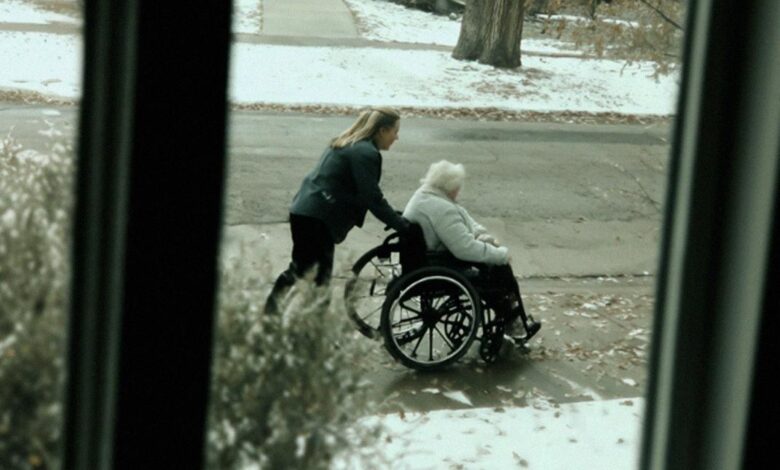
Enter Alyssa. At twenty-six, she was a breath of fresh air—organized, calm, and deeply respectful. She didn’t treat my mother like a toddler; she treated her like a person. Within weeks, she had transformed Mom’s “toast and cheese” diet into actual meals and had her diligently performing her physical therapy exercises. It felt like an answer to a prayer. Every Sunday afternoon, Alyssa would take Mom for a slow, gossipy walk around the block. It was a ritual they both seemed to cherish.
However, a few months into her employment, the atmosphere shifted. Mom began returning from those Sunday walks looking tense, her eyes occasionally red and puffy. When I asked how the walk was, she would offer the same hollow, rehearsed response every time: “It was nice, honey.” My mother is many things, but she is not a broken record.
The breaking point came last Sunday. When they returned, Mom looked visibly shaken, her hand trembling on her walker as she retreated straight to her bedroom. Alyssa gave me a bright, brittle smile that didn’t reach her eyes. Driven by a gut feeling I couldn’t ignore, I decided to check the audio on the video doorbell we had installed for Mom’s security.
As I sat at my dining table that night, the clip played back, and my heart nearly stopped. Through the speaker, I heard my mother’s voice, small and shaky: “I can’t keep this from my daughter. She deserves to know what you told me.”
Then came Alyssa’s response, low and steady: “You’re not ready to tell her yet. She might react badly. This could change everything.”
My mind immediately spiraled into worst-case scenarios. Was Alyssa manipulating her? Was she trying to swindle an elderly woman out of her inheritance? I barely slept, my brain writing dark essays about betrayal and financial elder abuse. The following Sunday, I took action. I intercepted them at the door and told Alyssa to take the afternoon off. Something flickered in her expression—not quite guilt, but a profound sort of apprehension.
Once the door was locked behind her, I sat before my mother. “Mom,” I said, “I heard the doorbell recording. I know you’re keeping something from me. What could possibly ‘change everything’?”
The truth, when it finally emerged, hit me with more force than the car accident that took my father. Mom took a shaky breath and whispered, “It’s about your father. He wasn’t faithful, once, about twenty-seven years ago. He had an affair, and there was a baby. A girl.”
The air in the room felt like it had turned to lead. “You’re telling me I have a sister?” I asked, my voice barely audible.
“Not just a sister,” Mom replied, her eyes wet with tears. “Alyssa.”
For a moment, I actually laughed—a sharp, hysterical sound born of pure shock. Alyssa, the woman I had invited into my mother’s home, was the living evidence of a secret my father had carried to his grave. Mom explained that Alyssa had approached her during their walks, but she hadn’t come empty-handed. She had been terrified of rejection, so she had surreptitiously taken a strand of my hair from a brush I’d left on the counter and run a DNA test.
“She knows it was wrong,” Mom said, pleading Alyssa’s case. “But she wanted to be sure before she upended our lives. The tests confirmed it. You are half-sisters.”
I sat in silence, staring at the family photos on the wall. There was my father, the man I thought was solid and predictable, now revealed as someone who had led a double life, leaving a daughter in the shadows while he provided me with every possible security. Alyssa had grown up with nothing—no child support, no visits, no acknowledgment. When her mother, Elena, passed away, Alyssa went looking for the man who had vanished from her life, only to find my mother instead.
My initial reaction was a hot, irrational flare of anger at the violation of my privacy—the stolen hair. But following closely behind was a crushing wave of guilt. While I was growing up in a stable home, Alyssa was wondering why she wasn’t “lovable” enough for her father to stay.
“I’m giving her a portion of what your father left me,” Mom added, her voice firm. “It’s not taking from your share, honey. It’s just correcting a piece of his wrong.”
I told Mom to call her. I wasn’t ready to forgive, but I was ready to see her without the mask of the “caregiver.” Alyssa returned that evening in plain clothes, looking younger and infinitely more vulnerable. She apologized immediately for the DNA test and the secrecy.
“I didn’t come for money,” she whispered. “After my mom died, I realized I had no one left who shared my history. I just wanted to know if he had been a decent man to someone. I wanted to see the life he chose.”
We did a new DNA test—this time with my full, legal consent. When the results arrived in my inbox, the “half-sibling match” was undeniable. There it was: the biological truth.
Integrating Alyssa into our lives has been a messy, painful, and complicated process. I told my husband, Mark, who was initially furious on my behalf before softening as he saw the genuine bond forming between Alyssa and my mother. My children were shocked to discover they had a “secret aunt” so close to their own age, but they’ve begun to bridge the gap with the ease that only young adults possess.
Now, the atmosphere in my mother’s house has fundamentally changed. Alyssa still cares for her, but she is no longer just an employee. She sits at the table for dinner; she helps Mom with crosswords; she listens to the stories of the man who was our father—though he was a very different man to each of us.
I am still angry at my father for his cowardice. I am still uneasy about the way Alyssa entered our lives. But as I watch her laugh with my mother over a puzzle, I’m starting to realize that some cracks in a family aren’t signs of a collapse. Sometimes, they are simply spaces where the light—and a new person—can finally get in. My life didn’t fall apart; it simply grew larger than I ever expected.