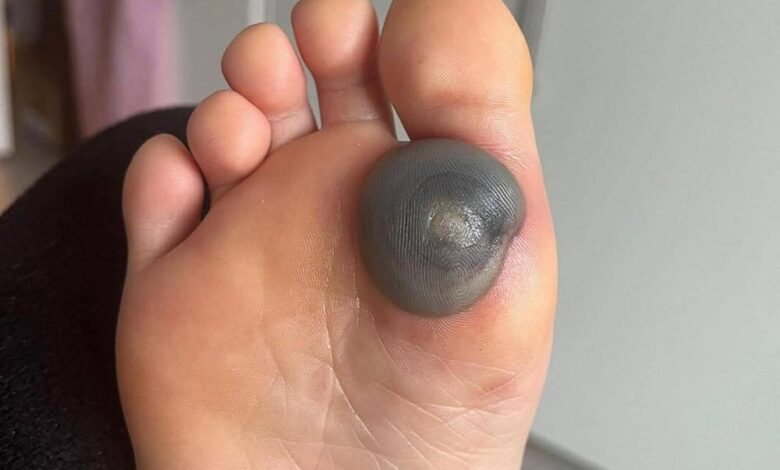
The sudden appearance of a dark, blood-filled blister on your child’s skin can be a jarring experience for any parent. One moment, their skin is clear; the next, an angry, purple-black bubble has emerged, looking like a tiny, trapped storm under the surface of the epidermis. Your immediate instinct might be a mixture of panic and confusion. You tell yourself it is “just a blister,” a minor inconvenience of childhood, yet the visceral appearance of it—swollen, dark, and seemingly full of pressure—suggests something more sinister. As a parent, you find yourself caught between the desire to fix it and the fear of making it worse.
To understand how to treat these spots, one must first understand the anatomy of the injury. A blood blister is a specific type of subepidermal hematoma. Unlike a standard friction blister, which is filled with clear serous fluid, a blood blister occurs when a more forceful trauma ruptures the fragile capillary vessels deep within the dermal layer without breaking the protective surface of the skin. This results in a pocket of blood being trapped in a raised, pressurized bubble. It is essentially a bruise that reached the surface but lacked an exit point.
The most common catalysts for these “angry” spots are mechanical injuries. We often see them after a finger is slammed in a heavy door, a toe is pinched by poorly fitting athletic shoes, or the palm of a hand is subjected to intense, repetitive friction from garden tools or sports equipment. In children, these injuries happen in the blink of an eye—a slip on the playground or a miscalculated grip on a bicycle handlebar. Because the skin remains intact, the body’s natural defense mechanism is to keep that fluid sealed away from external bacteria, creating a sterile environment for the healing process to begin.
When these blisters appear in the mouth, the emotional reaction is often even more intense. Oral blood blisters, or angina bullosa haemorrhagica, can appear on the tongue, the inside of the cheeks, or the palate. These are frequently triggered by accidental biting while eating, trauma from sharp dental appliances, or even the consumption of excessively hot or hard foods. While they look alarming against the pink backdrop of the mouth, their origin is usually just as mechanical and benign as a blister on the heel.
The golden rule of managing a blood blister is one that tests the patience of both parents and children: do not pop it. It is incredibly tempting to want to “drain” the dark fluid to relieve the pressure, but doing so is an open invitation for infection. The intact skin acting as the “roof” of the blister is the best natural bandage in existence. It keeps the raw, underlying tissue protected from the billions of microbes we encounter daily. When you puncture that seal, you transform a sterile injury into an open wound.
Instead, the protocol should be one of gentle vigilance. The area should be cleaned with mild soap and water, then patted dry—never rubbed. If the blister is in an area prone to further friction, such as the foot or the hand, it should be covered loosely with a breathable bandage or a specialized “donut” pad that relieves pressure from the center of the spot. Over the course of one to two weeks, the body will naturally reabsorb the fluid. The dark color will fade to a dull brown or tan as the blood breaks down, and eventually, the dried skin will peel away to reveal healthy, new tissue underneath.
However, while most blood blisters are merely a rite of passage for active individuals, patterns matter. If a child—or an adult—begins to develop these blisters frequently without a clear history of trauma, it is no longer “just a blister.” It becomes a symptom. Unexplained blood-filled spots can be the body’s way of signaling underlying systemic issues. For those living with conditions like diabetes, the body’s ability to heal is compromised, and a simple blister can quickly escalate into a serious ulcer. Similarly, those with circulation problems or clotting disorders may find that their fragile vessels rupture with almost no provocation.
There are specific red flags that every caregiver must be able to identify. If the blister begins to radiate heat, if you see red streaks emanating from the site, or if the fluid inside changes from dark red to a cloudy yellow or green (indicating pus), the injury has likely become infected. Furthermore, if the pain becomes throbbing and unbearable, or if the patient develops a fever, these are signs that the body’s inflammatory response is struggling to contain a secondary issue.
In the specific case of a daughter or son waking up with such a spot, the context is everything. If the blister is singular and located on an extremity, it is likely the result of a forgotten bump from the previous day’s play. But if there are multiple blisters appearing in clusters, or if they are accompanied by small purple dots (petechiae) or unexplained bruising elsewhere on the body, this warrants an immediate consultation with a pediatrician. This is not an overreaction; it is an essential part of listening to the body’s internal dialogue.
Medical professionals can perform simple blood tests to rule out platelet deficiencies or coagulation issues that might be causing spontaneous bleeding under the skin. They can also provide professional debridement if a blister is so large or pressurized that it risks a spontaneous, jagged rupture on its own.
Ultimately, the “huge spot” that causes so much initial fear is usually a testament to the body’s incredible ability to compartmentalize and heal an injury. By providing a clean environment and resisting the urge to intervene too aggressively, you allow the natural biological clock to do its work. However, the true value of these incidents is that they serve as a reminder to be observant. Our skin is the largest organ we have, and it serves as a billboard for our internal health. When a blood blister appears, it is an opportunity to slow down, assess our physical state, and ensure that the foundations of our health—our circulation, our nutrition, and our safety—are as robust as they should be.
If the blister heals as expected, it becomes a minor memory. If it persists or acts as the first of many, it becomes a valuable early warning. In either scenario, the dark bubble is a call to action: to protect, to observe, and to respect the delicate systems that keep us whole.


