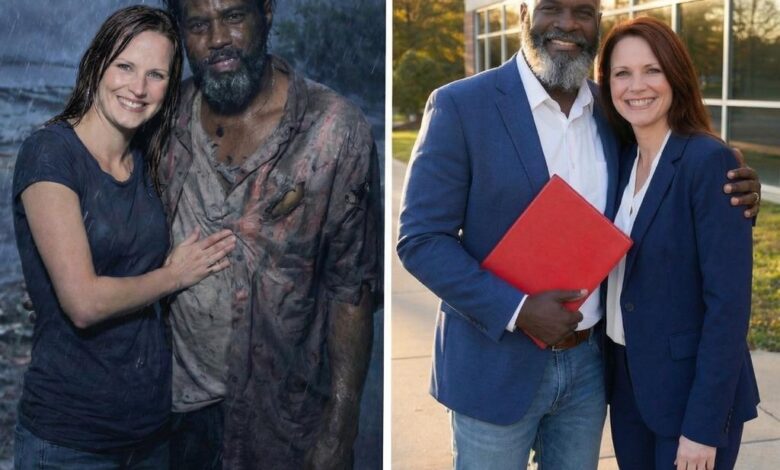
Two decades ago, I did not possess a particularly heroic self-image. I was a person of quiet habits and predictable rhythms, someone who believed that life was composed of small, manageable moments rather than grand, cinematic gestures. I wasn’t looking to alter the course of destiny or save a soul; I was simply a man living a modest life, unaware that the universe was about to test the true depth of my empathy. The night that changed everything began with a storm that felt personal in its ferocity. Thunder shook the floorboards of my small home, and rain lashed against the windowpanes with a relentless, percussive rhythm. I was in the kitchen, focused on the simple, domestic comfort of a boiling kettle, when a sound rose above the wind—a knock at the door, so faint and erratic that I initially mistook it for a branch scratching against the wood.
When I pulled the door open, the fury of the gale rushed into my hallway, bringing with it a man who seemed to be more shadow than flesh. He nearly collapsed into my foyer, a shivering figure whose clothes were torn and heavy with the freezing deluge. His skin was a ghostly, translucent grey, and his eyes were hollowed out by a weariness that transcended mere physical exhaustion. He looked at me with a desperate, naked vulnerability and whispered a plea that was barely audible over the crashing thunder: “Please… I just need help.”
In that heartbeat, the natural hesitation that usually guards a person’s privacy vanished. There was no internal debate about the risks of letting a stranger into my home or the potential for trouble. There was only the immediate, undeniable reality of another human being in distress. I guided him inside, the water from his sodden coat pooling on my floor. I wrapped him in the heaviest wool towels I owned, found him a set of dry, oversized flannels, and sat him by the heater with a bowl of steaming soup. His name, he told me between shudders, was James. He spoke very little that night, and I didn’t press him for his story. I didn’t need to know how he had ended up on my doorstep in the middle of a tempest; I only needed to ensure that, for a few hours, the world felt less cruel to him. He slept on my couch as the storm eventually exhausted itself, and the house fell into a deep, restorative silence.
By the following morning, the atmosphere had shifted entirely. The rain had washed the world clean, and sunlight streamed through the windows in brilliant, golden shafts. James looked transformed in the daylight—still frail, but with a spark of renewed life in his gaze. As he prepared to leave, he stood in my doorway and looked me directly in the eyes with an intensity that made me catch my breath. “One day, I’ll repay your kindness,” he promised. His voice was steady, carrying the weight of a solemn vow. I gave him a small smile and shook my head, telling him that he owed me absolutely nothing. I told him that the only repayment I required was for him to take care of himself and find his way back to whatever light he was seeking. I watched him walk down the driveway until he disappeared around the bend, and then I went back to my life.
Over the next twenty years, that night became a soft, blurred memory. In the relentless rush of existence—the changing of jobs, the loss of loved ones, the shifting of seasons—the story of James became a quiet anecdote I rarely revisited. I assumed he was just another traveler who had passed through my life, a momentary connection forged in a storm and lost in the sunlight. I never expected to see him again, and I certainly never expected that a few hours of hospitality would linger in a man’s heart for two decades.
Then came the second knock. It happened on a Tuesday afternoon, a day as unremarkable as any other. This knock was not the desperate scratching of twenty years ago; it was confident, calm, and deliberate. When I opened the door, I found myself looking up at a tall, impeccably dressed man. He possessed a composed, commanding presence, a neatly trimmed silver beard, and a smile that seemed to bridge the vast chasm of time. I blinked, my mind racing through a catalog of faces, struggling to place the familiarity in his eyes. Before I could speak, he said softly, “I think you already did.”
The name came to me like a whisper from a previous life: “James?”
He nodded, a tear shimmering in the corner of his eye. I invited him in, and as we sat in the same living room where he had once shivered under a towel, he shared the odyssey of his last twenty years. That stormy night had been his absolute rock bottom—a moment when he had convinced himself that he was invisible and that his life held no value. My decision to open the door hadn’t just given him dry clothes; it had provided him with the evidence that he still mattered to someone. That realization had been the catalyst for his transformation. He had spent those two decades working with a singular, quiet determination, moving through setbacks and study, building a career and a life from the ashes of his past. Through every struggle, he told me, he had carried the memory of that soup and that couch as a reminder of human grace.
Finally, James reached into a leather satchel and pulled out a thick, heavy folder. He placed it on the coffee table between us—a tangible symbol of the promise he had kept for twenty years. As my hands trembled while opening it, I realized that the “repayment” he spoke of was far greater than any financial sum. It was a collection of documents—scholarships he had established in my name for struggling students, a deed to a community center he had helped fund, and a personal letter detailing how he had paid that kindness forward to hundreds of others.
In that moment, the true magnitude of a simple gesture was revealed to me. I had offered a stranger a bowl of soup and a place to sleep, an act that cost me nothing but a few hours of sleep and a bit of laundry. Yet, that small seed of compassion had grown into a forest. I understood then that we never truly see the end of the ripples we create. When we offer connection to someone in need, we are not just helping one person; we are potentially altering the trajectory of an entire lineage of kindness.
James stayed for hours, and as he eventually stood to leave, we embraced—not as a benefactor and a debtor, but as two people who understood the profound, invisible threads that bind us together. As I watched him drive away this time, I stood in the doorway for a long time, looking at the sunlight on the driveway. I realized that twenty years ago, I had thought I was the one giving something away. Today, I understood that I was the one who had received the greatest gift of all: the knowledge that in a world of storms, a single open door can be enough to change everything forever.


