Throughout the history of the partnership between humans and animals, few bonds have proven as vital or as intellectually profound as that of the working canine. These remarkable creatures have transcended their origins as wild predators to become cornerstone figures in modern civilization, serving as emotional support anchors, service guides for the disabled, and highly specialized operatives in law enforcement. Within the rigorous world of the K9 unit, breeds like the German Shepherd, Belgian Malinois, and Labrador Retriever are more than just animals; they are sophisticated biological detection systems capable of identifying chemical signatures—ranging from narcotics and explosives to human remains—that are entirely invisible to their human handlers.
Among this elite class of working dogs, a German Shepherd named Max had established a reputation for unwavering precision and an almost preternatural instinct for the anomalous. Max had spent years serving alongside Officer Kelly, and their relationship was defined by a deep, non-verbal communication that allowed them to navigate high-stakes environments with a single shared gaze. While Max’s presence in a facility usually radiated a sense of calm and security, his behavior during a routine patrol at a prominent metropolitan hospital would soon unravel a criminal conspiracy hidden in plain sight.
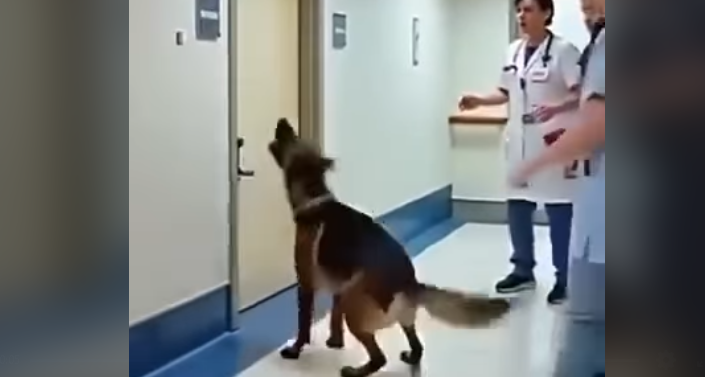
The incident began on a Tuesday that seemed indistinguishable from any other. The hospital, a vast labyrinth of sterile corridors and muffled activity, was under the watchful eye of the security K9 team. As Max and Officer Kelly proceeded through the quietest wing of the facility, they passed Room 207—a room that had been officially decommissioned and unoccupied for several months due to pending renovations. Under normal circumstances, Max would have moved past the door without a second glance. However, as they crossed the threshold of the hallway, Max’s posture shifted instantly. His ears pinned forward, his tail stiffened, and he emitted a low, guttural growl that stopped Officer Kelly in her tracks.
Suddenly, the silence of the wing was shattered by Max’s persistent, frantic barking directed squarely at the door of Room 207. For Officer Kelly, this was an alarming deviation from his standard training. Max was a professional, trained to signal discoveries with a “sit” or a subtle “point” during narcotics searches. This level of vocal intensity indicated something far more urgent and chaotic. Knowing that Max’s instincts were grounded in years of empirical success, Kelly motioned for the hospital staff to bring the master key, her hand resting instinctively on her radio.
The staff expressed immediate skepticism, noting that the room had been locked and empty for a significant duration. Yet, the moment the heavy door swung open, the skepticism evaporated. The interior of Room 207 was a scene of disturbing disorder. This was not the pristine, vacant room the hospital records described. Instead, furniture had been aggressively overturned, walls were stripped of their paneling, and a complex tangle of wires and high-end medical equipment lay scattered across the floor in a state of systematic disarray.
Max did not stop at the doorway. He lunged into the room, his nose tracing the perimeter of the far wall with frantic energy. He began scratching violently at a section of the drywall that appeared slightly misaligned near a ventilation duct. Officer Kelly, following Max’s lead, examined the area and discovered that a concealed compartment had been expertly fashioned behind the loosened section of the wall. This was not a maintenance error; it was a deliberate, sophisticated hideaway.
Upon further inspection, the authorities uncovered a trove of illegal substances and suspicious materials that suggested the room was being utilized as a centralized hub for a covert distribution network. The “vacant” status of the room had provided the perfect cover for criminal actors to operate within the very heart of a public safety institution, preying on the high volume of foot traffic to move materials undetected. The tangled wires and medical gear were part of a makeshift laboratory setup, hidden behind the administrative veil of a hospital renovation project.
The ripple effects of Max’s discovery were immediate. Backup was summoned, the wing was placed under a total security lockdown, and a federal investigation was launched to identify the individuals who had leveraged the hospital’s infrastructure for illicit gain. The sheer intellectual honesty of the dog’s response had accomplished what months of human surveillance and administrative audits had failed to do. Max had smelled the chemical “rot” behind the gypsum and paint, identifying a threat that was structurally and legally invisible to the humans around him.
In the aftermath of the raid, the hospital administration and local law enforcement held a commendation ceremony to honor Max and Officer Kelly. The story of Room 207 became a case study in the importance of trusting the sensory capabilities of specialized K9 units. It served as a stark reminder that in the complex, often deceptive world of human affairs, the unbiased and focused senses of a dog remain one of the most effective tools for justice. While technology continues to advance, the organic, evolved precision of a German Shepherd like Max proved that some things cannot be replicated by sensors or cameras.
For Max, the praise and the treats were secondary to the fulfillment of his purpose. He returned to his duties shortly after, walking the same corridors with the same quiet dignity he had always possessed. However, the staff at the hospital now viewed him with a new level of reverence. He was no longer just a dog on a leash; he was the guardian who had looked at a blank door and seen the truth hidden behind it.
His legacy is a testament to the fact that loyalty and instinct are powerful forces when properly channeled. By uncovering the covert operation in Room 207, Max didn’t just solve a crime; he restored the sanctity of a place dedicated to healing. In a world where chaos can often find a place to hide, the watchful eyes and keen nose of a K9 officer ensure that the light of accountability reaches even the darkest corners of our public spaces. Max’s story continues to inspire, reminding us that sometimes the most profound insights come not from human intellect, but from the silent, steadfast observation of our four-legged partners.