When I was eight years old, a boy at school asked me what my mother did for a living. I told him the truth, without hesitation. “It’s a garbage dump.”
He laughed so loudly that others gathered around, curious. That day marked the beginning of a new life, one defined by whispers, glances, and the cruel nickname they gave me.
“The Garbage Boy” became permanent. Recess, class, even teachers occasionally said it as a joke. I forced laughter, hiding the pain that burned inside, crying alone when nobody watched.
At home, I would lock myself in the bathroom, letting tears stream until I felt I might stop breathing. My mother, exhausted, never noticed. She worked long, grueling hours.
She left at four in the morning, returning at six in the evening, her uniform soaked with sweat and smell no soap could fully erase, yet always wearing a patient, loving smile.

“How was school, son?” she asked. “Okay, Mom,” I lied. I was doing poorly socially, not academically. I was always first in my class but invisible among peers.
Nobody wanted to sit with me. Nobody invited me to parties. Group projects assigned me to other rejected students. And I hated it, hated myself, hated my mother’s job silently.
I resented that we had no money. While classmates’ parents arrived in SUVs, my mother came in a borrowed garbage truck, stinking, making me shrink further, wishing to disappear from public view.
In high school, I once asked her not to pick me up after school. She looked confused. “But son, it’s too far for you to walk,” she said gently.
“It doesn’t matter, Mom. I want to exercise,” I lied. She understood. That day, I walked two hours in the sun, returning to find her crying silently in the kitchen.
She never asked why. I never explained. Since then, she never picked me up again. I carried the guilt for years, longing to ease her burden, longing to escape judgment from classmates.
When choosing a career, everyone expected practicality, something quick to provide money. I shocked them all. I chose Medicine, not for myself but to honor her sacrifices and prove our worth.
“Medicine? Are you crazy?” they asked. “It costs a fortune and lasts seven years.” I knew. That’s exactly why I chose it: to defy expectations, to repay my mother’s hard labor.
University was merciless. Everyone else had wealth. Cars, designer clothes, vacations to Europe. I arrived in two worn pairs of pants, glued shoes, carrying books instead of food, studying on empty stomachs.
At a classmate’s mansion party, someone asked our parents’ occupations. Engineers, lawyers, businessmen. My turn arrived. I hesitated. “I don’t have a dad,” I said. “And my mom?” Silence. “She works in cleaning.”
It wasn’t a lie, but it wasn’t the full truth. Soon, the university knew. Comments, glances, laughter, now more sophisticated, more biting, but I endured, fueled by determination to rise above ridicule.
I studied harder than anyone. While peers partied, I stayed in libraries. While they slept, I read with a flashlight during power outages. And I excelled, first in every class, always.

Graduation approached. Seven years of endurance. Highest average in my class. My turn to give the farewell speech, 300 people in the auditorium, families with cameras, balloons, flowers. And my mother invited.
She worked until the last moment. A garbage truck broke down on her route. She worried she’d be fired if she didn’t cover it. I insisted she come. Her presence mattered most.
She arrived straight from work, uniform soaked, boots caked in grime, hair messy, smell lingering. I saw her, and she saw me. That smile, enduring, warm, had kept me alive inside for twenty-five years.
I approached the stage, microphone in hand, trembling. Faces of those who mocked me for years stared. I paused, heart racing, then began, “Good afternoon. My name is Daniel Martínez, and I have the honor…”
“I have the honor of speaking today after seven years of effort, failure, endurance, and growth. Many ask why I succeeded. Intelligence? Sacrifice? Hard work? There is another truth beneath it all.”
Silence filled the room. “Every time I wanted to give up, every time the teasing was unbearable, every time despair whispered in my ear…” My voice trembled as I continued, pointing toward my mother.

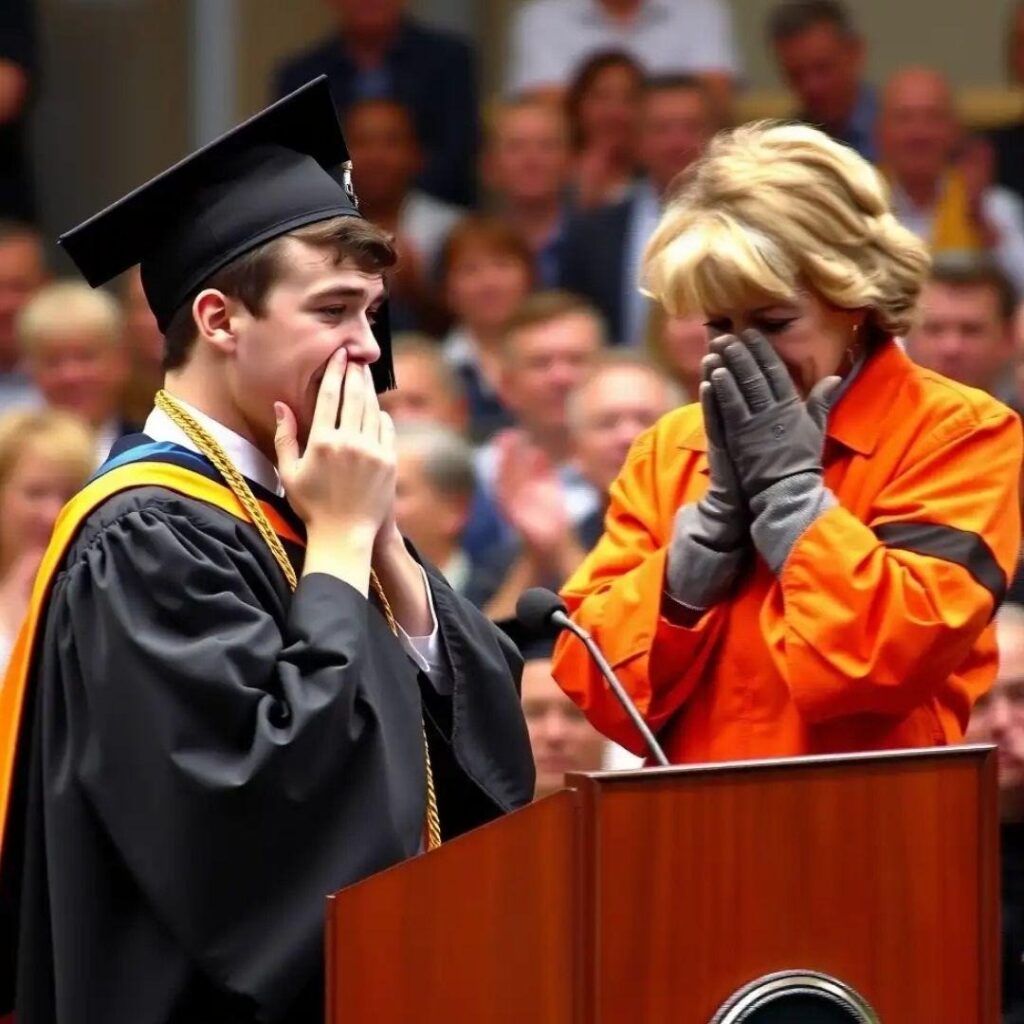
“That woman, in the orange uniform, is my mother. She collects the trash you discard, so you can live in a clean world. And I became a doctor, to clean wounds.”
Dead silence. The auditorium froze. For three eternal seconds, no one breathed, no one moved. Then, a slow clap. Another. Soon, the entire room erupted in applause, tears streaming from eyes everywhere.
Except my mother. She sat, hands over her face, crying quietly, overwhelmed. I stepped down, knelt in front of her. “Forgive me, Mom,” I whispered. She embraced me immediately.
“I’m sorry for pretending, for asking you to hide, for lying about your work. I’m sorry for everything,” I said. She held me tighter, warmth washing over decades of pain and sacrifice.
That night, colleagues who mocked me approached. “Sorry, brother. We didn’t know…” I nodded. Forgiveness isn’t forgetting. It’s releasing the weight that has been killing you quietly for years.
Two years later, she retired from garbage collection. I specialize in reconstructive surgery, working in public hospitals, treating people who lack resources, ensuring dignity and care, honoring her sacrifices with every patient I treat.
My mother now lives with me. A bright room overlooking a garden she tends. No trash, no smell. Only flowers, sunlight, and pride. Each day I check on her, saying truthfully, “How was your day, Mom?”
A month ago, I spoke at my old university about adversity and resilience. About the woman who spent thirty years collecting garbage so her son could heal people’s wounds and pursue his dreams.
A student asked, “What would you say to someone ashamed of their parents?” I replied, “True pride lies not in possessions, but in sacrifice, honesty, and love. That is wealth beyond any fortune.”
The applause echoed. But the real reward was my mother’s healed hands, her radiant smile, pride replacing exhaustion. She had carried me for twenty-five years. Now I carried her, figuratively and truly.
The world will judge. It will wound. It will make you feel small. But you can let that define you, or you can rise above, fueled by love, not shame, not fear.
I chose to rise. To turn insults into motivation, tears into perseverance, shame into inspiration. I graduated, became a doctor, and proved that dignity and worth are measured by heart, not occupation.

Now, when people ask my story, I tell them: your parents’ jobs don’t determine your future. The sacrifices they make, the love they give, those define who you are and who you can become.
My mother carried me for twenty-five years, lifting burdens I could not see, giving me a future in a world that tried to break me. Now, I honor her, every day, in everything I do.
If you feel ashamed of where you come from, remember this: courage, resilience, and love surpass wealth. True pride is inherited through sacrifice, honesty, and unconditional support, not bank accounts or luxury cars.