PART 1: THE SMELL OF BURNT TOAST
The first sign wasn’t the shaking. It never was. It was the smell.
Burnt toast.
It filled the interior of the luxury BMW X7, overwhelming the scent of the new leather seats and Greg’s expensive sandalwood cologne. It was acrid, thick, and suffocating, like someone had left a slice of bread in a toaster set to max and walked away.
Mia, nineteen years old, sitting in the passenger seat with her hands gripping her knees, knew there was no toast. She hadn’t eaten breakfast; she never did before appointments. She knew exactly what this was.
An aura. The neurological storm warning before the hurricane.
“We’re going to be late, Mia!” Greg shouted, slamming his hand on the steering wheel as he navigated the chaotic drop-off lane of St. Jude’s Hospital. The veins in his neck bulged against his starched white collar. “I have a tee time at 10:00 with the partners. If I miss it because of your drama, you’re walking home.”
Mia tried to answer. She wanted to say, It’s happening. Please help. Please pull over.
But her tongue felt like it was made of lead. It was swollen and heavy in her mouth. The words dissolved in her throat before they could form. The world outside the window—the nurses in blue scrubs smoking by the fountain, the patients in wheelchairs, the bright, blinding morning sun—tilted sideways at a forty-five-degree angle.
“Well? Get out!” Greg barked, putting the car in park but leaving the engine running. The idle hum of the engine vibrated through the seat, sending jagged spikes of pain through Mia’s skull.
Mia fumbled for the door handle. Her fingers were numb, tingling as if they had fallen asleep. They wouldn’t grip the smooth plastic latch. Her brain was sending the signal—open door—but her hand refused to receive it.
“I… can’t…” she stuttered. Her voice sounded underwater, distorted and slow.
Greg turned to her. His face was a mask of irritation, turning red with impatience. He didn’t see a nineteen-year-old stepdaughter struggling with a complex neurological disorder. He saw an inconvenience. He saw a girl who “wanted attention.” He saw a burden he had inherited when he married her mother three years ago.
“Stop it,” Greg hissed, leaning over the console. His breath smelled of coffee and mints. “Stop acting like a cripple. You were fine five minutes ago when you were texting your friends. This performance is getting old.”
Mia’s head snapped back involuntarily. Her eyes rolled up into her skull, showing only the whites. A guttural sound escaped her throat—a dry, terrifying rasp—as the air was forced out of her lungs by her diaphragm spasming.
She slumped against the cold glass of the passenger window.
Greg didn’t call a nurse. He didn’t check her airway. He didn’t recline the seat. He looked at his Rolex Submariner watch.
“Unbelievable,” he muttered. “Just unbelievable timing.”
He unbuckled his seatbelt with an angry click. He opened his door and stormed around the front of the massive SUV to the passenger side. He wasn’t rushing to save her. He was rushing to remove the obstacle blocking his golf game.
“If you won’t walk,” he hissed, grabbing the door handle, “I’ll drag you.”
PART 2: GRAVITY AND CONCRETE
Greg ripped the passenger door open.
Mia wasn’t braced. She was in the tonic phase of a Grand Mal seizure—her muscles locked rigid, her body stiff as a board. Without the door to support her, her center of gravity shifted instantly. Her upper body fell outward like a mannequin tipped off a shelf.
Greg caught her arm, but not to stabilize her. He grabbed her wrist with a crushing grip to pull her out of the vehicle faster.
“Get up! You’re embarrassing me! People are watching!” he screamed, yanking with full force.
Mia’s body slid off the slick leather seat. She was dead weight, completely unresponsive to his commands or gravity.
She hit the pavement hard.
CRACK.
The sound was sickening. It was a hollow, wet thud followed by a sharp crack—the sound of bone hitting stone. Mia’s head struck the sharp, granite edge of the curb.
Her body instantly went from rigid to thrashing. The clonic phase began. Her arms and legs jerked violently, scraping against the asphalt. Her heels drummed a frantic rhythm on the road. Saliva mixed with blood bubbled at her lips.
Blood—dark, venous, and fast—pooled under her head, staining the gray concrete a horrifyingly bright red. It spread quickly, soaking into her blonde hair.
Greg froze.
For a second, the anger remained on his face. He looked at the blood on his Italian loafers with disgust.
Then, he looked up.
A nurse was running toward them from the ER entrance, fifty yards away, shouting into her radio. A security guard was unholstering his radio. A woman in a minivan behind them was screaming.
Immediately, Greg’s face changed. It was like watching an actor switch roles mid-scene. The anger vanished. The red rage smoothed out. It was replaced by a look of panicked, devastated concern. It was a transformation so fast, so practiced, it was almost impressive.
“Help!” Greg screamed, his voice cracking perfectly. He dropped to his knees (careful not to get blood on his pants leg). “My daughter! She fell! Help me! She just had a seizure and fell out of the car!”
The nurse, a woman named Sarah with kindness etched into her tired face, slid to a halt next to them. She saw the blood. She saw the convulsing girl. She saw the distraught father hovering over her.
“Code Blue at Drop-off! Trauma! I need a gurney stat!” Sarah yelled into her radio. She grabbed a thick towel from her pocket and pressed it to Mia’s bleeding head wound.
“I tried to catch her,” Greg sobbed, wiping a fake tear from his cheek. “I opened the door to help her, and she just… she threw herself out. She was hysterical. She was flailing.”
Mia couldn’t hear his lies. She was lost in the electrical storm ravaging her brain. She didn’t feel the pain of her skull fracture. She didn’t feel the gravel tearing the skin off her elbows.
She was floating in a dark, static-filled void. She just faded into the black, leaving her body behind to be a prop in Greg’s play.
PART 3: THE IMPERFECT ALIBI
When Mia woke up, the world was too bright. The fluorescent lights overhead hummed with a frequency that felt like a drill in her ear.
She was in a hospital bed. Her head throbbed with a rhythm that matched the beeping of the cardiac monitor. She reached up with a trembling hand and felt the cold metal of staples in her scalp. A thick bandage was wrapped around her head.
“Don’t touch it,” a voice whispered from the shadows.
Mia turned her head slowly. The motion made the room spin.
Greg was sitting in the visitor’s chair next to the bed. He was leaning back, legs crossed, scrolling on his phone. He looked bored.
“Greg?” she croaked. Her throat was raw, likely from the intubation tube or just the violence of the seizure.
He looked up. His eyes were cold, dead sharks swimming in a sea of indifference.
“You really did it this time, Mia,” he said quietly, putting his phone in his pocket. “A Grade 3 concussion. Seven staples. Your mother is a wreck. She’s going to be so worried when she gets off her flight.”
“What… happened?” Mia whispered. A fuzzy memory clawed at the back of her mind. Burnt toast. The car door. The pavement rushing up to meet her.
“I told the doctors you tripped,” Greg said smoothly. “You were getting out of the car. You were flailing around, having one of your episodes, and you tripped. I tried to catch you, but you were too heavy.”
“I… didn’t trip,” Mia whispered. The memory sharpened slightly. “You pulled me. You yelled at me.”
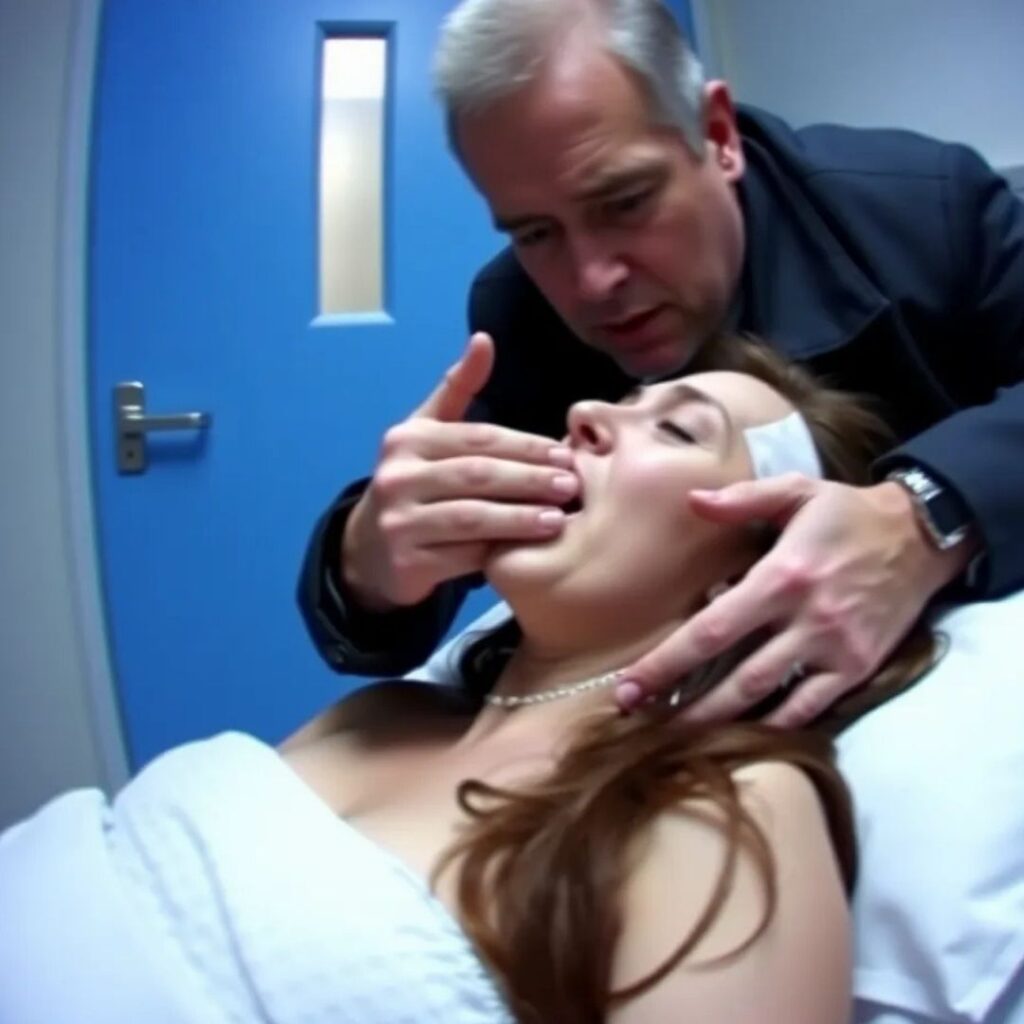
Greg stood up. He leaned over the bed rails, bringing his face inches from hers. He squeezed her hand. It wasn’t a comforting squeeze. He pressed his thumb into the soft spot between her knuckles, hard enough to bruise, sending a jolt of pain up her arm.
“Listen to me very carefully,” he said, his voice dripping with false pity but laced with steel. “You were having a seizure, Mia. Your brain was misfiring. You hallucinated. You don’t remember anything real. If you tell them I hurt you, they’ll think you’re crazy. They’ll put you in the psych ward. They’ll say the seizure made you paranoid. Do you want that? Do you want to be locked up?”
Mia felt hot tears sting her eyes. She was trapped. It was always like this. Her word against his. And her word was broken by epilepsy. Who would believe the girl with the “broken brain” over the wealthy, respectable stepfather?
The door opened.
Dr. Aris walked in. He was a young doctor with sharp, intelligent eyes and a no-nonsense demeanor. He held a metal clipboard. He didn’t look at Greg. He looked straight at Mia’s arm where Greg’s hand was still resting.
There, on her wrist, emerging from under the hospital gown, were four distinct, finger-shaped purple bruises. And on the other side, a thumbprint.
It wasn’t the scattered, random bruising pattern of a fall. It was the pattern of a grip. A vice.
“Mr. Greg,” Dr. Aris said, his tone professional but icy. “Could you step out? I need to ask the patient some private questions about her… seizure triggers. It’s standard protocol.”
“I’m her father,” Greg said, standing up to his full height, trying to use his physical presence to intimidate the smaller doctor. “I stay. She gets confused without me.”
“She’s nineteen,” Dr. Aris countered, not backing down an inch. “She’s an adult. And hospital policy strictly requires a private screening for all trauma admissions to rule out domestic causes. Step out. Now. Or I call security to escort you.”
Greg glared at the doctor, his jaw tightening. Then he looked at Mia, a silent warning in his eyes. “Remember what I said, honey. Don’t be confused. Don’t make things worse.”
He walked out, the door clicking shut behind him.
Dr. Aris waited a full ten seconds. He checked the door lock.
“Mia,” he said softly, sitting on the edge of the bed. “Those bruises on your arm. Did you do that during the seizure? Did you hit something?”
“I don’t know,” Mia sobbed, the dam breaking. “I don’t remember. He says I fell. He says I’m crazy.”
Dr. Aris nodded slowly. He didn’t write anything down. He pulled out his personal phone.
“I had Security pull the liability footage,” he said quietly. “It’s standard procedure for any injury on hospital grounds to protect us from lawsuits. We installed a new system last month. 4K cameras with high-gain audio microphones at the entrance.”
Mia stopped crying. She looked at him, hope flaring in her chest. “Audio?”
“I haven’t watched it yet,” Dr. Aris admitted. “Security just called me. The head of security, Mr. Henderson, watched it. He said… he said I should call the police before I view it. He said it made him sick.”
PART 4: THE 4K VERDICT
An hour later, the door to the room slammed open.
Greg burst back in, looking flustered and angry. He was carrying Mia’s backpack.
“We are leaving,” he announced, grabbing her discharge papers from the table. “I just got off the phone with your mother. I told her this hospital is incompetent. We are transferring you to a private clinic in the city. Get up.”
He moved to the bed to grab Mia’s arm—the same bruised arm.
“Don’t touch her.”
The voice came from the doorway. It was deep and authoritative.
Two uniformed police officers stood there, their hands resting near their belts. Behind them was the Hospital Security Chief, a large man named Henderson, holding an iPad like a weapon. Dr. Aris stood behind them, his arms crossed.
Greg laughed, a nervous, high-pitched sound that bounced off the tiled walls. “What is this? Am I being detained? I’m taking my daughter home against medical advice. That is my right as her guardian.”
“Actually,” the older officer, Sergeant Miller, stepped forward into the room, “Mia is an adult. You are not her guardian; you are her stepfather. And you aren’t going anywhere.”
“Excuse me?” Greg puffed out his chest, his face turning a mottled red. “I’m a respected businessman! I own three car dealerships! How dare you! I saved her life! She fell!”
“Did you?” Henderson, the Security Chief, asked. He stepped forward and turned the iPad screen toward Greg. “Let’s watch the replay, shall we?”
He pressed play.
The video was crystal clear. It wasn’t the grainy, black-and-white footage of old CCTV. This was high-definition, full color. It showed the silver BMW SUV gleaming in the sun. It showed the nurses smoking in the background.
And then, the sound.
Greg’s voice boomed from the iPad speakers, loud, angry, and distinct: “Get out of the car, Mia! I don’t have time for your drama today! I have a tee time!”
Greg went pale. His mouth opened, but no sound came out.
On the screen, Mia was visible through the windshield. She was clearly in distress. Her head lolled back. Her hands were curled into claws. She wasn’t being difficult; she was dying.
Then, Greg got out. The video showed him stomping around the front of the car. It showed his angry face. It showed him ripping the door open.
And then, the moment of truth. The verdict.
He didn’t reach out to catch a falling girl. He didn’t brace her. He reached out, grabbed her wrist, and yanked.
“Get up! You’re embarrassing me!”
The video showed the physics of cruelty. It showed him pulling a seizing girl onto the concrete like a sack of garbage. It showed her head snapping back. It showed the blood splatter.
And then, the transformation. The video showed Greg look around, spot the nurse running, and instantly change his face from rage to grief. It was like watching a sociopath flip a switch.
The silence in the hospital room was deafening. The only sound was the beep of Mia’s heart monitor, steady and strong.
Greg stared at the screen. He couldn’t speak. There was no “she tripped.” There was no “hallucination.” There was no “bad angle.” There was just him, in 4K resolution, being a monster.
“That’s…” Greg stammered, sweat beading on his forehead. “That’s out of context! I was panicked! I didn’t know she was seizing! I thought she was stalling!”
“Panicked people don’t worry about being embarrassed, Greg,” Sergeant Miller said coldly. “And they don’t drag unconscious people by one arm.”
He pulled out his handcuffs. The metal clicked ominously.
“Turn around. Gregory Davis, you are under arrest.”
“For what?” Greg shrieked, backing away until he hit the wall. “It was an accident! I’m rich! I can sue this hospital!”
“Aggravated Assault on a Disabled Person,” the officer listed, grabbing Greg’s arm and spinning him around. “Domestic Abuse. And since you dragged her knowing she was incapacitated, causing severe bodily injury, the District Attorney is looking at Attempted Manslaughter.”
The officer clicked the cuffs onto Greg’s wrists. They were tight.
Greg looked at Mia. His eyes were wide, desperate, pleading.
“Mia! Tell them! Tell them I love you! Tell them I take care of you! Tell them I pay for your meds! Don’t let them do this!”
Mia looked at the man who had made her feel like a burden for ten years. She looked at the man who had weaponized her own brain against her, making her doubt her own sanity. She looked at the man who cared more about his golf game than her life.
She looked him dead in the eye.
She took a slow, deep breath.
She didn’t say a word.
PART 5: THE INVISIBLE WITNESS
They dragged Greg out of the room. He was crying, screaming for a lawyer, kicking at the doorframe. The sounds faded down the hallway.
Mia sat in the silence. It was a beautiful silence.
Her mother rushed in ten minutes later, breathless. She had been at work. The police had sent the video to her phone.
She didn’t ask questions. She didn’t defend him. She ran to the bed and hugged Mia, sobbing uncontrollably.
“I didn’t know,” her mother cried, burying her face in Mia’s shoulder. “I swear, Mia, I didn’t know he was like that. He always told me you were difficult… he said you exaggerated… I’m so sorry I believed him. I’m so sorry I failed you.”
Mia patted her mother’s back, soothing the woman who was supposed to protect her. “It’s okay, Mom. He’s good at lying. He fooled everyone.”
Dr. Aris walked back in, holding a fresh ice pack.
“The police have the footage backed up on three servers,” he said. “They are securing an Emergency Protective Order. He won’t be allowed within 500 feet of you, even if he makes bail.”
“He won’t make bail,” Henderson, the Security Chief, added from the doorway. He looked satisfied. “The judge on duty watched the video. He denied bond. He called it ‘chilling’. Said Greg is a flight risk and a danger to the community.”
Mia touched the bandage on her head. It hurt, but it was a clean pain. It was the pain of healing, not the pain of hiding.
“I thought I was crazy,” Mia whispered to Dr. Aris. “He gaslit me for so long. I started to believe maybe I was faking it. Maybe I was just dramatic. Maybe I deserved it.”
Dr. Aris shook his head firmly. “That’s what abusers do, Mia. They make you doubt your own reality so you rely on theirs. But technology doesn’t doubt. The camera doesn’t blink. And it doesn’t lie.”
Mia looked out the window. The sun was setting over the city. The drop-off zone was empty now. The stain on the concrete had been washed away.
“He told me I wanted attention,” Mia said, a small, genuine smile playing on her lips for the first time in years. “He was right. I got the attention of the law.”
PART 6: THE LENS
Six Months Later.
Mia walked out of the courthouse. The air was crisp, smelling of autumn leaves.
She hadn’t had a seizure in three months. Dr. Aris had explained that stress was her biggest trigger—cortisol flooded her brain and caused the electrical storms. And the biggest source of stress in her life was now wearing a prison uniform in a state penitentiary.
Greg had taken a plea deal. Five years. No parole. The video was too damning to fight in court. His expensive lawyers had watched it once and told him to beg for mercy.
Mia adjusted her scarf. She looked up at the street corner. There was a black dome camera mounted on the traffic light, its lens reflecting the afternoon sun.
Before, those cameras felt like eyes watching her fail. Watching her fall. Watching her be “broken” in public. She used to hide from them.
Now, she looked at the camera and nodded.
It wasn’t a spy. It was a guardian. It was the invisible witness that couldn’t be bribed, bullied, or gaslit.
She touched the small white scar on her hairline where the hair hadn’t quite grown back.
“You tried to erase me, Greg,” she thought, the words clear and strong in her mind. “You tried to make me invisible. But you forgot one thing.”
She started walking down the street, her step light and free. She passed a shop window and saw her reflection—standing tall, unafraid.
“The world is watching. And now, so am I.”
THE END.